


Singapore yesterday conducted its first large-scale surprise security drill, staging mock bombings and a simulated chemical attack to test readiness for an extremist strike on the city-state.
Police cars with sirens wailing raced through the dark streets and a blast could be heard from within the Toa Payoh subway station as the exercise involving 2,000 personnel got underway in the pre-dawn hours.
The Singapore Civil Defense Force (SCDF) said that along with Toa Payoh, three other central subway stations -- Dhoby Ghaut, Raffles Place and Marina Bay -- were hit by near-simultaneous mock bomb blasts and a chemical attack.
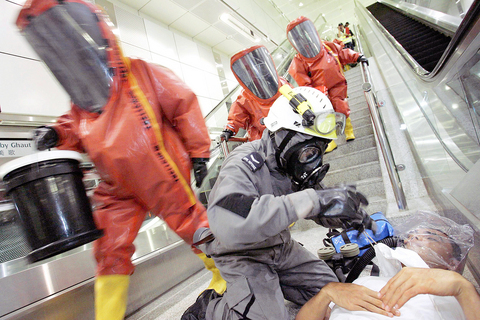
PHOTO: AFP
The city's transit system came under threat of a real attack in 2001, officials have said, and Prime Minister Lee Hsien Loong (李顯龍)in his New Year's address warned the nation to brace for a possible "terrorist attack" which would threaten economic growth in Southeast Asia's most developed country.
"We will do our best to prevent any such terrorist attack in Singapore but should it ever happen and it could, then this is how we should react," Lee told reporters at the Dhoby Ghaut station at the conclusion of the drill.
"This is how we go about our lives, this is how we respond to the emergency and how we put things back to normal again," Lee said.
Officials had kept secret the precise timing of the three-hour exercise, codenamed Northstar V.
SCDF, which operates the city's emergency ambulance and fire services, said the scenario for the drill was similar to the July 7 attacks on London's subway system and a bus, in which 52 commuters and four apparent suicide bombers died.
"Help" the would-be victims screamed from inside a smoking train at Toa Payoh station after the simulated bombing.
Officials used mannequins as well as live "victims" stained with fake blood. Some collapsed on the platform while others were wounded inside the train, their "severed" limbs lying nearby.
SCDF personnel removed the victims on stretchers.
At the bus interchange outside, rifle-toting police guarded the scene after a double-decker bus was hit by a mock bomb that left 42 people "wounded" and fake blood and debris strewn about the roadway as rain fell.
"During the exercise which involved over 2,000 personnel, thunderflashes, smoke and fire simulators were used," an SCDF statement said.
It said some 500 "live" victims and mannequins were deployed, and around 3,000 commuters evacuated.
"We tried to simulate as close as possible," one SCDF official said. "We are playing real-time."
Local radio reported that "grieving" relatives arrived in tears at a victim assistance center.
When a fake bomb went off at Dhoby Ghaut station, commuters escorted by SCDF personnel left their train through the back door and walked through a tunnel for about 100m to escape, local radio quoted a witness as saying.
A simulated chemical attack later occurred at Dhoby Ghaut, leaving about 40 people collapsed on the platform, radio reported.
One commuter, Jess Fung, was on her way to work when one of the blasts occurred. She said civil defense officers had boarded her train to advise passengers of the exercise, so she was not afraid.
Officials have said that extremists planned to attack a bus carrying US citizens to Yishun subway station in 2001 but authorities foiled the attack by arresting 15 people including members of the Jemaah Islamiyah (JI) network.
The city-state, a staunch US ally, has stepped up security on fears it will be a target for attack by regional and international extremist groups.
Around 30 Muslim Singaporeans suspected of JI membership are being held under the Internal Security Act, which allows for detention without trial.
Authorities have blamed JI for a string of attacks including the 2002 bombings on the Indonesian resort island of Bali, which killed 202 people.


Through the noise of rushing papers and whirring belts at a print factory in Kyoto, two creators watch their photo essay come to life in broadsheet form — part of an effort to win new audiences in the age of artificial intelligence (AI). Despite the decline of the publishing industry, self-publication and handmade “zine” magazines are growing in popularity in Japan, reflecting the nation’s enduring love of paper in the digital era. While speaking to Agence France-Presse at the plant, his hands black with ink, one of the creators, Kazuma Obara, said: “I think [paper] is a medium that engages all five
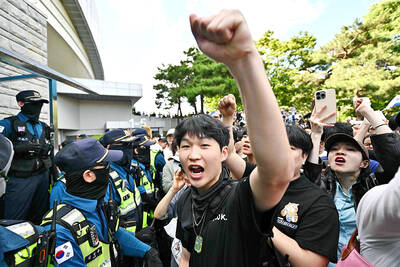
‘ABSURD MISTAKE’: The election commission said that there had been a failure to anticipate turnout after 14 polling stations ran short of ballot papers South Korean riot police yesterday cleared protesters from a Seoul polling station after a 35-hour blockade sparked by a shortage of ballot papers during local elections earlier this week. Wednesday’s election was the first nationwide vote since South Korean President Lee Jae-myung took office following the ouster of Yoon Suk-yeol over his short-lived martial law declaration. Lee’s ruling Democratic Party swept most races, but failed to flip the crucial Seoul mayoral seat. The South Korean National Election Commission apologized, blaming a failure to anticipate turnout after 14 polling stations in Seoul ran short of ballot papers. Some polling stations stayed open until 10pm to

France experienced its hottest spring on record, the French weather service said on Tuesday, after an exceptional early heat wave that also broke highs for the season in England and Wales. Meteo-France said the average nationwide temperature over March to May was 13.8°C — about 1.7°C above the norm, and surpassing records set in 2011 and 2020. “The warmest spring since records began in 1900,” it said in a bulletin. All three months were warmer than average, but the onset of an “unprecedented heatwave” late last month pushed the mercury to highs typically seen at the height of the summer. “Our country had never
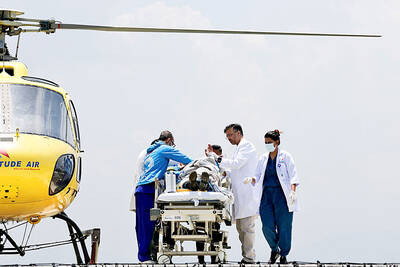
A Sherpa guide was found crawling to base camp on Mount Everest a week after he went missing and was reunited with his family, who had given up hope he would return. Dawa Sherpa was last seen on Friday last week descending the mountain, but he did not reach base camp even though his client did. The pair were among the last climbers on the mountain as the climbing season came to an end and the route was dismantled. Dawa was located by a cleaning crew on Thursday morning as he was crawling down the snowy slopes around the Khumbu Icefall, just above


 RSS
RSS