


Mat Sukarto last saw his son in August when he told him he was leaving Java island to seek construction work elsewhere in Indonesia. The 58-year-old farmer has now had to accept that Misno took a different path and joined the country's growing list of suicide bombers.
"I remember thinking he had no real problems in life. The only thing that was missing was that he was not married," the father said on Saturday. "I feel like I have been beaten up. If only I knew beforehand of his plans, I would have tried to prevent them."
His son Misno, who uses a single name, was one of three young militants who blew themselves up at crowded restaurants on the resort island of Bali last month, killing 20 people and wounding more than 100 others.
The Oct. 1 bombings, the fourth time suicide attackers have struck against Western targets in Indonesia since 2002, underscored how the tactic has taken root among terrorists in the world's most populous Muslim country.
Sukarto spoke at a news conference organized by the family's lawyer in the hope that reporters would no longer disturb the family once it was over. His wife cried throughout, and chose not to answer any questions.
The attacks were blamed on the al-Qaeda-linked Jemaah Islamiyah terror network, the same group implicated in the 2002 nightclub bombings on Bali that killed 202 people, mostly foreign tourists.
On Wednesday, an elite police unit killed one of the militants accused of masterminding the blasts, alleged Jemaah Islamiyah bomb maker Malaysian Azahari bin Husin, in a shootout in safe house in east Java province.
Indonesia has a long history of secularism and also religious moderation.
But those traditions have been challenged in recent years by a generation of terrorists, many of whom trained in Afghanistan and now claim to be angered by US foreign policy in the Muslim world.
It is unclear how the group recruited the 23-year-old Misno.
Sukarto said Misno -- the sixth of seven children -- dropped out of school during junior high, and left the family's poor home near central Java's Cilacap town soon after. His last job was that of a vendor of chicken porridge, Sukarto said.
He said his family had not been attracted to hardline Islamic teachings.
"He [Misno] wasn't especially religious and neither am I," he said. "He was a normal kid."
In August, Misno returned home and told his father that he was leaving for Batam, an island near Singapore, to find work as a construction worker. Sukarto said he told him he would write him when he had settled in there.
"When I heard nothing, I just assumed he was short of money," he said.
On Tuesday, another of Sukarto's sons recognized Misno from a photo of his severed head found at the scene of the attacks, and through a lawyer contacted the police, who took DNA samples from him and his wife. On Thursday, officers told him Misno was one of the bombers.
Sukarto said he hoped that his son's remains would soon be sent to Cilacap for burial.
Police said on Friday that a raid on a militant safe house had unearthed a video in which the three attackers tell their families they are preparing to carry out a "holy act."
The video, which police said was not intended to be distributed to the media as militant groups in the Middle East often do, is believed to mark the first time that suicide attackers in Indonesia have made such a recording of themselves.

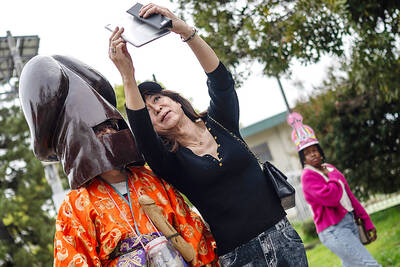
Showcasing phallus-shaped portable shrines and pink penis candies, Japan’s annual fertility festival yesterday teemed with tourists, couples and families elated by its open display of sex. The spring Kanamara Matsuri near Tokyo features colorfully dressed worshipers carrying a trio of giant phallic-shaped objects as they parade through the street with glee. The festival, as legend has it, honors a local blacksmith in the Edo Period (1603-1868) who forged an iron dildo to break the teeth of a sharp-toothed demon inhabiting a woman’s vagina that had been castrating young men on their wedding nights. A 1m black steel phallus sits in the courtyard of

HIGH HOPES: The power source is expected to have a future, as it is not dependent on the weather or light, and could be useful for places with large desalination facilities A Japanese water plant is harnessing the natural process of osmosis to generate renewable energy that could one day become a common power source. The possibility of generating power from osmosis — when water molecules pass from a less salty solution to a more salty one — has long been known. However, actually generating energy from that has proved more complicated, in part due the difficulty of designing the membrane through which the molecules pass. Engineers in Fukuoka, Japan, and their private partners think they might have cracked it, and have opened what is only the world’s second osmotic power plant. It generates

JAN. 1 CLAUSE: As military service is voluntary, applications for permission to stay abroad for over three months for men up to age 45 must, in principle, be granted A little-noticed clause in sweeping changes to Germany’s military service policy has triggered an uproar after it emerged that the law requires men aged up to 45 to get permission from the armed forces before any significant stay abroad, even in peacetime. The legislation, which went into effect on Jan. 1 aims to bolster the military and demands all 18-year-old men fill out a questionnaire to gauge their suitability to serve in the armed forces, but stops short of conscription. If the “modernized” model fails to pull in enough recruits, parliament will be compelled to discuss the reintroduction of compulsory service, German

Hundreds of Filipinos and tourists flocked to a sun-bleached field north of Manila yesterday, on Good Friday, to witness one of the country’s most blood-soaked displays of religious fervor, undeterred by rising fuel prices. Scores of bare-chested flagellants with covered faces walked barefoot through the dusty streets of Pampanga Province’s San Fernando as they flogged their backs with bamboo whips in the scorching heat. Agence France-Presse (AFP) journalists said they saw devotees deliberately puncturing their skin with glass shards attached to a small wooden paddle to ensure their bleeding during the ritual, a way to atone for sins and seek miracles from


 RSS
RSS