


Museums and other cultural institutions, threatened by tsunamis, earthquakes, war and terrorism, must rely on more than art specialists to safeguard their treasures, said conservation experts meeting in the Thai capital this week.
When trouble is brewing, everyone -- from the gallery guard to the curator to the board of directors and the local community -- has a role in protecting their cultural heritage, museum professionals from eight Asian countries were told.
Last December's Indian Ocean tsunami caused little damage to museums but it did raise awareness of the need for disaster preparedness, said John Zvereff, secretary general of the Paris-based International Council of Museums.
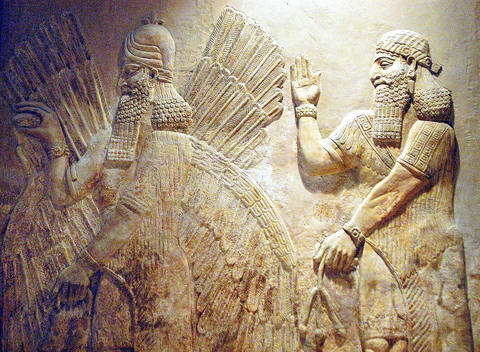
PHOTO: AFP PHOTO
Zvereff was speaking at the opening Monday of a seven-month course on emergency management for the protection of cultural property, attended by representatives from Cambodia, India, Japan, the Philippines, South Korea, Sri Lanka, Thailand and Vietnam.
Many of those taking the course, which will be carried out mostly over the Internet after an initial 12-day workshop, are representing their country's national museums.
Saving human lives in situations such as a tsunami is a priority everyone shares, said Nicholas Stanley-Price, director-general of the Rome-based International Center for the Study of the Preservation and Restoration of Cultural Property.
Cultural identity
But safeguarding the tangible features of a cultural identity can also help restore post-disaster confidence, he said.
The use of temples and mosques as recovery centers after the tsunami, with monks and clerics offering moral support, shows the enduring strength of cultural elements, he told reporters at a news conference to introduce the training course.
The course will also cover civil strife and war, at least as threatening to cultural treasures as natural disasters, with the looting of museums that took place after the US invasion of Iraq a marked example.
Preparedness
Earl Kessler, deputy executive director of the Bangkok-based Asian Disaster Preparedness Center, and an instructor for the course, said Iraq was a good example of disaster preparedness.
He said the looted items were recovered because of an informal contingency plan that had evolved after Iraq's earlier war with Iran.
Timothy Whalen, who is director of the Los Angeles-based Getty Conservation Institute -- one of the three organizers of the course -- said responsibility for disaster management could not be left to museum conservators alone.
Successful conservation and preservation of cultural heritage -- whether in the face of disaster or a daily stream of visitors -- depends on effective management at all levels, he said.
At the same time, improving the physical surroundings of collections and cultural sites to limit damage is crucial.
Quake-proofed
The wealthy Getty Museum, in southern California's risky seismic region, has been as quake-proofed as possible. Among its innovative measures is the giant "base isolator," which can cushion objects as heavy as one ton sitting atop it from earthquake tremors.
Turkey's Topkapi museum, which sits on a seismic fault in Istanbul, has chosen a more practical approach, said disaster expert Kessler.
One measure is to "use catgut to secure a chalice against the backdrop, so if it shakes it doesn't fall off the stand," he said.
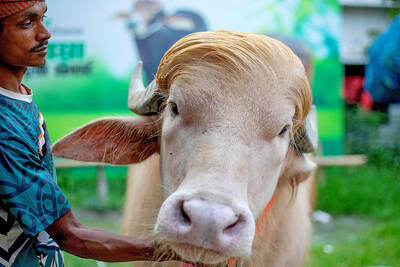
Crowds in Bangladesh are flocking to snap photographs with an unlikely social media star — an albino buffalo with flowing blond hair nicknamed “Donald Trump” that is due to be sacrificed within days. Owner Zia Uddin Mridha, 38, said his brother named the 700kg bull over its flowing helmet of hair resembling the signature look of the US president. “My younger brother picked this name because of the buffalo’s extraordinary hair,” he said at his farm in Narayanganj, just outside the capital, Dhaka. Mridha said that a constant stream of curious visitors — social media fans, onlookers and children — have come throughout

It began as a satirical online project. Now millions of young people in India are flocking to it as an outlet for their frustration. A parody political party called the Cockroach Janta Party, with the insect as its symbol, has exploded across India’s social media by turning absurdist humor into protest. Memes and short videos mocking corruption, joblessness and political dysfunction have flooded social media sites, where millions of users are embracing the cockroach — known for its ability to survive harsh conditions — as a tongue-in-cheek symbol of endurance. The online movement’s rise has been unusually rapid. The Cockroach Janta Party (CJP)
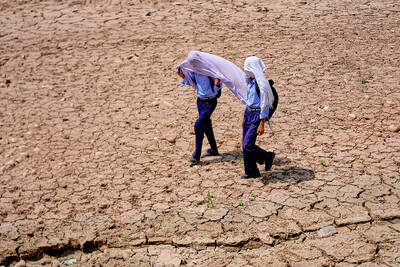
HOTTER: While Indians are accustomed to summer heat, climate change has caused northwestern India to warm faster than other parts of the country, an academic said Roads and markets have emptied during afternoons and some farmers have switched to nighttime work to avoid scorching temperatures as a heat wave grips large parts of India. The India Meteorological Department forecast maximum temperatures for yesterday of about 45°C in the capital, New Delhi, where authorities have opened temporary “cooling zones” to help people cope. The weather department warned that conditions would likely persist across several northern regions in the coming days, with temperatures staying well above seasonal averages. Authorities urged people to stay indoors during the hottest hours and take precautions against heat-related illnesses. India declares a heat wave whenever maximum temperatures
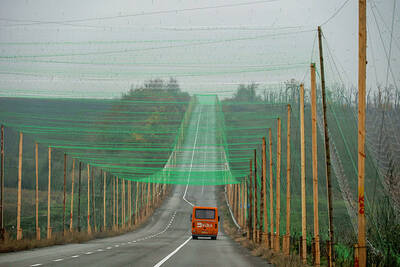
BIGGER ROLE: Beijing has said it maintains an impartial stance on the war in Ukraine, but by training Russian troops, China is far more involved than previously known China’s armed forces secretly trained about 200 Russian military personnel in China late last year, and some have since returned to fight in Ukraine, according to three European intelligence agencies and documents seen by Reuters. While China and Russia have held a number of joint military exercises since Moscow’s full-scale invasion of Ukraine in 2022, Beijing has repeatedly said that it is neutral in the conflict and presents itself as a peace mediator. The covert training sessions, which predominantly focused on the use of drones, were outlined in a dual-language Russian-Chinese agreement signed by senior Russian and Chinese officers in Beijing on


 RSS
RSS