


In the lawless southern Philippines, where an ancient Mafia-style honor code still thrives, all it takes to spark an orgy of bloodshed is something as trivial as a stolen spare tyre.
And so it did. A tyre theft in 1998 led to two killings, a kidnapping and pillage as two branches of a Muslim clan settled a dispute the way it had been done for generations on Mindanao island.
First Dalomabi Bula's nephew killed a second cousin accused of the crime.
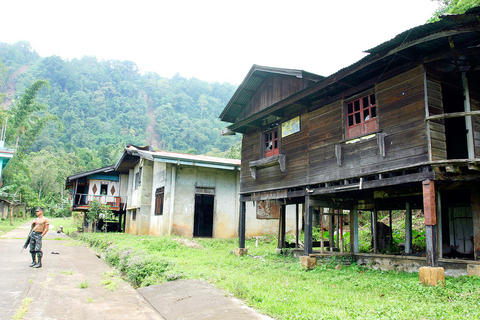
PHOTO: AFP
Then, in a revenge attack, Bula's husband's construction business in Marawi city was targeted by the dead man's family which looted one of its project sites, killed a worker and kidnapped another.
English professor Bula, whose father died in a clan war sparked by cattle rustling in the early 1950s, says burying the hatchet under the terms of the honor code, called rido, extracts a heavy price.
"Rido has been with all of us, Muslims and non-Muslims alike, since Adam and Eve were taken out of paradise. Rido will stay with us," she sighs.
Rido is the term in local Muslim dialects referring to killings and other forms of violence sparked by perceived personal affront.
"A violation of this deep sense of personal honor rationalizes revenge and will legitimize killing someone whether he is good or bad and regardless of whether the cause of the conflict was legal or illegal," says Jamail Kamlian of Mindanao State University's (MSU) Institute of Technology.
Studies jointly funded by the United States Agency for International Development (USAID) and the Asia Foundation have documented 1,220 clan conflicts since 1930 in 11 provinces of Mindanao, home to the mostly Roman Catholic nation's four million-strong Muslim minority.
The vicious cycle of violence has left 4,512 people dead and more than 3,000 other people injured or missing.
Bloody inter-clan conflict "is something that has happened throughout history," says Steven Rood, country director of the Asia Foundation, citing counterparts in other countries and cultures.
Researchers from Mindanao's Ateneo de Zamboanga University and Notre Dame University say deadly family quarrels have erupted over the flimsiest disputes, such as women eloping with men who were out of favor with their respective families or who failed to pay a dowry. They also break out over land disputes, electoral contests, or unpaid debts.
Clan feuds blur separatist conflict
Sometimes lasting for generations, the deadly feuds between family branches, rival clans, or different ethnic groups, have blurred the roots of the bloodshed in a region that has seen some 120,000 deaths amid a relatively recent Muslim separatist guerrilla war.
On Mindanao clan conflict is closely tied to "problems of governance" on the the restive island and the ready availability of guns in the black market, says Abhoud Syed Lingga of the Institute of Bangsamoro Studies, based in Cotabato city.
Instead of going to the police or the courts, warring parties seek to settle their own disputes.
Army Major Dickson Hermoso says that "in some cases, some clans will join the armed forces, the police and paramilitary forces to get back at another clan known to be sympathetic to the Muslim rebels."
But shooting is the most common method of revenge.
"The initial move of relatives when a conflict becomes a full-blown rido [is] to buy more firearms," says Moctar Matuan, also a professor at MSU, who has studied 337 clan wars in the Lanao region of Mindanao.
Jowell Canuday of the Ateneo de Davao University estimates that there are at least 35,000 unlicensed firearms in the hands of civilians in the Autonomous Region in Muslim Mindanao, a self-rule area made up of five of the 11 provinces in the clan studies.
With heavy firepower brought to bear, clan wars have brought about large-scale destruction of homes and farms, he adds.
"More often than not, the origin of a firefight on conflict-affected areas in Mindanao is due to rido," says Major Hermoso, a member of a government committee monitoring a two year-old truce between the government and the separatist Moro Islamic Liberation Front.
"Rido is undermining the gains of the ongoing talks," he adds referring to peace negotiations between President Gloria Arroyo's government and the MILF being held in Malaysia. The next round of talks is scheduled for late July.
crimes unsolved,
few go to jail
Hermoso says "people involved in clan wars seldom face prosecution in our justice system or end up in prison."
Among the Lanao Muslims, "recourse to formal law is deemed cowardice", says Monalinda Doro, of the Research Institute for Mindanao Culture at Xavier University in Cagayan de Oro city.
In the case of Bula's nephew, he was sent to a guerrilla camp run by the MILF instead of a government jail. Even if a killer serves a prison term in a government jail, he is "liable for retaliation" once the sentence is served, says Doro.
Warring parties use third-party conciliators and pay blood money or indemnity to reach a settlement. Peace deals are sealed by both parties swearing over the Koran, the Muslim holy book, and the initial aggressor throws a feast to celebrate the end of hostilities.
Bula says his family's dispute was resolved after mediation by a neutral relative and deal was sealed with a thanksgiving feast. The kidnapped construction worker was ransomed and released unharmed.
Doro says warring families tend to base the terms of their settlement on assuaging injured pride, instead of making reparations for death or injury.
But settlements are not common. Of the 1,220 clan wars the studies documented, 60 percent remain unresolved -- meaning they could flare up again at any moment.

Through the noise of rushing papers and whirring belts at a print factory in Kyoto, two creators watch their photo essay come to life in broadsheet form — part of an effort to win new audiences in the age of artificial intelligence (AI). Despite the decline of the publishing industry, self-publication and handmade “zine” magazines are growing in popularity in Japan, reflecting the nation’s enduring love of paper in the digital era. While speaking to Agence France-Presse at the plant, his hands black with ink, one of the creators, Kazuma Obara, said: “I think [paper] is a medium that engages all five
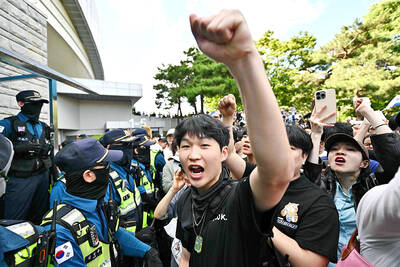
‘ABSURD MISTAKE’: The election commission said that there had been a failure to anticipate turnout after 14 polling stations ran short of ballot papers South Korean riot police yesterday cleared protesters from a Seoul polling station after a 35-hour blockade sparked by a shortage of ballot papers during local elections earlier this week. Wednesday’s election was the first nationwide vote since South Korean President Lee Jae-myung took office following the ouster of Yoon Suk-yeol over his short-lived martial law declaration. Lee’s ruling Democratic Party swept most races, but failed to flip the crucial Seoul mayoral seat. The South Korean National Election Commission apologized, blaming a failure to anticipate turnout after 14 polling stations in Seoul ran short of ballot papers. Some polling stations stayed open until 10pm to

Australian researchers have trained lab-grown brain cells on a silicon computer chip to play the 1990s shooter game Doom and said they are just scratching the surface of what the neurons could be capable of doing. It is the science-fiction work of biotech boffins at Cortical Labs, who researched and developed the technology that harnesses the workings of the brain’s networking system. Each so-called “biological computer” contains about 200,000 living human brain cells, grown from stem cells that were harvested from blood donations. Having mastered the simple computer game Pong, where a paddle is moved up and down to send a ball

France experienced its hottest spring on record, the French weather service said on Tuesday, after an exceptional early heat wave that also broke highs for the season in England and Wales. Meteo-France said the average nationwide temperature over March to May was 13.8°C — about 1.7°C above the norm, and surpassing records set in 2011 and 2020. “The warmest spring since records began in 1900,” it said in a bulletin. All three months were warmer than average, but the onset of an “unprecedented heatwave” late last month pushed the mercury to highs typically seen at the height of the summer. “Our country had never


 RSS
RSS