


■ Hong Kong
Plastic pistol whiip useless
A tip for muggers and thugs: If you decide to pistol whip a victim who won't cough up cash, don't do it with a plastic toy gun. Two thieves tried to rob a 55-year-old woman working as a parking lot cleaner on Thursday, the Ming Pao newspaper reported yesterday. When the woman wouldn't hand over any money, the men began hitting her on the head with a toy gun, the paper reported. When the gun's barrel broke, the woman saw it was fake and began screaming for help, causing the muggers to drop the pistol and run away, the paper said. The Ming Pao showed a picture of the black toy gun with a large spring popping out of its broken barrel.
■ Australia
Non-festive weapons seized
Customs officers said yesterday they have seized a container full of potentially deadly weapons from China, including stun guns, knuckledusters, extendable batons, flick knives and catapults. The shipment of 320 banned weapons had been declared as "festivity commodity" items such as paper lanterns and other decorations. It was seized on Tuesday during a search of shipping containers at Port Botany in Sydney. A follow-up raid Thursday on three shops, a home and a car revealed a further 155 weapons. "This deadly cache had the potential to cause serious harm in the community," said senior customs official Gayle Brown in a statement.
■ India
Guards kill dozens of birds
Prison guards, furious at a prisoner's refusal to admit to murdering a fellow inmate, twisted the necks of about 100 of his pet pigeons and killed them, newspapers reported Thursday. Another 300 birds safely escaped the jail in the northern Indian town of Ghaziabad, the Times of India reported. Animal groups say they plan legal action against the prison, it added. After a fellow inmate allegedly died during police questioning this month, authorities blamed the death on tuberculosis until an autopsy showed he was murdered. Prison authorities pressured the inmate to confess to the killing, another paper, the Hindustan Times reported.
■ China
`Star Wars' movie draws few
The latest "Star Wars" epic opened with a lot of space but not much force. Theaters were all but empty for Thursday night's debut of Episode III: Revenge of the Sith -- in stark contrast to the excitement and hordes of costumed fans who greeted its opening in the US and elsewhere. "Business is pretty normal," said a ticket seller at the nearly empty Cathay Theater just off Shanghai's main Hauihai Road shopping artery, where a 1m high posters advertised Xishi de Fanji, as the film is called in Chinese. "Thursday nights are usually slow," said the woman, who declined to give her name.
■ United Kingdom
nUS protests Saddam photos
The US military yesterday condemned a British newspaper's decision to print photographs of former Iraqi president Saddam Hussein, including one showing him in his underwear. A front-page picture in the tabloid Sun showed the captive, clad only in white briefs, folding a pair of trousers. Another showed Saddam hand-washing a piece of clothing. The Sun said it obtained the photos from "US military sources." The military said the photos violated military guidelines "and possibly Geneva Convention guidelines for the humane treatment of detained individuals." The source of the photos was unknown, the military said, but believed they were taken more than a year ago.
■ Russia
Lake disappears overnight
A village was left baffled after its lake disappeared overnight. TV showed pictures of a giant muddy hole bathed in summer sun, while fishermen from the village of Bolotnikovo looked on disconsolately. "It is very dangerous. If a person had been in this disaster, he would have had almost no chance of survival. The trees flew downwards, under the ground," said a local official. Officials said water in the lake might have been sucked down into an underground water-course or cave system, but some villagers had more sinister explanations. "I am thinking, well, America has finally got to us," said one old woman, as she sat on the ground outside her house.
■ Sweden
Cops jailed for ignoring rape
A court jailed two police officers for ignoring a woman's telephone plea for help for a friend who was being raped. A 19-year-old woman being subjected to a three-hour rape in a Stockholm suburb managed to alert a friend by phone and the friend dialed the police emergency number, but the dispatch center did not send anyone to investigate. The officer in charge and policeman who took the call were jailed for a month and a third was fined. Lawyers said that the call did not make it clear exactly where the rape was taking place.
■ Sweden
Judge pays for sex
A supreme court judge, Leif Thorsson, 59, admitted to contacting a male high school student and paying for sexual favors. The 20-year-old was sentenced in March for robbing a client. During their investigation, police found several phone numbers in the young man's cellphone, including Thorsson's, and text messages sent by Thorsson. Police believe Thorsson met the 20-year-old at least four times, and met via a gay Web site. Thorsson may face a court hearing or a fine, the affair is likely to cost him the seat he has held since 1994.
■ Belgium
EU Constitution at stake
EU President Luxembourg rules out renegotiating the EU Constitution if France rejects the treaty in a referendum this month, Luxembourg Prime Minister Jean-Claude Juncker said yesterday. "If France votes `no' in a referendum on the European constitutional treaty, the European Union will lose 20 years. Treaties have never been renegotiated," Juncker said.. The latest opinion polls give the anti-treaty campaign in France a slender lead.
■ Peru
Giant armadillo fossil found
The nearly complete fossilized remains of a glyptodon, an extinct ancient armadillo the size of a small car, were accidently discovered by a worker in the southern Peruvian city of Cuzco, officials said Thursday. The glyptodon remains were 95 percent complete, said Jorge Gamarra from Peru's National Institute of Culture. Glyptodons lived in the Americas between 2 million and 1.5 million years ago in the Ice Age during the Pleistocene epoch. A worker accidentally found the remains as he was leveling land in the San Sebastian neighborhood of the city of Cuzco, the former capital of the Inca empire, Gamarra told reporters.
■ Chile
Pinochet suffers stroke
General Augusto Pinochet, the former Chilean dictator accused of hundreds of human rights abuses, was rushed to the hospital Thursday after suffering a stroke, days ahead of the latest ruling in a fraud case against him. Initial reports indicated that Pinochet's condition was serious but not life threatening. Officials at the Santiago Military Hospital said his condition was improving after a "temporary ischemic condition," or interruption of blood flow to the brain.
■ Venezuela
Chavez calls Aznar a fascist
Venezuelan President Hugo Chavez called former Spanish prime minister Jose Maria Aznar a "fascist," saying Aznar once told him to forget about the poor nations of the world. Chavez recalled late Thursday that Aznar had urged him to get on "the train of the future" and distance himself from Cuba's Fidel Castro. Chavez, who met Thursday with Spanish Labor and Social Affairs Minister Jesus Caldera, said he once asked Aznar what he thought of the situation of poor African countries and Haiti. "He told me, `Forget about them, those nations missed the train of history. They are condemned to disappear.'" recalled Chavez, saying such ideas remind one of Adolf Hitler. "He is a true fascist."
■ United States
Anti-Indian law repealed
The Massachusetts Legislature has repealed a 330-year-old law that barred American Indians from entering Boston and has long irked area tribes -- even though it hasn't been enforced. Both the House and the Senate on Thursday voted to strike down the 1675 law passed during King Philip's War between colonists and area Indians, and that has remained on the books ever since. Activists and Indian groups have been trying for years to scuttle the law. Boston Mayor Tom Menino filed a petition last fall to dump it, and the city council passed it. The law was passed when tensions between colonists and Wampanoag leader Metacom -- derisively dubbed Philip by the settlers -- escalated into violence in 1675. The war ended when Metacom was killed in 1676, but the law remained.
■ Brazil
Deforestation increases
Deforestation in the Amazon rainforest last year was the second worst ever, figures released by the Brazilian government have shown. Satellite photos and other data showed that ranchers, loggers and especially soy bean farmers felled more than 26,000km2. The figures shocked Brazil's environment minister, Marina Silva, who said she believed that increases in deforestation had been stemmed and that illegal deforestation was under control. In fact, the destruction was nearly 6 percent higher than in the same period in 2003, when 24,700km2 were destroyed.

Crowds in Bangladesh are flocking to snap photographs with an unlikely social media star — an albino buffalo with flowing blond hair nicknamed “Donald Trump” that is due to be sacrificed within days. Owner Zia Uddin Mridha, 38, said his brother named the 700kg bull over its flowing helmet of hair resembling the signature look of the US president. “My younger brother picked this name because of the buffalo’s extraordinary hair,” he said at his farm in Narayanganj, just outside the capital, Dhaka. Mridha said that a constant stream of curious visitors — social media fans, onlookers and children — have come throughout

It began as a satirical online project. Now millions of young people in India are flocking to it as an outlet for their frustration. A parody political party called the Cockroach Janta Party, with the insect as its symbol, has exploded across India’s social media by turning absurdist humor into protest. Memes and short videos mocking corruption, joblessness and political dysfunction have flooded social media sites, where millions of users are embracing the cockroach — known for its ability to survive harsh conditions — as a tongue-in-cheek symbol of endurance. The online movement’s rise has been unusually rapid. The Cockroach Janta Party (CJP)
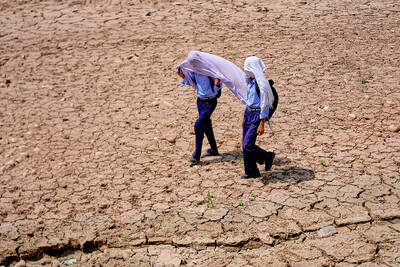
HOTTER: While Indians are accustomed to summer heat, climate change has caused northwestern India to warm faster than other parts of the country, an academic said Roads and markets have emptied during afternoons and some farmers have switched to nighttime work to avoid scorching temperatures as a heat wave grips large parts of India. The India Meteorological Department forecast maximum temperatures for yesterday of about 45°C in the capital, New Delhi, where authorities have opened temporary “cooling zones” to help people cope. The weather department warned that conditions would likely persist across several northern regions in the coming days, with temperatures staying well above seasonal averages. Authorities urged people to stay indoors during the hottest hours and take precautions against heat-related illnesses. India declares a heat wave whenever maximum temperatures

BIGGER ROLE: Beijing has said it maintains an impartial stance on the war in Ukraine, but by training Russian troops, China is far more involved than previously known China’s armed forces secretly trained about 200 Russian military personnel in China late last year, and some have since returned to fight in Ukraine, according to three European intelligence agencies and documents seen by Reuters. While China and Russia have held a number of joint military exercises since Moscow’s full-scale invasion of Ukraine in 2022, Beijing has repeatedly said that it is neutral in the conflict and presents itself as a peace mediator. The covert training sessions, which predominantly focused on the use of drones, were outlined in a dual-language Russian-Chinese agreement signed by senior Russian and Chinese officers in Beijing on


 RSS
RSS