


Thousands of Maori demonstrated outside parliament yesterday to protest government plans to nationalize New Zealand's shoreline -- which indigenous tribes say belongs to them.
A sea of people, banners and Maori sovereignty flags engulfed the grounds in front of parliament as marchers demanded the Labor-led coalition government dump its plans to "confiscate" Maori land.
As marchers crammed the grounds, Deputy Prime Minister Michael Cullen and several Maori lawmakers came out to greet the protesters in line with Maori tribal tradition.

PHOTO: EPA
Their presence sparked a fierce Maori haka war dance by 40 bare-chested warriors armed with clubs and spears.
"No Raupatu" (confiscation) and "Legalized Theft" read banners as the crowd shouted for the Labor government's seven Maori lawmakers to vote against the law.
Faced with the defection of two Maori women Labor lawmakers who oppose the law, center-left Prime Minister Helen Clark has enlisted the support of anti-migrant New Zealand First Party to help pass the law, which was due to be voted on for the first time today. The government needs a minimum 61 votes in the 120-member house. It has currently marshaled 65 votes.
The government says that the legislation is intended to protect public access to beaches while granting Maori "customary use" of their ancestral areas on the coast.
Maori say the plan will strip tribes of their customary ownership of coastal areas, contravening the Treaty of Waitangi. Signed in 1840, the treaty made indigenous Maori into citizens under British rule and guaranteed their rights to their lands, forests, fisheries, culture and language.
Maori, who make up 530,000 of New Zealand's 4 million people, are among the poorest, least healthy, worst educated and poorest housed -- and suffer high unemployment.
The crowd chanted that "Maori own the foreshore" and warned government "don't you ... confiscate" Maori land.
The government should not use "its brutal power to take something that belongs to someone else," said Ngapuhi tribal elder Rima Edwards.
Police estimated the crowd at 15,000 while local media reported at least 20,000 had joined the protest.
Former national Maori Council chairman and tribal elder Sir Graeme Latimer urged Clark to take heed of the protest.
"You can't ignore ... 20,000 people gathered on a cold day," he said, adding "it could do them a lot of harm" in next year's election if they ignore Maori opposition to the law.

School bullies in Singapore are to face caning under new guidelines, but the education minister on Tuesday said it would be meted out only as a last resort with strict safeguards. Human rights groups regularly criticize Singapore for the use of corporal punishment, which remains part of the school and criminal justice systems, but authorities have defended it as a deterrent to crime and serious misconduct. Caning was discussed in the parliament after legislators asked how it would be used in relation to bullying in schools. The debate followed stricter guidelines on serious student misconduct, including bullying, unveiled by the Singaporean Ministry of

As evening falls in Fiji’s capital, a steady stream of people approaches a makeshift clinic that is a first line of defense against one of the world’s fastest-growing HIV epidemics. In the South Pacific nation — a popular tourist destination of just under a million people — more than 2,000 new HIV cases were recorded last year, a 26 percent increase from 2024. The government has declared an HIV outbreak and described it as a national crisis. “It’s spreading like wildfire,” said Siteri Dinawai, 46, who came to be tested. The Moonlight Clinic, a converted minibus parked in a suburban cul-de-sac in Suva, is

A MESSAGE: Japan’s participation in the Balikatan drills is a clear deterrence signal to China not to attack Taiwan while the US is busy in the Middle East, an analyst said The Japan Self-Defense Forces yesterday fired a Type 88 anti-ship missile during a joint maritime exercise with US, Australian and Philippine forces, hitting a decommissioned Philippine Navy ship in waters facing the disputed South China Sea, in drills that underscore Tokyo’s rising willingness to project military power on China’s doorstep. The drill took place as Manila and Tokyo began talks on a potential defense equipment transfer, made possible by Japan’s decision to scrap restrictions on military exports. The discussions include the possible early transfer of Abukuma-class destroyers and TC-90 aircraft to the Philippines, Japanese Minister of Defense Shinjiro Koizumi said. Philippine Secretary of
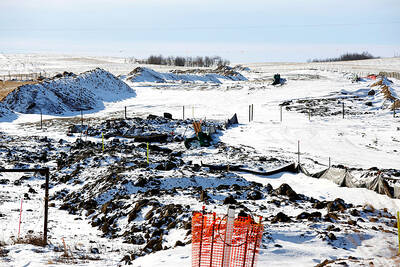
Separatists in Alberta are preparing to submit a petition tomorrow that they said has enough signatures to force a referendum on independence for the oil-rich Canadian province. Polls indicate the pro-independence camp remains a minority among Alberta’s 5 million people, but has hit a historic high of roughly 30 percent. Alberta separatists are also closer than ever to forcing a referendum, riding momentum fueled by intensifying grievances over Ottawa’s control of the provincial oil industry. They have also undeniably gotten a boost from the return to power of US President Donald Trump. After launching a petition in January, Stay Free Alberta, the group


 RSS
RSS