


Argentine President Nestor Kirchner inaugurated a "Museum of Memory" at a navy base infamous as a torture center on Wednesday to commemorate thousands of people killed under one of Latin America's most brutal dictatorships.
The transformation of the whitewashed building of the Navy Mechanical School, ESMA, into a museum is a landmark for rights groups and relatives after two decades of democracy to honor up to 30,000 victims of the 1976-1983 "Dirty War."
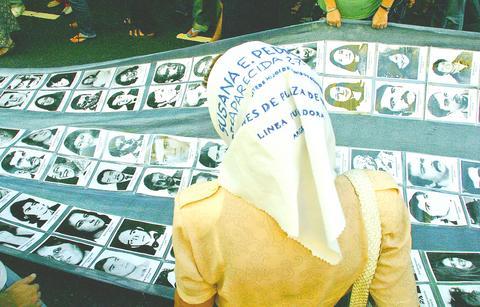
PHOTO: EPA
"There is only one name for those responsible for the sinister and macabre acts at concentration camps like ESMA -- murderers repudiated by the Argentine people," Kirchner told thousands of people massed at what has been called "Argentina's Auschwitz."
Allowed to enter ESMA for the first time since the dictatorship, girls hugged their grandmothers by the main doors and remembered murdered love ones. Men wept while touching the faded black-and-white photographs of victims.
"I'm overcome with emotion. Years ago I was here, hooded in this concentration camp and condemned to death," said Mario Villani, a torture survivor.
Up to 5,000 people were interrogated at ESMA -- the most notorious of more than 300 detention centers created by a military junta in a war on suspected leftist opponents. Most were tortured and never heard of again.
"At least now I have somewhere to place a flower," said Ana Maria Astudillo, 54, who still does not know what happened to her parents and brother-in-law after they disappeared in 1977.
"Their remains were never found," she added, her voice cracking as she stood by ESMA's railings where families had hung over 1,000 photos of victims.
Her 18-year-old son looked on at pictures of grandparents he never knew. Her sister cried.
Kirchner, who also symbolically pulled down portraits of junta leaders on the 28th anniversary of the coup that brought the military to power, has angered the armed forces.
Several top generals have said they would resign in protest of the museum's creation, according to local media.
The transformation of ESMA was the latest move by Kirchner, who was briefly detained under the dictatorship, to end what he calls a "culture of impunity."
The leftist leader has campaigned to lift amnesties protecting military officials involved in rights abuses and annulled a decree that prevented their extradition.
Polls show most Argentines support Kirchner's rights drive, but wounds are still festering. As relatives hung placards with pictures of disappeared around their necks, a "Long live the Army" banner was briefly strung from a nearby building.
Some people scrawled anti-military graffiti on ESMA's walls and broke down doors.
Under the dictatorship, many government opponents detained at ESMA were drugged and thrown from planes into the Atlantic.
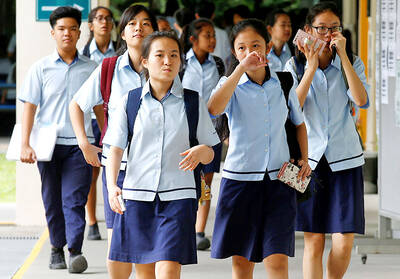
School bullies in Singapore are to face caning under new guidelines, but the education minister on Tuesday said it would be meted out only as a last resort with strict safeguards. Human rights groups regularly criticize Singapore for the use of corporal punishment, which remains part of the school and criminal justice systems, but authorities have defended it as a deterrent to crime and serious misconduct. Caning was discussed in the parliament after legislators asked how it would be used in relation to bullying in schools. The debate followed stricter guidelines on serious student misconduct, including bullying, unveiled by the Singaporean Ministry of
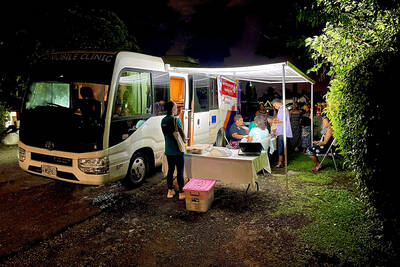
As evening falls in Fiji’s capital, a steady stream of people approaches a makeshift clinic that is a first line of defense against one of the world’s fastest-growing HIV epidemics. In the South Pacific nation — a popular tourist destination of just under a million people — more than 2,000 new HIV cases were recorded last year, a 26 percent increase from 2024. The government has declared an HIV outbreak and described it as a national crisis. “It’s spreading like wildfire,” said Siteri Dinawai, 46, who came to be tested. The Moonlight Clinic, a converted minibus parked in a suburban cul-de-sac in Suva, is
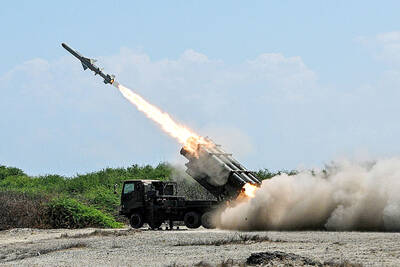
A MESSAGE: Japan’s participation in the Balikatan drills is a clear deterrence signal to China not to attack Taiwan while the US is busy in the Middle East, an analyst said The Japan Self-Defense Forces yesterday fired a Type 88 anti-ship missile during a joint maritime exercise with US, Australian and Philippine forces, hitting a decommissioned Philippine Navy ship in waters facing the disputed South China Sea, in drills that underscore Tokyo’s rising willingness to project military power on China’s doorstep. The drill took place as Manila and Tokyo began talks on a potential defense equipment transfer, made possible by Japan’s decision to scrap restrictions on military exports. The discussions include the possible early transfer of Abukuma-class destroyers and TC-90 aircraft to the Philippines, Japanese Minister of Defense Shinjiro Koizumi said. Philippine Secretary of
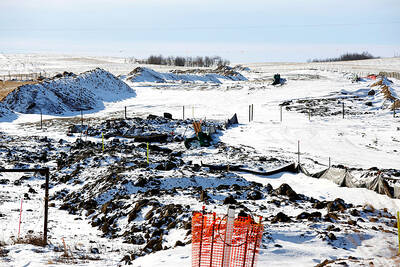
Separatists in Alberta are preparing to submit a petition tomorrow that they said has enough signatures to force a referendum on independence for the oil-rich Canadian province. Polls indicate the pro-independence camp remains a minority among Alberta’s 5 million people, but has hit a historic high of roughly 30 percent. Alberta separatists are also closer than ever to forcing a referendum, riding momentum fueled by intensifying grievances over Ottawa’s control of the provincial oil industry. They have also undeniably gotten a boost from the return to power of US President Donald Trump. After launching a petition in January, Stay Free Alberta, the group


 RSS
RSS