


Opposition parties, political and military experts and relatives of detained officials on Monday questioned Pakistan's assertion that the founder of the country's nuclear program had shared technology with Iran, Libya and North Korea for more than a decade without the knowledge of his superiors.
"This is cock-and-bull story," said Dr. Muhammad Shafiq, 39, the son of a retired Pakistani army brigadier accused of participating in the scheme. "If you want to believe it, believe it. The truth is nowhere near this story."
In a background briefing to 20 Pakistani journalists on Sunday night, a senior Pakistani official said the scientist, Dr. Abdul Qadeer Khan, had confessed to covertly sharing nuclear secrets with Iran, Libya and North Korea from 1989 to 2000. US officials said parts of the government's account matched events tracked by US intelligence and that nuclear aid from Pakistan had flowed to North Korea in 2002 and Libya last fall.
Khan and his close relatives could not be reached for comment on Monday. A man who answered the telephone at Khan's home, which is now surrounded by security officials, said he was not present. Shafiq, the son of the detained brigadier said to have aided Khan, said he did not expect Khan's family to comment until the government announced whether it will prosecute.
A senior official declined to give further details about what the government has said was a sprawling smuggling network that involved German and Dutch middlemen, chartered planes and covert meetings between Khan and Iranian and Libyan scientists. If the government account is true, Khan and the middlemen carried out one of the most complex schemes ever to evade international efforts to control nuclear weapons.
In a telephone interview on Monday, Zahid Malik, Khan's official biographer, said he had not spoken to the scientist for 10 days. Government officials ordered him on Sunday night to stop publicly commenting on the case, he said. "I cannot say anything categorical," he said when asked about the confession. "I have not met the gentleman I still have so much regard for."
Those who questioned the government's account said Monday that they were skeptical that Khan had acted without the approval of the country's powerful military leadership. Some suggested that Khan had agreed to confess to a version of events that put the army in a good light in exchange for a promise that the military-dominated government would not prosecute him.
The account of events given by the senior government official on Sunday also raised questions about General Mirza Aslam Beg, the chief of Pakistan's army from 1988-1991. The senior official said Khan had told investigators that Beg urged him to share nuclear technology with Iran.
Beg has acknowledged that in 1991 he proposed that Pakistan form a military alliance with Iran and Afghanistan to thwart what he thought was an impending US invasion of all three countries. But he said he never approved the transfer of nuclear technology.
"I would not be stupid enough to do such a thing," Beg said in a telephone interview on Monday. "I know what my responsibility is."
Beg said the security of the nuclear program had not been his responsibility. The country's nuclear labs were under the control of the country's president and prime minister at the time, he said.
"KRL was not under my command," Beg said, referring to Khan Research Laboratories. "It was not my responsibility."
Some political and military experts accused Beg of making false statements. They said the country's army has maintained tight control over the nuclear program since its inception in 1974. Pakistan's army has ruled the country for most of its modern history.
"He is lying," said Ayesha Siddiqa, a defense analyst, referring to Beg. "They are trying to protect a lot of names."

Kouri Richins, a Utah mother who published a children’s book about grief after the death of her husband is to serve a life sentence for his murder without the possibility of parole, a judge ruled on Wednesday. Richins was convicted in March of aggravated murder for lacing a cocktail given to her husband, Eric Richins, with five times the lethal dose of fentanyl at their home near Park City in 2022. A jury also found her guilty of four other felonies, including insurance fraud, forgery and attempted murder for trying to poison her husband weeks earlier on Feb. 14, 2022, with a

‘PERSONAL MISTAKES’: Eileen Wang has agreed to plead guilty to the felony, which comes with a maximum sentence of 10 years in federal prison A southern California mayor has agreed to plead guilty to acting as an illegal agent for the Chinese government and has resigned from her city position, officials said on Monday. Eileen Wang (王愛琳), mayor of Arcadia, was charged last month with one count of acting in the US as an illegal agent of a foreign government. She was accused of doing the bidding of Chinese officials, such as sharing articles favorable to Beijing, without prior notification to the US government as required by law. The 58-year-old was elected in November 2022 to a five-person city council, from which the mayor is selected
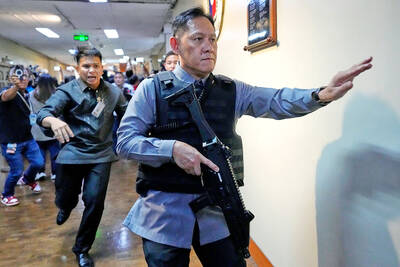
DELA ROSA CASE: The whereabouts of the senator, who is wanted by the ICC, was unclear, while President Marcos faces a political test over the senate situation Philippine authorities yesterday were seeking confirmation of reports that a top politician wanted by the International Criminal Court (ICC) had fled, a day after gunfire rang out at the Philippine Senate where he had taken refuge fearing his arrest. Senator Ronald “Bato” dela Rosa, the former national police chief and top enforcer of former Philippine president Rodrigo Duterte’s “war on drugs,” has been under Senate protection and is wanted for crimes against humanity, the same charges Duterte is accused of. “Several sources confirmed that the senator, Senator Bato, is no longer in the Senate premises, but we are still getting confirmation,” Presidential
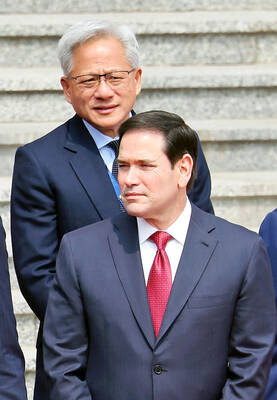
HELP DENIED? The US Department of State said that the Cuban leadership refuses to allow the US to provide aid to Cubans, ‘who are in desperate need of assistance’ US Secretary of State Marco Rubio on Wednesday said that Cuba’s leadership must change, as Washington renewed an offer of US$100 million in aid if the communist nation agrees to cooperate. Cuba has been suffering severe economic tumult led by an energy shortage that plunged 65 percent of the country into darkness on Tuesday. Cuba’s leaders have blamed US sanctions, but Rubio, a Cuban American and critic of the government established by Fidel Castro, said the system was to blame, including corruption by the military. “It’s a broken, nonfunctional economy, and it’s impossible to change it. I wish it were different,” he told


 RSS
RSS