


Visionary reformer, political king-maker, prince of disorder -- veteran Japanese lawmaker Ichiro Ozawa has been called all of these, and more.
A decade after brewing a political storm that briefly ousted Japan's Liberal Democratic Party (LDP) from power and shaped debate over security policy and economic reform, Ozawa -- now No. 2 in the main opposition Democratic Party -- says he's getting close to achieving his goal of real political change.
"It's a process of `hop, step and jump.' Last year's general election was the hop, this year's Upper House election is the step and the next Lower House election will be the jump," Ozawa said in an interview.
"We will win the next Lower House election because people want a change," he said, sipping green tea in his office not far from parliament.-
In the latest twist of a complex political career, Ozawa last year merged his small Liberal Party -- the rump of a broader but fractious anti-LDP bloc -- with the Democrats.
Led by former grassroots activist Naoto Kan, the Democrats boosted their presence in parliament's 480-seat Lower House to 177 from 137 in a November election.
That was a big step toward a true two-party system and one the biggest opposition party hopes to build on by the time of the next Lower House election, which has to be held by the end of 2007.
political success
Once a rising star in the LDP, Ozawa quit the conservative party with around 40 other lawmakers in 1993, setting off a chain reaction that ended the LDP's four-decade rule and replaced it, albeit for less than a year, with a reform-minded coalition.
That same year Ozawa grabbed attention at home and abroad with his best-seller, A Blueprint for a New Japan, which urged Japan to play a global security role commensurate with its economic might and to implement reforms to free the economy from bureaucratic control.
Those ideas are echoed now by Prime Minister Junichiro Koizumi, an LDP veteran who came to power in 2001 vowing to change his hidebound party or destroy it in the attempt.
And this week, Japan's Self-Defense Forces, as the military is known, embarked on their riskiest mission since World War II, arriving in Iraq to help with its reconstruction.
Never one to mince words, Ozawa says Koizumi has gone too far with the troop dispatch, over which public opinion is sharply divided, but not nearly far enough on domestic reform.
"This is not a peacekeeping activity based on United Nations leadership or the United Nations Charter," said Ozawa, an LDP heavyweight at the time of the 1991 Gulf War, when Japan gave cash but sent no troops, and an architect of the 1992 law that allowed its military to take part in UN peacekeeping missions.
"It is completely different from the Gulf War and there is neither a basis for, nor meaning in, sending [Japan's] military to take part," he added.
The Democrats have opposed the dispatch, but Ozawa says the party needs to clarify its position on security, a task fraught with risk for a group that includes a wide spectrum of lawmakers from former Socialists to hawkish conservatives.
"There are still things that are left vague and this can become a target for criticism by the LDP and by the people," he said.
A protege of Kakeui Tanaka, the LDP king-maker who built Japan's postwar political regime of pork-barrel spending and party factions, Ozawa was seen as a leading candidate for prime minister until his defection from the long-ruling party.
Known for his adeptness at back-room deals, the often pugnacious Ozawa has been accused by critics of being better at destroying the old order than creating a new one.
But Ozawa, 61, is confident that the LDP will be toppled in the not-too-distant future, a scenario some political analysts say is credible given the party's shrinking constituency of vested interests such as farmers, builders and small businesses.
optimism
Barring unpredictable events such as deaths of Japanese troops in Iraq or an attack at home, the Democrats should put in a respectable performance in an Upper House poll in July, Ozawa said.
"The call for a change in administration is growing stronger, so I think we will have a good showing, but whether it will be an overwhelming victory or not, I don't know," he said. "But we will win in the next Lower House election, without a doubt."
Sometimes dubbed a "shadow shogun" for operating behind the scenes, Ozawa says he has no desire to be prime minister himself.
"Through a change in administration, the LDP government -- the LDP itself -- would collapse. The existing power structure would collapse. In other words, the iron triangle of politicians, bureaucrats and industry would collapse," he said.
"At that point, a new Japan would begin. And at that point, my mission would be nearly complete."
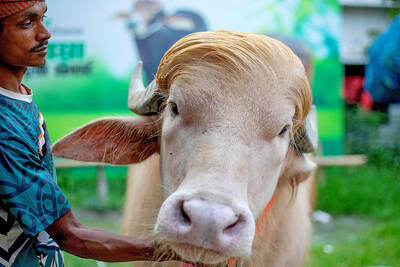
Crowds in Bangladesh are flocking to snap photographs with an unlikely social media star — an albino buffalo with flowing blond hair nicknamed “Donald Trump” that is due to be sacrificed within days. Owner Zia Uddin Mridha, 38, said his brother named the 700kg bull over its flowing helmet of hair resembling the signature look of the US president. “My younger brother picked this name because of the buffalo’s extraordinary hair,” he said at his farm in Narayanganj, just outside the capital, Dhaka. Mridha said that a constant stream of curious visitors — social media fans, onlookers and children — have come throughout

It began as a satirical online project. Now millions of young people in India are flocking to it as an outlet for their frustration. A parody political party called the Cockroach Janta Party, with the insect as its symbol, has exploded across India’s social media by turning absurdist humor into protest. Memes and short videos mocking corruption, joblessness and political dysfunction have flooded social media sites, where millions of users are embracing the cockroach — known for its ability to survive harsh conditions — as a tongue-in-cheek symbol of endurance. The online movement’s rise has been unusually rapid. The Cockroach Janta Party (CJP)
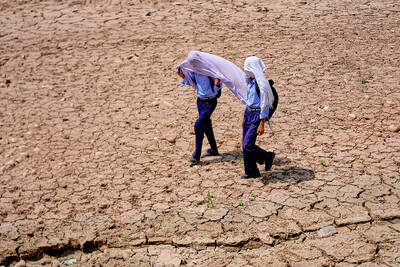
HOTTER: While Indians are accustomed to summer heat, climate change has caused northwestern India to warm faster than other parts of the country, an academic said Roads and markets have emptied during afternoons and some farmers have switched to nighttime work to avoid scorching temperatures as a heat wave grips large parts of India. The India Meteorological Department forecast maximum temperatures for yesterday of about 45°C in the capital, New Delhi, where authorities have opened temporary “cooling zones” to help people cope. The weather department warned that conditions would likely persist across several northern regions in the coming days, with temperatures staying well above seasonal averages. Authorities urged people to stay indoors during the hottest hours and take precautions against heat-related illnesses. India declares a heat wave whenever maximum temperatures
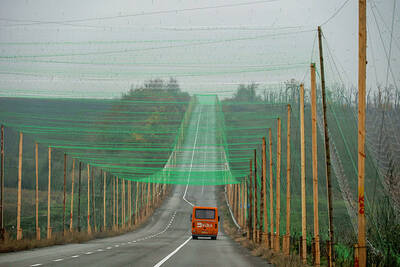
BIGGER ROLE: Beijing has said it maintains an impartial stance on the war in Ukraine, but by training Russian troops, China is far more involved than previously known China’s armed forces secretly trained about 200 Russian military personnel in China late last year, and some have since returned to fight in Ukraine, according to three European intelligence agencies and documents seen by Reuters. While China and Russia have held a number of joint military exercises since Moscow’s full-scale invasion of Ukraine in 2022, Beijing has repeatedly said that it is neutral in the conflict and presents itself as a peace mediator. The covert training sessions, which predominantly focused on the use of drones, were outlined in a dual-language Russian-Chinese agreement signed by senior Russian and Chinese officers in Beijing on


 RSS
RSS