


The nation's leading mobile phone operator Chunghwa Telecom Co (中華電信) yesterday warned the public to be aware of excess charges on their cellphone bills.
The company made the statement after the circulation of an e-mail that offers for sale a device that can copy mobile phone Subscriber Identity Number (SIM) cards.
A SIM card is a chip that acts as a mobile phone's control center, storing the owner's passwords, communication records and phone lists.
"Access to SIM-card data means others can make phone calls and then put the charge on your bills," Chunghwa's chief engineer Shih Mu-piao (石木標) said.
"If consumers notice that their phone bills jump significantly, they might have been charged for phone calls by dishonest people," he added.
The trick works like this: first the device (a so-called SIM-card writer) is connected to a computer, and then users can run the software to copy all data from one SIM card to another.
According to Shih, the card writers were priced at NT$3,500 in the circulated e-mail -- and blank SIM cards sell for NT$2,500 each.
While selling these copying gadgets isn't against the law, using fake cards to make calls is absolutely illegal.
"They are not only sold on the Web, I know an increasing number of mobile phone retailers are beginning to put the device on their shelves," said Huang Wan-fa (
"Illegal users will be fined up to NT$1.5 million or sentenced for up to five years in prison," he added.
However, both Chunghwa Te-lecom and Huang said that the situation is under control.
"So far we didn't get any report from consumers regarding the use of fake SIM cards," Huang said.
Chunghwa's Shih said that, because unscrupulous people can't make copies unless they obtain the original cards, "the chances of getting over-billed is limited as long as users keep their SIM cards with them."
Users should also not leave their SIM cards with others and be sure to take their SIM cards out when they send their mobile phones in for repairs.
Meanwhile, a member of the Consumer Foundation (消基會) expressed worry over the new practice.
"This can be yet another headache after the fake credit card crisis," said attorney Joann Su (蘇錦霞), a member of the foundation's business committee.
Credit card fraud topped the foundation's complaints list last year, with more than 200 disputes reported to the committee.
She also asked the mobile service company to protect consumers.
"For example, users should insist on further investigation of excess phone charges before paying it."
In addition, operators should try to upgrade their SIM-card technology to avoid illegal usage, Su said.
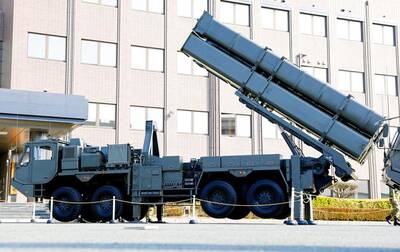
Japan has deployed long-range missiles in a southwestern region near China, the Japanese defense minister said yesterday, at a time when ties with Beijing are at their lowest in recent years. The missiles were installed in Kumamoto in the southern region of Kyushu, as Japan is attempting to shore up its military capacity as China steps up naval activity in the East China Sea. “Standoff defense capabilities enable us to counter the threat of enemy forces attempting to invade our country ... while ensuring the safety of our personnel,” Japanese Minister of Defense Shinjiro Koizumi said. “This is an extremely important initiative for

The nation’s fastest supercomputer, Nano 4 (晶創26), is scheduled to be launched in the third quarter, and would be used to train large language models in finance and national defense sectors, the National Center for High-Performance Computing (NCHC) said. The supercomputer, which would operate at about 86.05 petaflops, is being tested at a new cloud computing center in the Southern Taiwan Science Park in Tainan. The exterior of the server cabinet features chip circuitry patterns overlaid with a map of Taiwan, highlighting the nation’s central position in the semiconductor industry. The center also houses Taiwania 2, Taiwania 3, Forerunner 1 and
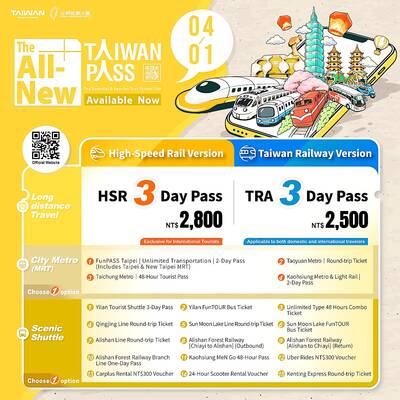
MORE POPULAR: Taiwan Pass sales increased by 59 percent during the first quarter compared with the same period last year, the Tourism Administration said The Tourism Administration yesterday said that it has streamlined the Taiwan Pass, with two versions available for purchase beginning today. The tourism agency has made the pass available to international tourists since 2024, allowing them to access the high-speed rail, Taiwan Railway Corp services, four MRT systems and four Taiwan Tourist Shuttles. Previously, five types of Taiwan Pass were available, but some tourists have said that the offerings were too complicated. The agency said only two types of Taiwan Pass would be available, starting from a three-day pass with the high-speed rail and a three-day pass with Taiwan Railway Corp. The former costs NT$2,800

FIRST TRIAL: Ko’s lawyers sought reduced bail and other concessions, as did other defendants, but the bail judge denied their requests, citing the severity of the sentences Former Taipei mayor Ko Wen-je (柯文哲) was yesterday sentenced to 17 years in prison and had his civil rights suspended for six years over corruption, embezzlement and other charges. Taipei prosecutors in December last year asked the Taipei District Court for a combined 28-year, six-month sentence for the four cases against Ko, who founded the Taiwan People’s Party (TPP). The cases were linked to the Core Pacific City (京華城購物中心) redevelopment project and the mismanagement of political donations. Other defendants convicted on separate charges included Chinese Nationalist Party (KMT) Taipei City Councilor Angela Ying (應曉薇), who was handed a 15-year, six-month sentence; Core Pacific


 RSS
RSS