


Pundits were lukewarm on the initial public offering of the nation's number two convenience store, FamilyMart Taiwan (
"The convenience store market is becoming saturated, and I estimate the industry won't grow significantly in the short term," said Bryan Chiang (
FamilyMart fell on its trading debut yesterday, dropping 6.8 percent to NT$23.3.
With 1,194 outlets currently in operation around the island, FamilyMart Taiwan is a subsidiary of Japan-based FamilyMart Co, which owns about 48 percent of the Taiwan venture.
According to Chang Jen-dung (
The move pits the Japanese brand against President Chain Store Corp (
While there are already a whopping 2,964 7-Eleven stores in Taiwan, Hsu Chung-jen (
According to Invesco's Chiang the real prize in the region is opening stores in China.
"To boost their businesses operators in the industry may have to tap the mainland Chinese market."
"If FamilyMart Taiwan can get a franchise to operate convenience stores in China, it will benefit the venture a lot."
FamilyMart Taiwan's Chang said the venture is currently working to obtain approval from its Japanese parent company for it to operate a franchise on the mainland.
President Chain Store, also keen on developing the China market, has been locked in fierce competition with several potential licensees from Japan and China. Chairman of the Uni-President Group Kao Ching-yuan (
Kao made the remark yesterday during a meet with local press in Taipei. He predicted there was a "60-percent chance" the group would obtain a license during the first half of the year to open its first store in Shanghai or Beijing in the fall.
Dallas-based 7-Eleven had said last year that it would evaluate its current business relationships and other factors as it sized up the China market and was expected to have a clear strategy for the market by the first quarter of 2002, according to Bob Jenkins, vice president of the company, while he was attending a three-day annual international conference of 7-Eleven store operators organized by President Chain Stores last June in Taipei.
With NT$18.2 billion in sales last year, FamilyMart forecast NT$20.8 billion in sales for 2002, while revenues of President Chain Store this year are estimated to grow 10 percent or more from last year's NT$64.8 billion.
But, another industry analyst suggests convenience store operators should focus more on "service" [rather than sales] this year.
"The sales growth coming from selling "products" such as beverages and toiletries is very limited, thus they should try to generate income from services," said Abby Chen (
These services include bills or ticket payments, home-delivery services or ATM banking services, she added.
"Even if the revenue generated directly from these services accounts for a small percentage of total profits, it will bring a great deal of added value to the venture," Chen said.
As long as you can lure customers into stores, they may spend more on products after enjoying these services, she explained.
According to Chen, beverage sales account for 35 percent of 7-Eleven's revenue in 2001, while service accounts for less than 1 percent.
Breakdowns for other categories were toiletries' 20 percent, books and magazines' 16 percent, fast food such as lunch boxes, sandwiches, rice balls and hotdogs' 16 percent, and food's 13 percent.

The nation’s fastest supercomputer, Nano 4 (晶創26), is scheduled to be launched in the third quarter, and would be used to train large language models in finance and national defense sectors, the National Center for High-Performance Computing (NCHC) said. The supercomputer, which would operate at about 86.05 petaflops, is being tested at a new cloud computing center in the Southern Taiwan Science Park in Tainan. The exterior of the server cabinet features chip circuitry patterns overlaid with a map of Taiwan, highlighting the nation’s central position in the semiconductor industry. The center also houses Taiwania 2, Taiwania 3, Forerunner 1 and

FIRST TRIAL: Ko’s lawyers sought reduced bail and other concessions, as did other defendants, but the bail judge denied their requests, citing the severity of the sentences Former Taipei mayor Ko Wen-je (柯文哲) was yesterday sentenced to 17 years in prison and had his civil rights suspended for six years over corruption, embezzlement and other charges. Taipei prosecutors in December last year asked the Taipei District Court for a combined 28-year, six-month sentence for the four cases against Ko, who founded the Taiwan People’s Party (TPP). The cases were linked to the Core Pacific City (京華城購物中心) redevelopment project and the mismanagement of political donations. Other defendants convicted on separate charges included Chinese Nationalist Party (KMT) Taipei City Councilor Angela Ying (應曉薇), who was handed a 15-year, six-month sentence; Core Pacific
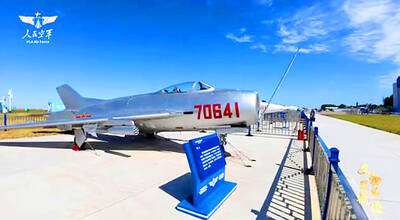
J-6 REMODEL: The converted drones are part of Beijing’s expanding mix of airpower weapons, including bombers with stand-off missiles and UAV swarms, the report said China has stationed obsolete supersonic fighters converted to attack drones at six air bases close to the Taiwan Strait, a report published this month by the Arlington, Virginia-based Mitchell Institute for Aerospace Studies said. Satellite imagery of the airfields from the institute’s “China Airpower Tracker” shows what appear to be lines of stubby, swept-winged aircraft matching the shape of J-6 fighters that first flew with the Chinese People’s Liberation Army (PLA) Air Force in the 1960s. Since their conversion to drones, the aircraft have been identified at five bases in China’s Fujian Province and one in Guangdong Province, the report said. J.

China used fake LinkedIn profiles to harvest sensitive data from NATO and EU institutions by soliciting information from staff, a European security source said on Friday. The operation, allegedly orchestrated by the Chinese Ministry of State Security, targeted dozens of employees at the military alliance or EU organizations through fictitious accounts, the source said, confirming reports in French and Belgian media. Posing as recruiters on the online professional networking platform, Chinese spies would initially request paid reports before later soliciting non-public or even classified information. One particularly active fake profile used the name “Kevin Zhang,” claiming to be the head


 RSS
RSS