


Taipei Times: Construction on ScinoPharm's (
Jo Shen (
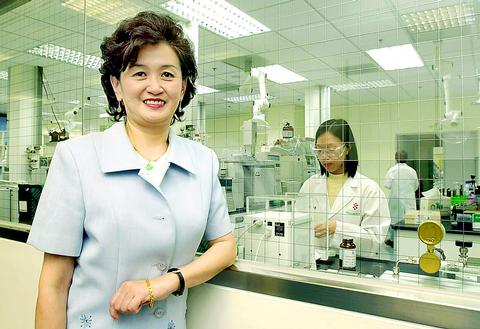
PHOTO: CHIANG YING-YING, TAIPEI TIMES
But from the time we moved in, at the end of 1999, until now, we have already finished an administration building, an R&D building, all of our utilities supplies and a warehouse.
At the backside of the R&D building we also built several small manufacturing areas. In all, we're going to build seven manufacturing areas. At this point, we have three built.
The manufacturing capacity represented by those three areas built last year is only 5 percent of the total capacity that we eventually will have. The fourth plant will be ready in May, and we have another three plants in a large production building which are under construction. Every two to three months, another one will come online. Two of the seven areas we have two lines, so we will have a total of nine lines.
TT: Are you already making sales?
Shen: We have not finished our plant construction. We only have our small manufacturing suites, which give us the possibility to provide our customers with samples.
By the way, those samples are very expensive. Some of them are sold at US$10,000 to US$150,000 a kilo. But there is this particular product, which has more than one customer, I should say three customers, who are willing to pay half a million [US] dollars per kilo for as much as we can give them. These customers are chasing us and want us to give them a commitment date. Our three little manufacturing areas are running around the clock [just] to keep up the demand of sample from our customers.
Construction has been coming along according to schedule, and there has been no delay. We intentionally put the large production bays later on the schedule because the customers cannot use our large bay until later, after they get their drug approved.
TT: How does that work?
Shen: They have to formulate their products with our product. So we have to produce our product in a small quantity to give to them to formulate, and then it goes to the FDA (United States Food and Drug Administration) for approval.
Actually, we built the large building for three major lines and one of the lines will be completed sooner than intended. The reason being the brand companies are looking for someplace to manufacture their products -- there's a shortage of active pharmaceutical ingredient capacity meeting their standards -- but they want to see the plant built before outsourcing their products to us. So, we have to make our investment first.
It's very difficult for people in other businesses to understand our business, and especially the uncontrollable part, which is the timing of FDA inspection and approval. In our business, it takes a long time to get started. But once you're in the business, it's very good. Unless you really botch up, you're not going to lose any sales easily and the product lifecycle is almost forever. Just think about Tylenol and Aspirin, they've been on the market for a long time.
Customers can't change their suppliers easily either, they would have to go through FDA approval all over again. So they are "locked in." It's like finding a partner or a spouse, you're going to stay together for a long time, so you'd better find the right one.
TT: Why does this business model work in today's world? Is the leap in biotechnology pushing forward your business model?
Shen: It's a brand new business model, it's a brand new company. We did not spin off from another company. However, Uni-President Enterprises Group (
Our business model works in Taiwan now and is attributed to the timely combination of the government's strategic interest, our private investors' desire to move into biotech/pharma business and the desire and availability of a core team with all necessary business expertise.
The story of building ScinoPharm is very interesting, there's a lot of satisfaction for us ... when you reach a certain age and nothing is more important than seeing that somebody can be helped by you. You want to do more `give' than `take,' and we are very fortunate to have the opportunity to `give.' I mean, we were just a bunch of strangers and all of a sudden we met and we built something together, in Tainan.
TT: How many customers has ScinoPharm picked up so far?
Shen: We currently have eight brand companies working with us and close to 30 generic companies working with us. The brand companies are looking at outsourcing their current manufacturing to us as a contract manufacturer. More and more, while they're still developing the compounds, they start working with us. They're depending on our process R&D capability to develop a manufacturing process and give us the chance to start producing clinical materials and eventually the commercial material.
TT: How does that work -- do you develop a manufacturing process for them and then turn it over to them or do you continue to manufacture for them?
Shen: No, they would not want to manufacture themselves. They would like to depend on us to supply the active pharmaceutical ingredients. This is the trend now. Many pharmaceutical companies say, `What is our specialty? Our specialty is not making products, not shipping products and not packaging products. Our specialty is in developing new drugs.'
So this "virtual operation concept" is growing and growing, and besides, this is also the big companies' point of view.
Big companies are starting to outsource and the outsourcing trend goes back to the earlier phase in the R&D pipeline.
Now [with the biotech boom] you have hundreds if not thousands of biotech companies. These are brand new companies and they are very focused, with one clinician, one chemist and one this and one that. So why should they have to build a plant? Why should they have to build a laboratory?
So right from day one they contract companies like us to develop and manufacture active pharmaceutical ingredients.
TT: Is this biotech industry movement fueling ScinoPharm's growth?
Shen: Yes. Several of our customers are true biotech companies. We actually have two products that we started developing the manufacturing process for a year ago, and now we're trying to produce the materials for them. Understanding the biotech industry, understanding their needs, coupling that with our expertise ... the more they blossom, the better we are as a partner for biotech.
On the other hand, our own biotech arm (ScinoPharm's biotech subsidiary) will be working in the drug discovery area ... that is going to be the focal point.
TT: Although you specialize solely in active ingredients, if a company wanted you to make a product for them could you also help them make the entire drug, the filler, formulations -- one stop shopping?
Shen: First of all, ScinoPharm wants to be a full scope pharmaceutical company when we grow up. But a full scope pharmaceutical company must cover drug discovery, drug development, manufacturing of active ingredients, manufacturing of formulation, as well as sales and marketing.
This is such a big realm and as a brand new start-up company, there is no way we could tackle it all. Then we looked at this whole value chain, we said where is the area we could enter with the lowest entry barrier. So, we picked the active pharmaceutical ingredient. But we're still only three years old, I'd say, give it another two to three years and then we'll become a real active ingredient company.
After that, it depends on opportunities, it depends on the market ... we have no reason not to think about going those ways expanding vertically. The expansion can either be upward first and downward later or vice-versa.
I'll give you an example on new drug discovery. Because we have a lot of very good, well-trained medicinal chemists, when we were working with our customers, we found out that we could actually help them to optimize the new drug design.
TT: Do you want to get into drug development R&D?
Shen: With certain drugs, we may have the opportunity to get into the drug discovery side first. We might work collaboratively with somebody else and so if you look at the entire supply chain, we may start at various segments at different times, and then later on complete the chain. In terms of formulation, in house we have quite a few formulation experts on board, Michael Lee (李樹德), our Senior Director of Marketing, is one of them. He used to be the plant manager of Roche and Glaxo in Taiwan. Both are formulation plants.
The reason that it is important for active pharmaceutical ingredient companies like ours to hire expertise from downstream is because we really need to understand from their business development, product development and manufacturing point of view what our customers' requirements are. I found it very handy with some of us, including myself, coming from the formulation side of this business.
So I think sooner or later if we have some unique active pharmaceutical ingredient, coupled with some unique formulation technology, we probably would do it ourselves. Are we going to build a manufacturing plant or subcontract it somewhere else? Are we going to build a plant in Taiwan or China? It all depends.
Besides, we made a very clear decision early on: because our customers in the US, Europe and Japan are in the formulation business, we will not do formulation business in those markets simply because we don't want to compete with our customers. But the rest of the world is very big.
TT: A number of experts and academics say Taiwan should focus more on R&D since in biotech, intellectual property creates more wealth -- and further, that the government should not favor manufacturing activities so heavily. As a manufacturing facility, how does ScinoPharm fit or not fit this statement?
Shen: Taiwan can do manufacturing and Taiwan can do research. A lot of people look down on manufacturing, which I would say "depends on the business." If you understand manufacturing in the pharmaceutical business, you would agree that it is not something that is easy or cheap. There are a lot of intellectual properties involved in manufacturing process technologies. The manufacturing business can be very profitable too.
But, you're right, though, we are looking upstream. In fact, in the next few weeks we should probably put out a news release, we are forming a biotech company.
Dr Hardy Chan will be heading that company, it is called ScinoPharm Biotech, Ltd. The new subsidiary is specifically designed to allow us to take advantage of the advancement in biotechnology and then focus on using biotechnology to develop new drugs, design new manufacturing processes for active ingredients.
So from there, our goal is to generate new drugs. Any product developed by the Biotech subsidiary will be produced by ScinoPharm Taiwan. In fact (ScinoPharm Biotech) is almost a fully owned subsidiary of ScinoPharm Taiwan, it is actually surrounded by ScinoPharm Taiwan.
We are building a facility right now for our ScinoPharm Biotech company on the third floor of the technology building. This is exactly the virtual company concept, they will only be hiring people in R&D and ScinoPharm Taiwan provides all the other infrastructure support, which include analytical services, finance, administration, human relations, training, safety and engineering.
TT: Are you building operations anywhere other than in Taiwan?
Shen: We actually have a small facility under construction outside of Shanghai. It's to subsidize our technology development in Taiwan. We have so many projects, so many requests from customers that we can't do it fast enough here even though we already have over 100 people in R&D, we still don't have enough. So we're building a research center outside of Shanghai, and we will have another 20-30 R&D people there plus a small plant.
TT: With years of experience in the US pharmaceutical industry, what advice would you offer other Taiwanese companies in entering the pharma or biotech industry in Taiwan?
Shen: Actually, I don't have a lot of advice for them because they know a lot that I don't know. I would just say it is important to have a strategy. You have to have a target, your strategy, and your field of expertise well defined. Then lay out a systematic plan to do it.
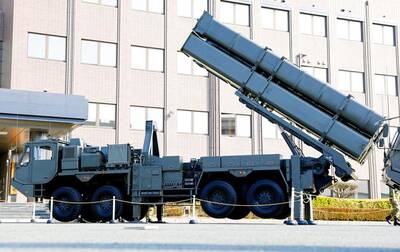
Japan has deployed long-range missiles in a southwestern region near China, the Japanese defense minister said yesterday, at a time when ties with Beijing are at their lowest in recent years. The missiles were installed in Kumamoto in the southern region of Kyushu, as Japan is attempting to shore up its military capacity as China steps up naval activity in the East China Sea. “Standoff defense capabilities enable us to counter the threat of enemy forces attempting to invade our country ... while ensuring the safety of our personnel,” Japanese Minister of Defense Shinjiro Koizumi said. “This is an extremely important initiative for
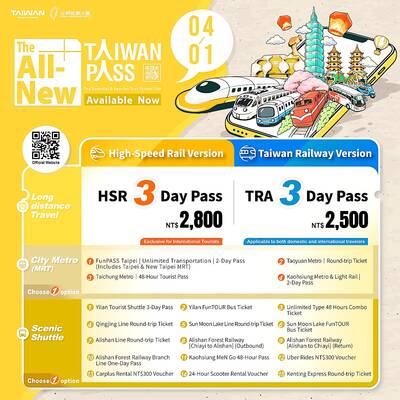
MORE POPULAR: Taiwan Pass sales increased by 59 percent during the first quarter compared with the same period last year, the Tourism Administration said The Tourism Administration yesterday said that it has streamlined the Taiwan Pass, with two versions available for purchase beginning today. The tourism agency has made the pass available to international tourists since 2024, allowing them to access the high-speed rail, Taiwan Railway Corp services, four MRT systems and four Taiwan Tourist Shuttles. Previously, five types of Taiwan Pass were available, but some tourists have said that the offerings were too complicated. The agency said only two types of Taiwan Pass would be available, starting from a three-day pass with the high-speed rail and a three-day pass with Taiwan Railway Corp. The former costs NT$2,800

POLLS CONCERNS: There are concerns within the KMT that a Cheng Li-wun-Xi Jinping meeting could trigger a voter backlash in elections in November Chinese Nationalist Party (KMT) Chairwoman Cheng Li-wun (鄭麗文) accepted an invitation from Chinese President Xi Jinping (習近平) to visit next month, her party and Chinese state media reported yesterday. Cheng, who took up her role in November last year, “gladly accepted” the invitation to lead a delegation to China, the KMT said in a statement, confirming a Xinhua news agency report. Cheng “looks forward to joint efforts by both parties to advance the peaceful development of cross-strait relations, promote cross-strait exchanges and cooperation, and work for peace in the Taiwan Strait and greater well-being for people on both sides,” the statement said. Chinese
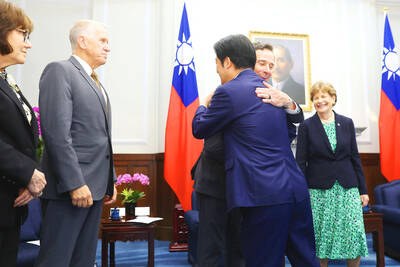
SIGNIFICANT TO THE WORLD: The delegation’s visit aims to send a clear message that bipartisan support for Taiwan is consistent, US Senator Jeanne Shaheen said The US Senate’s bipartisan support for Taiwan remains strong and Taiwan-US ties would continue for decades to come, a US Senate delegation said in Taipei yesterday, while calling on the legislature to swiftly pass a special defense budget bill. A US delegation led by Democratic US Senator Jeanne Shaheen and Republican US Senator John Curtis — both members of the US Senate Committee on Foreign Relations — arrived in Taiwan yesterday for a two-day visit. The other senators of the delegation included Senate Taiwan Caucus cochair Thom Tillis and Senate Committee on Armed Services senior member Jacky Rosen. Shaheen told a news


 RSS
RSS