


Chinese Nationalist Party (KMT) Chairwoman Cheng Li-wun (鄭麗文) accepted an invitation from Chinese President Xi Jinping (習近平) to visit next month, her party and Chinese state media reported yesterday.
Cheng, who took up her role in November last year, “gladly accepted” the invitation to lead a delegation to China, the KMT said in a statement, confirming a Xinhua news agency report.
Cheng “looks forward to joint efforts by both parties to advance the peaceful development of cross-strait relations, promote cross-strait exchanges and cooperation, and work for peace in the Taiwan Strait and greater well-being for people on both sides,” the statement said.
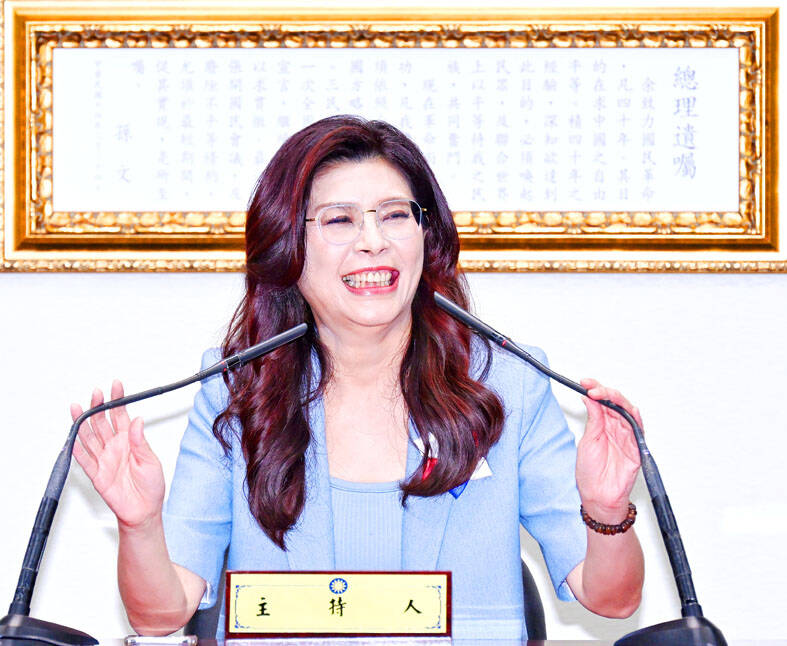
Photo: Fang Pin-chao, Taipei Times
Chinese state media said the delegation would visit the eastern province of Jiangsu, Shanghai and Beijing from Tuesday next week to April 12, but did not specify if Cheng would meet with Xi, which she has been publicly pushing for.
Cheng at news conference yesterday said it has been 10 years since the last visit to China by a KMT chair, referring to November 2016 when then-KMT chairwoman Hung Hsiu-chu (洪秀柱) met with Xi in Beijing.
Cheng expressed the hope that the trip can mark a successful first step toward peace and stability across the Taiwan Strait.
From former KMT chairman Lien Chan (連戰) to former president Ma Ying-jeou (馬英九), and now with her visit to China, all have opposed Taiwan independence and upheld the so-called “1992 consensus” based on a shared political foundation, she said.
“Opposing Taiwan independence can prevent war, and the 1992 consensus can create peace,” she said.
The so-called “1992 consensus” — a term that former Mainland Affairs Council chairman Su Chi (蘇起) in 2006 admitted making up in 2000 — refers to a tacit understanding between the KMT and the Chinese Communist Party that both sides of the Taiwan Strait acknowledge that there is “one China,” with each side having its own interpretation of what “China” means.
President William Lai’s (賴清德) Democratic Progressive Party (DPP) has never acknowledged the “1992 consensus,” arguing that agreeing to it implies acceptance of China’s claim over Taiwan.
Cheng yesterday said that since Lien’s visit to China, opposing Taiwanese independence and upholding the “1992 consensus” have been formally written into the KMT party charter, reflecting the party’s consistent cross-strait policy, adding that this stance also aligns with the provisions and spirit of the Constitution.
“The entire world follows the ‘one China’ policy and does not support Taiwanese independence, including long-time ally the US, which has consistently expressed a clear position,” she said, adding that she believes this reflects a shared expectation and is the heartfelt hope of mainstream public opinion.
When asked whether she would prioritize interactions with China over those with the US, she said that cross-strait relations are of utmost importance and the same applies to relations with the US.
“There is no either-or, no question of one being more important than the other,” she said.
Using a popular Internet phrase, she said: “Only children make choices — Taiwan wants it all.”
There are concerns within the KMT that a Cheng-Xi meeting could trigger a voter backlash in the local elections in November.
While the KMT has long supported friendlier relations with Beijing, Cheng has been accused by the DPP of doing Beijing’s bidding by stalling the government’s defense budget.
Asked whether she would meet with Lai before departing, Cheng said that she is very willing to meet and exchange views with Lai, whether before leaving or after completing the visit.
There are too many “knots” between them that need to be untangled, she said, adding that Taiwan cannot continue with endless internal conflict.
“For the sake of Taiwan, Penghu, Kinmen and Matsu, I am always willing to engage in dialogue with Lai on cross-strait developments, domestic disputes and the constitutional deadlock,” she said.
The legislature is debating proposals for a special defense budget aimed at boosting the nation’s military capabilities against a potential Chinese attack.
Lai’s government has proposed NT$1.25 trillion (US$39.07 billion) in spending on critical defense purchases, including US arms, while the KMT wants to allocate NT$380 billion for US weapons with the option for more acquisitions, but some KMT lawmakers are pushing for a much higher budget than the one proposed by the party, signaling an internal split over defense.
Cheng’s trip to China was announced as a US bipartisan congressional delegation visited Taiwan, dialing up pressure for greater military spending.
Presidential Office spokeswoman Karen Kuo (郭雅慧) yesterday said that at a time when the legislature still refuses to review the general budget and the special defense budget, the public should be even more eager for Cheng to explain why she is actively pursuing such a meeting in China under these circumstances.
In response, the KMT criticized the Presidential Office, saying that instead of looking positively at any cross-strait interactions that could help reduce risks and prevent misjudgements, it is eager to deliberately link the legislature’s budget review with cross-strait exchanges.
Cheng’s gesture of goodwill is being treated as hostility, it said.
“If the Presidential Office filters every opportunity for dialogue through a political lens, how can the public believe the DPP is truly committed to addressing cross-strait issues?” it said.

‘NO SECURITY RISK’: The Railway Bureau reassured the public that the technicians’ activities were limited to technical guidance and did not involve sensitive systems The Railway Bureau yesterday said it had invited eight Chinese technicians to assist with an airport MRT construction project. The bureau issued the confirmation after an Internet user said Chinese nationals had entered the construction zone of Taiwan Taoyuan International Airport’s Terminal 3 project. They asked why “individuals from an enemy state” were allowed access to such a major national infrastructure project, which raised serious concerns over Taiwan’s industrial safety, sensitive systems and information security. The bureau’s Northern Region Engineering Branch Office said subcontractor Taiwan Handle Industrial Co (台灣手把工業) of the Taoyuan airport MRT’s “Contract No. CU05 Project A14 Station Civil, MEP &

A US uncrewed surface vessel (USV) encountered multiple Chinese warships during an autonomous transit of the Taiwan Strait, US defense company Seasats said in a statement on Wednesday. Seasats announced that a Lightfish USV had completed the first autonomous transit of the Taiwan Strait. Over five days, the USV traversed the entire length of the Strait while constantly monitoring surface vessel traffic, the company said. The Lightfish encountered multiple Chinese warships, one of which was a Chinese People’s Liberation Army Navy (PLAN) Type 056 corvette, it said. The Chinese vessels were operating “well within Taiwan’s exclusive economic zone without transmitting their identity via the

Taiwan is still in the process of assessing the possibility of recruiting workers from Eswatini, the Ministry of Foreign Affairs said yesterday, adding that its goal is to help Eswatini upgrade its vocational training centers. If there are plans to recruit workers from Eswatini, safeguarding national security, protecting public health and ensuring the employment rights of Taiwanese would be prerequisites, Department of West Asian and African Affairs Director-General Yen Chia-liang (顏嘉良) told a news conference. Key considerations would also include filling labor shortages in specific industries, and fostering bilateral professional and technical exchanges, he said. Yen was asked about the progress of labor
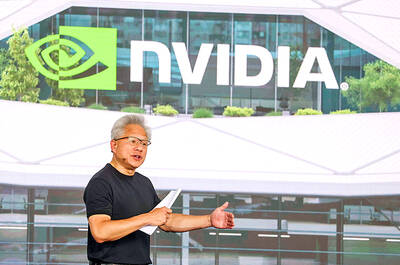
‘BOOMING’: ’ The number of partners we have here is incredible. You can see from their stock prices. They’re doing so well, they’re so happy,’ Jensen Huang said Nvidia Corp’s spending in Taiwan has ballooned to about US$150 billion a year, 10 times the US$10 billion to US$15 billion the company spent five years ago, Nvidia chief executive officer Jensen Huang (黃仁勳) said yesterday, suggesting Taiwan’s strategic importance in the global artificial intelligence (AI) supply chain. “Taiwan is the epicenter of the AI revolution. This is where the chips come, packaging comes. This is where the systems are made. This is where AI supercomputers were created,” Huang said at a meeting for the company’s employees in Beitou-Shilin Technology Park (北投士林科技園區) in Taipei, the planned site of Nvidia’s Taipei headquarters. “Taiwan


 RSS
RSS