


The US Senate’s bipartisan support for Taiwan remains strong and Taiwan-US ties would continue for decades to come, a US Senate delegation said in Taipei yesterday, while calling on the legislature to swiftly pass a special defense budget bill.
A US delegation led by Democratic US Senator Jeanne Shaheen and Republican US Senator John Curtis — both members of the US Senate Committee on Foreign Relations — arrived in Taiwan yesterday for a two-day visit. The other senators of the delegation included Senate Taiwan Caucus cochair Thom Tillis and Senate Committee on Armed Services senior member Jacky Rosen.
Shaheen told a news conference held following a meeting with President William Lai (賴清德) at the Presidential Office in Taipei that the delegation’s visit aims to send a clear message that the US Senate’s bipartisan support for Taiwan is strong and consistent, adding that stability and resilience of the relationship is significant to the world, as well as people in Taiwan and the US.
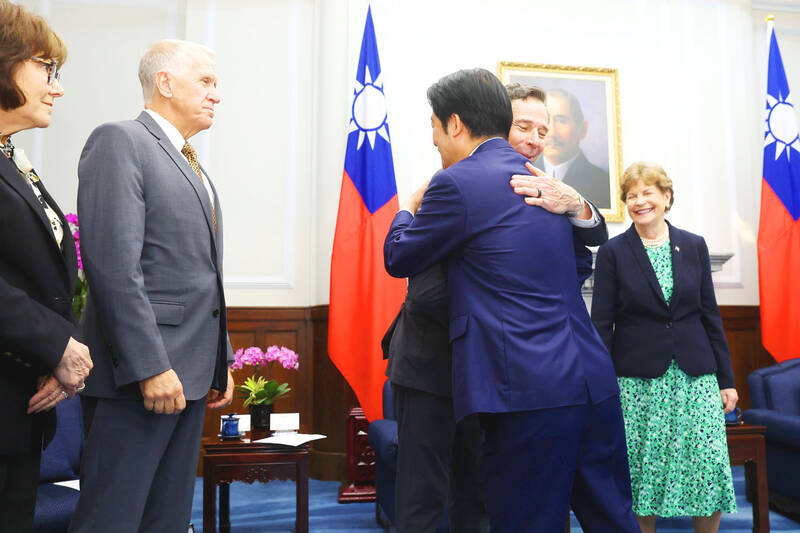
Photo: CNA
The US has voiced concern over Beijing’s continued escalation of pressure on Taiwan, including military activities around the nation that could increase the risk of miscalculation, she said, adding that at the same time, Washington has acknowledged Taiwan’s efforts to enhance its self-defense, from strengthening its military to investing in social resilience.
Cross-strait peace and stability is vital to the global economy, and the prosperity of Taiwan and the US, she added.
As annual trade between the sides has surpassed US$250 billion, the US has clear a interest in ensuring the credibility of its commitments, Shaheen said, adding that the US Congress would continue to work to uphold those commitments.
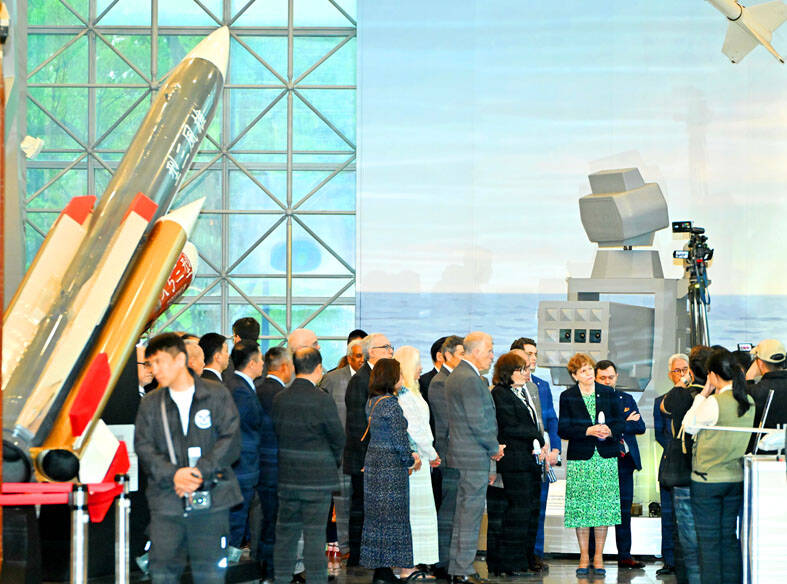
Photo: Tien Yu-hua, Taipei Times
The strong US-Taiwan relationship has spanned decades, enduring changes in both Congress and the White House, she said, adding that the clear, bipartisan message conveyed by the visit is that the relationship would continue for decades.
Curtis said the delegation’s visit reflects the importance of US-Taiwan ties and aims to show Taiwanese that the two nations are a crucial part of maintaining global security.
“I’d like to personally endorse the special defense budget and tell you that, back in Washington, my colleagues are watching — this is important,” he said.
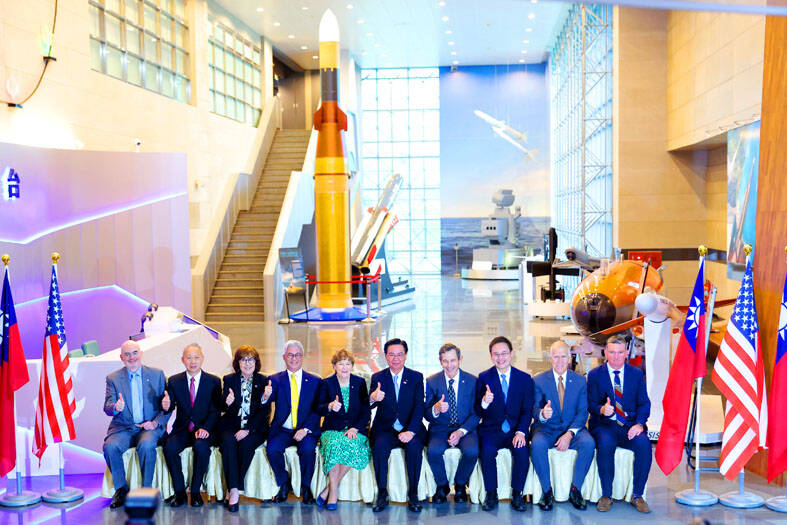
Photo: Ritchie B. Tongo, EPA
“We want to make sure that as we invest in this part of the world, you are also investing and that we’re in this together,” he added.
Tillis said that a shortfall in defense spending by NATO over the past two decades “may be one of the reasons that [Russian President] Vladimir Putin felt emboldened to launch his incursion into Ukraine.”
“As we go forward and celebrate Taiwan’s decades-long pursuit of life and liberty, please note that your defense and your peace can only come through strength — and that strength comes from taking action to support the Taiwanese people, and your continued safety and sovereignty,” he said.
Rosen said the purpose of the visit is to reaffirm that the US places great importance on its relationship with Taiwan, a relationship built on shared interests and democratic values.
As uncertainty in the Indo-Pacific region rises, the partnership becomes even more critical, she said.
The US remains committed to maintaining peace and stability across the Taiwan Strait, and ensuring that Taiwan has the capability to defend itself, Rosen said, adding that at the same time, Taipei must continue investing in its defense, as deterrence is key to maintaining stability.
In his meeting with the delegation, Lai expressed his gratitude to the visiting senators for demonstrating the US’ bipartisan support for Taiwan and its deep friendship.
Lai said a government-proposed NT$1.25 trillion (US$39.07 billion) special defense budget enjoys support from more than 60 percent of the public, but its review by the legislature has been delayed for political reasons.
Lai said he wanted to assure US friends of his government’s determination and commitment to strengthening self-defense capabilities, enhancing Taiwan-US cooperation, and safeguarding national security remain unwavering.
The visit came as legislators wrapped up a three-day joint session on Thursday last week to review three competing special defense budget proposals without reaching a conclusion.
The Democratic Progressive Party put forward the NT$1.25 trillion bill, while the Chinese Nationalist Party (KMT) and Taiwan People’s Party proposed smaller plans of NT$380 billion and NT$400 billion respectively.
With no consensus reached, the proposals have been referred to cross-party negotiations.
Later yesterday, the delegation also visited the National Chung-Shan Institute of Science and Technology (NCSIST), where they saw displays showing the results of a live-fire test of a drone-mounted warhead.
During the visit, the display of a 50-millimeter high- strength steel plate that was penetrated by a multipurpose warhead mounted on a Mighty Hornet IV drone in live-fire testing was exhibited publicly for the first time.
Jointly produced by the NCSIST and US-based defense company Kratos, the Mighty Hornet IV is a repurposed Kratos MQM-178 target drone with a range of 1,000 kilometers.
The NCSIST also showed previously unveiled systems during the visit, including the Mighty Hornet II and Mighty Hornet III drones.
The delegation’s visit is part of a broader Indo-Pacific trip, the American Institute in Taiwan said.
After the Taiwan leg, the group are to visit Japan and South Korea in a bid to strengthen US alliances in the region, media reports said.
Additional reporting by CNA

‘NO SECURITY RISK’: The Railway Bureau reassured the public that the technicians’ activities were limited to technical guidance and did not involve sensitive systems The Railway Bureau yesterday said it had invited eight Chinese technicians to assist with an airport MRT construction project. The bureau issued the confirmation after an Internet user said Chinese nationals had entered the construction zone of Taiwan Taoyuan International Airport’s Terminal 3 project. They asked why “individuals from an enemy state” were allowed access to such a major national infrastructure project, which raised serious concerns over Taiwan’s industrial safety, sensitive systems and information security. The bureau’s Northern Region Engineering Branch Office said subcontractor Taiwan Handle Industrial Co (台灣手把工業) of the Taoyuan airport MRT’s “Contract No. CU05 Project A14 Station Civil, MEP &

A US uncrewed surface vessel (USV) encountered multiple Chinese warships during an autonomous transit of the Taiwan Strait, US defense company Seasats said in a statement on Wednesday. Seasats announced that a Lightfish USV had completed the first autonomous transit of the Taiwan Strait. Over five days, the USV traversed the entire length of the Strait while constantly monitoring surface vessel traffic, the company said. The Lightfish encountered multiple Chinese warships, one of which was a Chinese People’s Liberation Army Navy (PLAN) Type 056 corvette, it said. The Chinese vessels were operating “well within Taiwan’s exclusive economic zone without transmitting their identity via the
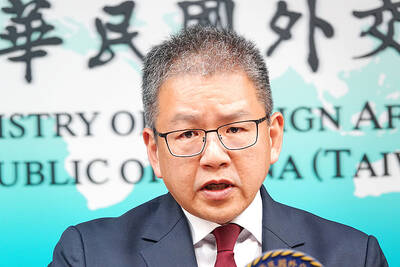
Taiwan is still in the process of assessing the possibility of recruiting workers from Eswatini, the Ministry of Foreign Affairs said yesterday, adding that its goal is to help Eswatini upgrade its vocational training centers. If there are plans to recruit workers from Eswatini, safeguarding national security, protecting public health and ensuring the employment rights of Taiwanese would be prerequisites, Department of West Asian and African Affairs Director-General Yen Chia-liang (顏嘉良) told a news conference. Key considerations would also include filling labor shortages in specific industries, and fostering bilateral professional and technical exchanges, he said. Yen was asked about the progress of labor
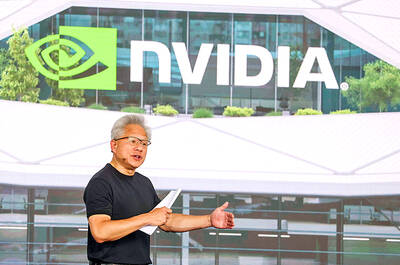
‘BOOMING’: ’ The number of partners we have here is incredible. You can see from their stock prices. They’re doing so well, they’re so happy,’ Jensen Huang said Nvidia Corp’s spending in Taiwan has ballooned to about US$150 billion a year, 10 times the US$10 billion to US$15 billion the company spent five years ago, Nvidia chief executive officer Jensen Huang (黃仁勳) said yesterday, suggesting Taiwan’s strategic importance in the global artificial intelligence (AI) supply chain. “Taiwan is the epicenter of the AI revolution. This is where the chips come, packaging comes. This is where the systems are made. This is where AI supercomputers were created,” Huang said at a meeting for the company’s employees in Beitou-Shilin Technology Park (北投士林科技園區) in Taipei, the planned site of Nvidia’s Taipei headquarters. “Taiwan


 RSS
RSS