


By his own admission, J.D. Corp President Gino Tsai doesn't like walking. "My legs are too short, and my walking speed always seems too slow," he says.
Tsai wanted a better way to get around the factory floor, something smaller and more compact than a bike, and easier than walking. He put the company's research and development team to work, and before long they had invented the hottest new product of the year, the Razor Scooters that are suddenly so popular on the streets of New York, Tokyo and Europe.
But the two-year journey from conception to hit product is not a story of savvy marketing and clever promotion. Quite the opposite -- the Razor Scooter proved so popular that customers clamored for it, and J.D. Corp's key concern was to ramp up production fast enough to meet the unexpected demand.
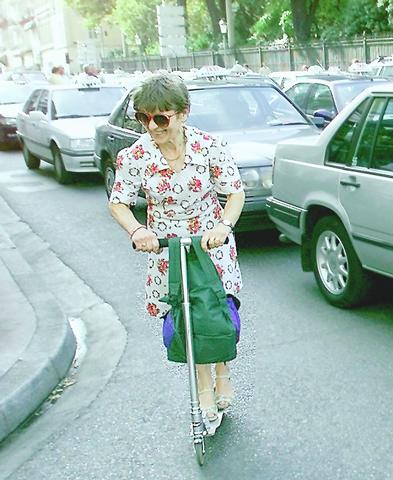
PHOTO: AFP
Basically, Tsai built a better mousetrap, and the world beat a path to his door.
It took five years to develop the current model. The first version had a steel base and 25cm rubber wheels, but at 6kg it was too heavy to carry around. Tsai added electric power to the second version, but it was still heavy, and had the added inconvenience of a battery that had to be charged.
It was the third generation scooter that proved to be the winner. By adding polyurethane wheels and making the base from aircraft-grade aluminum, J.D. Corp produced a compact, easy-to-carry prototype that weighed just 3kg. Never again would Tsai have to walk around the factory floor.
The Razor Scooter's commercial launch came almost by accident. Tsai took the prototype to the NSGA World Sports Expo, held July 17 to 19, 1998 in Chicago, where J.D. Corp was marketing its line of aluminum bicycle parts. As Tsai scooted around the show, he attracted the attention of Sharper Image Corp. Tsai asserts that though his scooter was only a prototype, not a show product, Sharper Image was very interested.
The US retailer placed the first order for the Razor: 4,000 scooters. But it was the Japanese market that gave the Razor its rocket-like launch. In January 1999, J.D. Corp showcased the scooter for the first time, at the Hong Kong Toys and Games Fair. There it caught the attention of Atras Auto Co Ltd, a Japan-based importer of European cars. In April 1999, Atras placed an order for 300 Razor scooters.
Atras knew its market well. Rather than advertise the Razor as a sporting good, Atras promoted it as a fashion accessory, a must-have item for the ultra-hip of Tokyo. That caught the eye of the fashion-conscious consumers, and soon the scooter had attracted the attention of the media as well. By August 1999, Japanese customers were demanding more Razors than J.D. Corp could produce.
In the US meanwhile, the Razor had become a popular toy among daredevil teenagers, and a user group called Razor Team had sprung up in Los Angeles. Tsai admits he doesn't understand the US market, so the company asked Razor Team to be its American agent. In May, Razor Team accepted and formed a company called Razor USA. The Razor's adoption and promotion by trend-setting generation-X Californians helped cement its image as a hip, youthful product.
In its 15 years of existence, J.D. Corp has never had a hit like the Razor. Until recently, it had produced a line of aluminum bicycle parts, along with its own Tranz X bicycle brand and City Bug electric scooters. But sales were middling, and J.D. Corp had always been just another little-known parts producer from Changhua.
Its biggest challenge was ramping up scooter production to keep up with demand, otherwise product awareness would fade and the trend would fizzle. Tsai moved quickly to expand his factory in Shenzhen. The company boosted output from just 500 scooters in May 1999, to 500,000 in June.
Of the half million Razors produced each month, about 150,000 go to the US, 150,000 to Japan, and 125,000 to Europe, with Hong Kong, Australia and other countries accounting for the rest.
"We were able to increase our volume in a very short time, and satisfy the demand very quickly, so we could catch up with the market," Tsai says.
In 1999, just 10 percent of the company's revenue came from the Razor, but this year the figure is expected to approach 90 percent. The company's 1999 revenue of US$40 million will more than double this year, Tsai claims, but beyond that he is not making any predictions.
Now that it has a hit, the company is trying hard to sustain the trend. It plans to introduce three separate models next year: a shorter, stronger Razor Sport for teens; a longer Razor Cruiser with comfortable suspension for leisure riders; and a more compact battery-operated Razor Power for urban transportation.
The streets of Taipei are full of kick-scooters, but you will very seldom see a genuine Razor. Local manufacturers, quick to copy a hit, have flooded the market with cheap imitations. But Tsai says he's not worried. Razor has applied for three US patents, and one has been granted already, and it has applied for another eight patents in Taiwan and China.
Taiwanese and Chinese manufacturers are not known for their respect for patent law, but Tsai believes Razor's customers will remain brand loyal.
"Our distributors tell us that their consumers ask for Razor Scooters only, and so the copies do not sell very well," he says. "Instead our customers increase their Razor Scooter orders."
How long will the trend last? Gary Melyan, a Taipei-based producer and exporter of sporting goods, says it might last as long as the roller blade and the updated skateboard -- or it might not. "It depends on what happens next summer," he says. "It will probably have a two-year lifespan, and after that it's hard to predict."
According to Melyan, prices and quality will fall as cheap producers enter the market. The Razor, with its comparatively high quality, has a reasonable chance of surviving past a second season.
High-quality producers survived the roller-blade shakeout as well, and if kick-scooters do survive, the Razor has a better chance than most of its competitors.
Tsai himself can't explain the sudden success of the Razor. "Even we don't understand why it is so hot right now -- we are very surprised," he says.
But one thing is certain he'll never have to walk around the factory floor again.

The nation’s fastest supercomputer, Nano 4 (晶創26), is scheduled to be launched in the third quarter, and would be used to train large language models in finance and national defense sectors, the National Center for High-Performance Computing (NCHC) said. The supercomputer, which would operate at about 86.05 petaflops, is being tested at a new cloud computing center in the Southern Taiwan Science Park in Tainan. The exterior of the server cabinet features chip circuitry patterns overlaid with a map of Taiwan, highlighting the nation’s central position in the semiconductor industry. The center also houses Taiwania 2, Taiwania 3, Forerunner 1 and

FIRST TRIAL: Ko’s lawyers sought reduced bail and other concessions, as did other defendants, but the bail judge denied their requests, citing the severity of the sentences Former Taipei mayor Ko Wen-je (柯文哲) was yesterday sentenced to 17 years in prison and had his civil rights suspended for six years over corruption, embezzlement and other charges. Taipei prosecutors in December last year asked the Taipei District Court for a combined 28-year, six-month sentence for the four cases against Ko, who founded the Taiwan People’s Party (TPP). The cases were linked to the Core Pacific City (京華城購物中心) redevelopment project and the mismanagement of political donations. Other defendants convicted on separate charges included Chinese Nationalist Party (KMT) Taipei City Councilor Angela Ying (應曉薇), who was handed a 15-year, six-month sentence; Core Pacific

J-6 REMODEL: The converted drones are part of Beijing’s expanding mix of airpower weapons, including bombers with stand-off missiles and UAV swarms, the report said China has stationed obsolete supersonic fighters converted to attack drones at six air bases close to the Taiwan Strait, a report published this month by the Arlington, Virginia-based Mitchell Institute for Aerospace Studies said. Satellite imagery of the airfields from the institute’s “China Airpower Tracker” shows what appear to be lines of stubby, swept-winged aircraft matching the shape of J-6 fighters that first flew with the Chinese People’s Liberation Army (PLA) Air Force in the 1960s. Since their conversion to drones, the aircraft have been identified at five bases in China’s Fujian Province and one in Guangdong Province, the report said. J.

China used fake LinkedIn profiles to harvest sensitive data from NATO and EU institutions by soliciting information from staff, a European security source said on Friday. The operation, allegedly orchestrated by the Chinese Ministry of State Security, targeted dozens of employees at the military alliance or EU organizations through fictitious accounts, the source said, confirming reports in French and Belgian media. Posing as recruiters on the online professional networking platform, Chinese spies would initially request paid reports before later soliciting non-public or even classified information. One particularly active fake profile used the name “Kevin Zhang,” claiming to be the head


 RSS
RSS