


Minister of National Defense Wellington Koo (顧立雄) yesterday said that he was “cautiously optimistic” about arms sales from the US after US President Donald Trump said he was still considering whether to go ahead with new sales to Taiwan.
Trump’s meeting with Chinese President Xi Jinping (習近平) last week, at which Taiwan was a point of focus, has caused concern in Taipei about the US’ commitment to helping it defend itself, especially as China ramps up its military activities.
Taiwan’s role as the world’s main producer of advanced semiconductors means any conflict would cause major disruptions to the global economy.
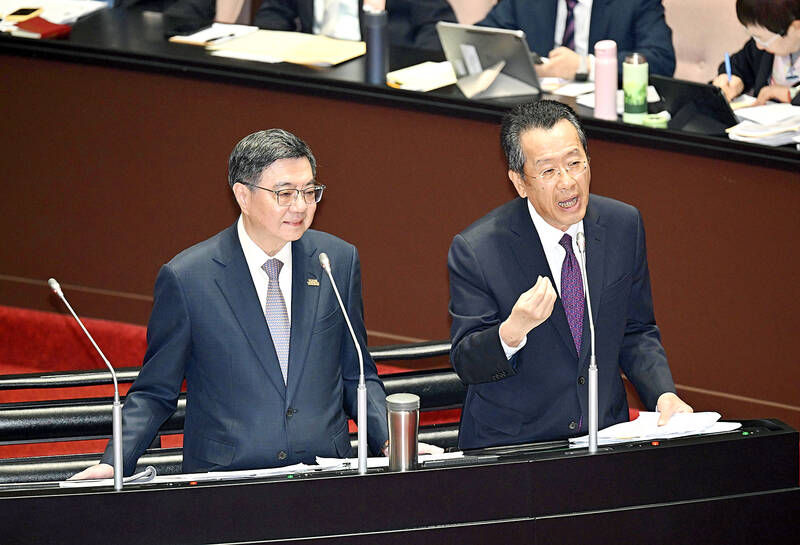
Photo: Lo Pei-de, Taipei Times
The US is bound by law to provide Taiwan with weapons and in December last year the Trump administration approved a US$11 billion arms package, the largest ever. A second package worth US$14 billion has yet to be formally approved.
Speaking to reporters at the Legislative Yuan, Koo said the US has repeatedly said its policy toward Taiwan has not changed.
“For a long time, the United States has maintained peace and stability in the Taiwan Strait region through arms sales channels. This was established under the Taiwan Relations Act,” he said, referring to the 1979 law that mandates arms sales.
Weapons sales are an important “counterbalancing force” for maintaining peace and stability in the Taiwan Strait, Koo said.
“It is clear that the side repeatedly provoking, creating incidents, and undermining the peaceful and stable status quo in the Taiwan Strait is China, not our country,” he added. “Therefore, under these circumstances, we believe that maintaining this arms-sales channel is in line with US interests.”
Taiwan is continuing to talk to the US about arms sales and “at present, we remain cautiously optimistic,” he said.
Separately yesterday, Premier Cho Jung-tai (卓榮泰) said that China is the greatest source of regional unease and instability due to its ongoing military activities as the Chinese People’s Liberation Army Navy announced it had sent a carrier task force into the western Pacific for training.
Cho expressed concern about what China was up to.
“The People’s Republic of China continues to conduct military exercises of various scales and types in the Taiwan Strait region, the Indo-Pacific region, the South China Sea and even around Japan, affecting navigational safety,” he said.
“This is the greatest source of regional unease and instability,” he added.
China’s Taiwan Affairs Office did not immediately respond to a request for comment on Cho’s comments.
China’s armed forces operate almost daily around Taiwan, and yesterday its navy said that a carrier task group, led by the Liaoning, had been sent to the “relevant waters” of the western Pacific, although it did not give an exact location.
The ships will carry out live firing and other drills to “test and enhance the realistic combat training capabilities of the forces,” it said in a statement. “This is a routine training organized in accordance with the annual plan, which aims to enhance the military’s capability to fulfil its missions, and is fully in compliance with international law and practice.”
Cho reiterated that the Republic of China, Taiwan is a “sovereign and independent country,” and again called for talks.
“We still hope for healthy and orderly exchanges between the two sides of the Taiwan Strait, and for dialogue based on equality and dignity. This has been our consistent principle,” he said.

Yangmingshan National Park authorities yesterday urged visitors to respect public spaces and obey the law after a couple was caught on a camera livestream having sex at the park’s Qingtiangang (擎天崗) earlier in the day. The Shilin Police Precinct in Taipei said it has identified a suspect and his vehicle registration number, and would summon him for questioning. The case would be handled in accordance with public indecency charges, it added. The couple entered the park at about 11pm on Thursday and began fooling around by 1am yesterday, the police said, adding that the two were unaware of the park’s all-day live
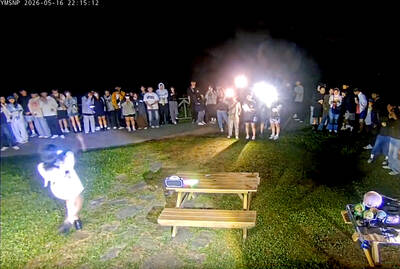
Yangmingshan National Park’s Qingtiangang (擎天崗) nature area has gone viral after a park livestream camera observed a couple in the throes of intimate congress, which was broadcast live on YouTube, drawing large late-night crowds and sparking a backlash over noise, bright lights and disruption to wildlife habitat. The area’s livestream footage appeared to show a couple engaging in sexual activity on a picnic table in the park on Friday last week, with the uncensored footage streamed publicly online. The footage quickly spread across social media, prompting a tide of visitors to travel to the site to “check in” and recreate the

Minister of Digital Affairs Lin Yi-ching (林宜敬) yesterday cited regulatory issues and national security concerns as an expert said that Taiwan is among the few Asian regions without Starlink. Lin made the remarks on Facebook after funP Innovation Group chief executive officer Nathan Chiu (邱繼弘) on Friday said Taiwan and four other countries in Asia — China, North Korea, Afghanistan and Syria — have no access to Starlink. Starlink has become available in 166 countries worldwide, including Ukraine, Malaysia, the Philippines and Vietnam, in the six years since it became commercial, he said. While China and North Korea block Starlink, Syria is not
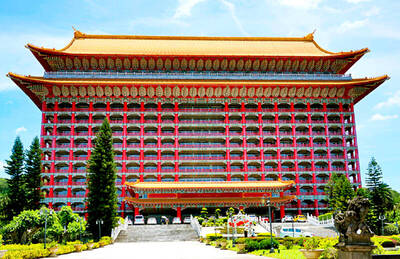
The Grand Hotel Taipei has rejected media reports claiming that the hotel had prevented CBS from broadcasting coverage of the Beijing summit between U.S. President Donald Trump and Chinese President Xi Jinping (習近平) on its premises. Media reports alleging that the hotel owner, dissatisfied with CBS’s coverage, prohibited the network from broadcasting political content on the hotel premises, are not true, the hotel said in a statement issued last night. The reports were “inconsistent with how the hotel actually handled the matter,” it said. The hotel said it received a refund request from a


 RSS
RSS