


On a stretch of open land in southern Taiwan, an engineer from Thunder Tiger Corp wearing first-person view goggles guides an unmanned aerial vehicle (UAV) through a series of sharp turns before bringing it down for a controlled landing.
Nearby, at the Asia UAV AI Innovation Application R&D Center in Chiayi County, Taiwanese drone maker 7A Drones Co is testing a multirotor drone with engineers from French company Parrot Drones SAS.
As the aircraft hovers overhead, the teams monitor flight data on laptops and discuss design adjustments aimed at improving stability and maneuverability.
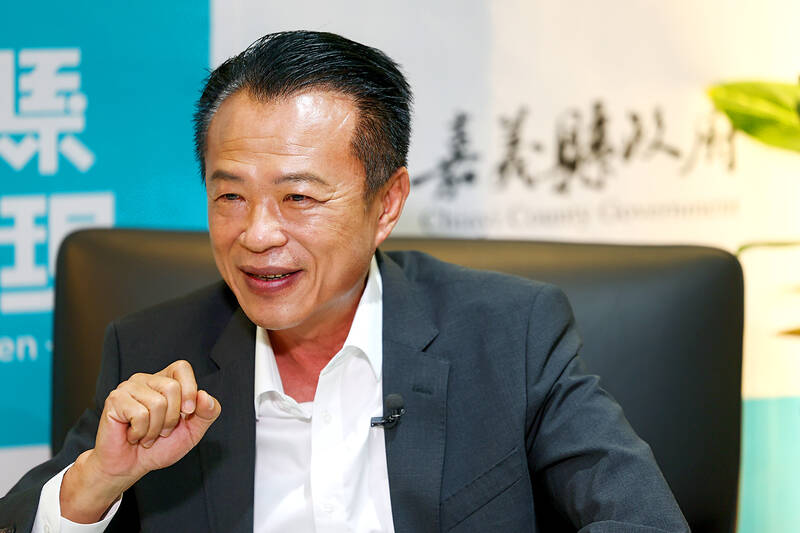
Photo: CNA
The center, once a vacant site described by local officials as a “wasteland,” has become a key base for Taiwan’s push to develop a trusted drone supply chain at a time of rising demand for alternatives to Chinese-made UAVs.
It now hosts more than 50 drone companies and institutions and has received representatives from 36 companies around the world for exchanges with Taiwanese firms based at the site.
Chiayi County Commissioner Weng Chang-liang (翁章梁) recalled to the Central News Agency how the center was established in Puzi City.
The 5,000-ping (16,528-square-meter) site had been vacant since the National Taiwan University of Sport’s Chiayi campus moved out in 2015, prompting the county government to look for ways to reactivate the land.
After taking office in 2018, Weng began encouraging drone companies to set up operations there after learning that the National Chung-Shan Institute of Science and Technology planned to build a drone-focused facility in nearby Minsyong Township (民雄).
Weng said he was unsure whether companies would accept the invitation, as the site had been idle for years and “looked like a wasteland.”
At the time, Taiwan’s drone industry was still in its early stages, with local governments competing to attract companies and no clear policy direction from the central government, making funding difficult to secure, he said.
Still, several companies moved in and gradually formed a cluster. They later told Weng the site’s spaciousness and clear airspace made it ideal for test flights.
“What we saw as a disadvantage was in fact an advantage for drone companies,” he said.
That became the foundation of the county government’s R&D center project in 2020.
When inaugurating the Asia UAV R&D Center in August 2022, then-president Tsai Ing-wen (蔡英文) announced plans for a Taiwan drone alliance integrating the public, private and research sectors, and expressed hope that Chiayi could become a new aerospace hub.
The policy direction boosted confidence among companies and institutions, attracting support from the Ministry of Economic Affairs (MOEA), the Civil Aviation Administration and certification bodies, Weng said.
Taiwan’s drone industry gained new urgency after Russia invaded Ukraine in February 2022.
Ukraine relied heavily on drones in asymmetric warfare, initially sourcing many from China-based DJI.
However, cybersecurity concerns grew after reports that DJI’s AeroScope system could track the positions of drone operators, fueling demand for trusted, non-Chinese supply chains.
Minister of Economic Affairs Kung Ming-hsin (龔明鑫) said that Taiwan has signed memorandums of understanding with France, the United States, Poland and the Czech Republic, all of which are seeking alternatives to Chinese supply chains.
Eastern European countries located near authoritarian powers have especially pressing needs, he said.
After taking office in May 2024, President William Lai (賴清德) named drones one of Taiwan’s five “trustworthy industries” aimed at strengthening ties with democratic partners.
More importantly, Kung said, drones are essentially “flying computers.”
If Taiwan succeeds in developing drones free of Chinese- made components, it could drive growth across other unmanned systems industries, including land and marine vehicles, as well as low-orbit satellites, he said.
Industrial Technology Research Institute Chairman Wu Tsung-tsong (吳政忠) said the institute is seeking partnerships with startups around the world to complement Taiwan’s hardware strengths and improve its software capabilities and system integration.
The US -based Association for Uncrewed Vehicle Systems International is also planning to establish its first overseas Green UAS certification mechanism in Taiwan, Wu said.
That would allow Taiwanese firms to obtain certification without traveling to the U.S., he added.
Green UAS certification verifies that commercial drones meet cybersecurity and supply chain standards under U.S. defense regulations.
Kung said Taiwan also needs to develop unmanned systems to strengthen national defense and resilience.
Commercial drones also have broad civilian applications, including infrastructure inspection, flood monitoring, disaster rescue and agricultural spraying, he said.
Government agencies are planning to purchase tens of thousands of drones over the next three years to support smart city initiatives, Kung added.
Several Taiwanese firms have also begun expanding internationally.
Carbon Based Technology Inc., previously focused on military drones for the National Chung-Shan Institute of Science and Technology, is now developing dual-use drones for both defense and commercial markets.
Thunder Tiger, originally a remote-controlled aircraft maker, has transformed into a drone company and was added in February to the US Department of Defense Blue UAS list, which covers drones that meet cybersecurity standards.
Both companies, along with 7A Drones, which deployed drones during the Hualien County Matai’an Creek barrier lake disaster, have established operations at the Chiayi R&D Center.
Weng said the county government has acquired land in nearby Taibao City for a second base to meet growing demand from companies seeking to join the cluster.
The National Chung-Shan Institute of Science and Technology has also announced plans for an aerospace and drone industrial park in Minxiong.
The park is scheduled for completion in 2028 and is expected to host more than 100 companies.
Meanwhile, the Cabinet has established an “unmanned vehicle project conference” led by Vice Premier Cheng Li- chiun (鄭麗君) to coordinate inter-agency resources and elevate the Chiayi center into a national strategic project.
According to MOEA data, the industry’s output value reached NT$12.9 billion (US$407.72 million) in 2025, a 2.5-fold increase from 2024, while exports totaled NT$2.95 billion.
Growth has continued into 2026, with first-quarter exports already surpassing the total for all of 2025.
Over the past few years, Taiwan’s drone sector has grown from scattered startups into a government-backed supply chain aimed at serving both domestic needs and overseas markets looking for trusted alternatives to Chinese-made UAVs.

Yangmingshan National Park authorities yesterday urged visitors to respect public spaces and obey the law after a couple was caught on a camera livestream having sex at the park’s Qingtiangang (擎天崗) earlier in the day. The Shilin Police Precinct in Taipei said it has identified a suspect and his vehicle registration number, and would summon him for questioning. The case would be handled in accordance with public indecency charges, it added. The couple entered the park at about 11pm on Thursday and began fooling around by 1am yesterday, the police said, adding that the two were unaware of the park’s all-day live

A former soldier and an active-duty army officer were yesterday indicted for allegedly selling classified military training materials to a Chinese intelligence operative for a total of NT$79,440. The Taipei District Prosecutors’ Office indicted Chen Tai-yin (陳泰尹) and Lee Chun-ta (李俊達) for contravening the National Security Act (國家安全法) and the Anti-Corruption Act (貪污治罪條例). Chen left the military in September 2013 after serving alongside then-staff sergeant Lee, now an army lieutenant, at the 21st Artillery Command of the army’s Sixth Corps from 2011 to 2013, according to the indictment. Chen met a Chinese intelligence operative identified as “Wang” (王) through a friend in November

Minister of Digital Affairs Lin Yi-ching (林宜敬) yesterday cited regulatory issues and national security concerns as an expert said that Taiwan is among the few Asian regions without Starlink. Lin made the remarks on Facebook after funP Innovation Group chief executive officer Nathan Chiu (邱繼弘) on Friday said Taiwan and four other countries in Asia — China, North Korea, Afghanistan and Syria — have no access to Starlink. Starlink has become available in 166 countries worldwide, including Ukraine, Malaysia, the Philippines and Vietnam, in the six years since it became commercial, he said. While China and North Korea block Starlink, Syria is not
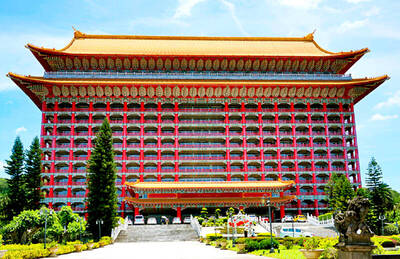
The Grand Hotel Taipei has rejected media reports claiming that the hotel had prevented CBS from broadcasting coverage of the Beijing summit between U.S. President Donald Trump and Chinese President Xi Jinping (習近平) on its premises. Media reports alleging that the hotel owner, dissatisfied with CBS’s coverage, prohibited the network from broadcasting political content on the hotel premises, are not true, the hotel said in a statement issued last night. The reports were “inconsistent with how the hotel actually handled the matter,” it said. The hotel said it received a refund request from a


 RSS
RSS