


Ahead of Paraguayan President Santiago Pena’s visit to Taiwan next week, Taipei’s last remaining diplomatic ally in South America is facing internal divisions as “a growing chorus of Paraguayans want to switch allegiances” to China, the New York Times reported yesterday.
Emerging as “one of the most anti-China nations in Latin America,” Paraguay is one of Taiwan’s 12 remaining diplomatic allies worldwide, the article said, describing the partnership as “an unlikely long-distance relationship that has endured for decades.”
Former regional allies Panama, Honduras, El Salvador, the Dominican Republic and Nicaragua switched diplomatic recognition to China in the past decade, it said.
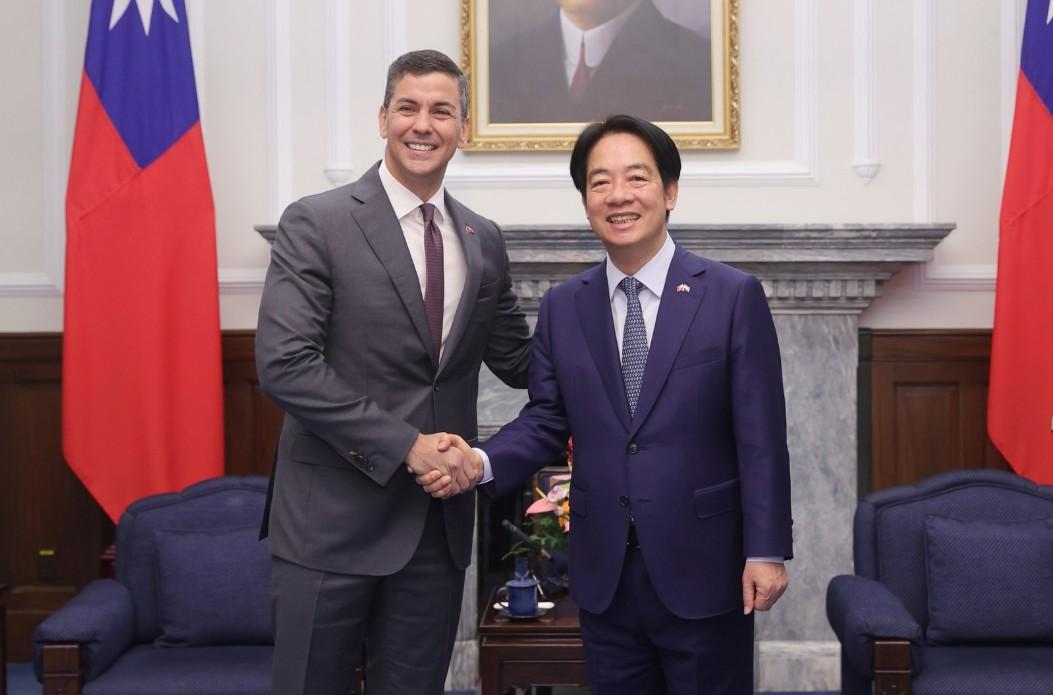
Photo courtesy of the Presidential Office
Paraguay, a landlocked nation with a population of 6.1 million, saw economic growth of 6.6 percent last year, among the highest rates in the region, it added.
Taiwan and Paraguay established diplomatic relations in 1957, united by two military rulers — former president Chiang Kai-shek (蔣介石) and former Paraguayan president Alfredo Stroessner — and “driven by anti-Communist fervor,” the New York Times said.
Pena is scheduled to lead a delegation to Taiwan from Thursday to Sunday next week for a state visit, and President William Lai (賴清德) is to welcome him with military honors on Friday next week, the Ministry of Foreign Affairs said yesterday.
Lai is to confer on Pena the Order of Brilliant Jade with Grand Cordon in recognition of his contributions to Taiwan-Paraguay ties, and he is also to receive an honorary doctorate from the National Taiwan University of Science and Technology, the ministry said.
Pena last visited Taiwan in May 2024 to attend Lai’s inauguration.
Today, bilateral relations between the two countries are sustained in part through “freebies,” such as a “presidential jet, hand-me-down helicopters, electric buses and sightseeing trips for Paraguayan politicians to Taipei,” the New York Times said.
Moreover, Taiwan has lent Paraguay US$200 million to help build homes for the poor, contributed US$20 million toward a new hospital and provided more than 800 Paraguayans with scholarships to study science, technology, engineering and mathematics in Taipei, while funding a US$18 million technical college in Asuncion, it said.
The two find common ground in “standing up to neighboring giants,” as Paraguay’s conflicts with Brazil and Argentina in the 19th century mirror Taiwan’s struggle to remain separate from China today, the article quoted Pena as saying.
“Fighting against odds is something that we felt in our own skin,” he said.
However, “a growing chorus of Paraguayans want to switch allegiances” to China, the article said, citing agricultural trade barriers linked to the country’s ties with Taiwan.
Taipei has also accused Beijing of spying on diplomats in Asuncion, while the US has blamed China for cyberattacks on Paraguayan government agencies, it said.
Many also criticize Pena’s argument that “Paraguay should shun China as an authoritarian one-party regime,” as they question Paraguay’s own democracy, where the ruling party has been in power for all but five of the past 79 years, it added.
Many Latin American countries that switched allegiance from Taiwan to China have come to regret it, Pena said earlier this year, as China “siphoned away their raw materials and undercut their industries with cheap manufactured goods,” the article said.
Taiwan is a “reliable partner” and that it is vastly preferable to getting into bed with a “giant,” the article quoted former ambassador to Paraguay Jose Han (韓志正) as saying.

The military has spotted two Chinese warships operating in waters near Penghu County in the Taiwan Strait and sent its own naval and air forces to monitor the vessels, the Ministry of National Defense (MND) said. Beijing sends warships and warplanes into the waters and skies around Taiwan on an almost daily basis, drawing condemnation from Taipei. While the ministry offers daily updates on the locations of Chinese military aircraft, it only rarely gives details of where Chinese warships are operating, generally only when it detects aircraft carriers, as happened last week. A Chinese destroyer and a frigate entered waters to the southwest

Japanese Prime Minister Sanae Takaichi’s comment last year on Tokyo’s potential reaction to a Taiwan-China conflict has forced Beijing to rewrite its invasion plans, a retired Japanese general said. Takaichi told the Diet on Nov. 7 last year that a Chinese naval blockade or military attack on Taiwan could constitute a “survival-threatening situation” for Japan, potentially allowing Tokyo to exercise its right to collective self-defense. Former Japan Ground Self-Defense Force general Kiyofumi Ogawa said in a recent speech that the remark has been interpreted as meaning Japan could intervene in the early stages of a Taiwan Strait conflict, undermining China’s previous assumptions
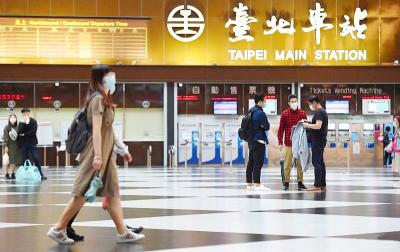
Taiwan Railways Corp (TRC) today announced that Shin Kong Mitsukoshi has been selected as the preferred bidder to operate the Taipei Railway Station shopping mall, replacing the current operator, Breeze Development Co Ltd. Among eight qualified firms that delivered presentations and were evaluated by a review committee, Shin Kong Mitsukoshi was ranked first, while Breeze was named the runner-up, the rail company said in a statement. Contract negotiations are to proceed in accordance with regulations, it said, adding that if negotiations with the top bidder fail, it could invite the second-ranked applicant to enter talks. Breeze in a statement today expressed doubts over

UNFOUNDED CONCERNS: Public concerns that allowing Indian workers to come and work in Taiwan would lead to increased sex crimes are baseless, the labor ministry said Amid public concern over the government’s plan to bring Indian workers to Taiwan, the Ministry of Labor (MOL) pointed to past intake and said that public safety remained stable. Minister of Labor Hung Sun-han (洪申翰) on April 9 told the legislature that the first group of Indian workers could arrive as early as the end of this year. Taiwan and India signed a memorandum of understanding (MOU) in February 2024 to address Taiwan’s labor shortage. The MOU was sent to the Legislative Yuan for review in mid-2024 and received cross-party backing, prompting the MOL to begin follow-up negotiations with India, Hung said. Public


 RSS
RSS