


Amid public concern over the government’s plan to bring Indian workers to Taiwan, the Ministry of Labor (MOL) pointed to past intake and said that public safety remained stable.
Minister of Labor Hung Sun-han (洪申翰) on April 9 told the legislature that the first group of Indian workers could arrive as early as the end of this year.
Taiwan and India signed a memorandum of understanding (MOU) in February 2024 to address Taiwan’s labor shortage. The MOU was sent to the Legislative Yuan for review in mid-2024 and received cross-party backing, prompting the MOL to begin follow-up negotiations with India, Hung said.
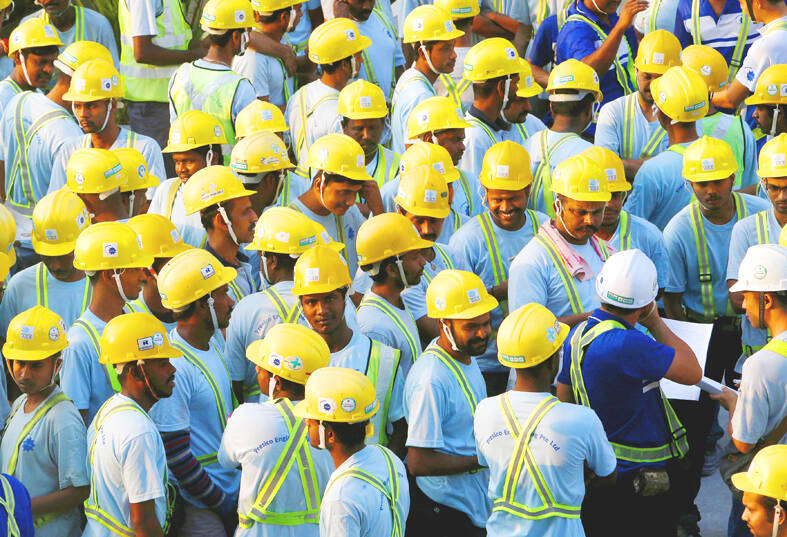
Photo: Reuters
Public concern has subsequently surfaced, with a petition launched on the National Development Council’s public policy participation platform. The petition calls for a halt to the plan and referenced fears among some in Taiwan about the risk of Indian workers comitting sexual violence.
Some others argued that Taiwan already faces serious issues with undocumented migrant workers and should not expand labor sources without first addressing those problems.
Latest data from the MOL showed that, as of the end of March, there were approximately 873,000 migrant workers in Taiwan. Indonesians accounted for the largest share at 37.3 percent, followed by Vietnamese at 33.7 percent. In the manufacturing sector, 40 percent of migrant workers are from Vietnam, while in social welfare positions, such as domestic caregivers, as many as 70 percent are Indonesian workers.
The MOL said that, in addition to Taiwan’s irreversible trends of an aging population and declining birthrate, the labor shortage crisis would continue to grow each year. Compared with countries like Japan, South Korea and Singapore, which each have migrant workers from more than 10 different source countries, Taiwan relies on just four — Thailand, the Philippines, Vietnam and Indonesia, it said.
If any of these countries were to temporarily halt labor exports due to policy or international developments, it would create a “labor shortage national security crisis” for Taiwan’s industries and care systems, it said.
Expanding Taiwan’s sources of migrant workers is intended to give employers “more options,” but the choice of which country to hire from would remain up to them, it said, adding the recruitment process still follows a “nationals first” principle, requiring employers to attempt to hire local workers before applying for migrant labor. Migrant workers are meant to fill gaps in physically demanding, dirty or dangerous jobs in manufacturing, construction and agriculture, without opening new industries to migrant labor, it said
The government would start with a small-scale pilot of about 1,000 workers, with future expansion dependent on its success, it added.
Concerns that bringing in Indian migrant workers could lead to more sex crimes or a strain on Taiwan’s labor and health insurance systems are unfounded, the MOL said.
Experience from Japan and Singapore show that public safety did not deteriorate after recruiting Indian workers, it said, adding that a recent survey in Japan even ranked Indian workers as the third most welcomed group among foreign laborers.
All recruits must provide a “certificate of good conduct” from the Indian government and pass Taiwan’s strict screening process, the MOL said.
It also said that migrant workers are “net contributors” to the insurance system as they are young, stay only temporarily, rarely use health services and most return home before collecting pensions.
Additional reporting by CNA


UPGRADE: The Kang Ding-class frigate is replacing its Chaparall missiles with Tien Chien II and Hua Yang VLS, which would provide it with long-range, 360° air defense Taiwan plans to produce 1,200 to 1,376 Hai Chien II missiles (海劍二, Sea Sword II) — also known as TC-2N — to serve as the standard air defense system of the navy’s surface combatant fleet, a source said yesterday. Last week, the Hai Chien II, the naval version of the Tien Kung II missile (天劍二, Sky Sword II), completed a live-fire test in waters off the National Chungshan Institute of Science and Technology’s Jiupeng facility (九鵬) in Pingtung County’s Manjhou Township (滿州). The MIM72 Chaparral and other dated air defense missiles that currently arm Taiwanese ships have inadequate range to combat Chinese

REASONS FOR TRAVEL: An assistant professor said that proposed amendments to penalize drivers if they used drugs overseas would not deter people from traveling People who operate a motor vehicle under the influence of marijuana would have their driver’s license revoked, even if they used the substance while overseas, the Ministry of Transportation and Communications said yesterday, citing proposed amendments to the Road Traffic Management and Penalty Act (道路交通管理處罰條例). The amendments would also authorize the government to revoke the licenses of people determined to have used Category 1 or Category 2 narcotics, even if they were not operating a vehicle while under the influence of drugs, as well as ban them from taking the license test for three years, the ministry said. People aged 18 or
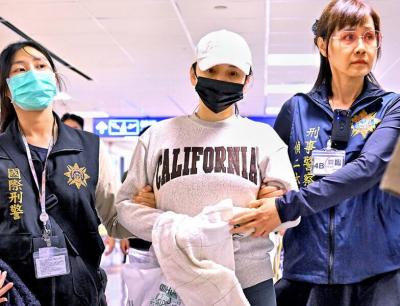
Johanne Liou (劉喬安), a Taiwanese woman who shot to unwanted fame during the Sunflower movement protests in 2014, returned to Taiwan last night after being deported from the US. She is to stand trial in Taiwan for charges involving embezzlement, fraud and drug crimes. The Criminal Investigation Bureau (CIB) said it took her into custody at Taiwan Taoyuan International Airport and would first question her before transferring her to the New Taipei District Prosecutors’ Office. She was arrested upon disembarking a flight from San Francisco that landed shortly before 7pm. Liou absconded to the US in 2019 after jumping bail
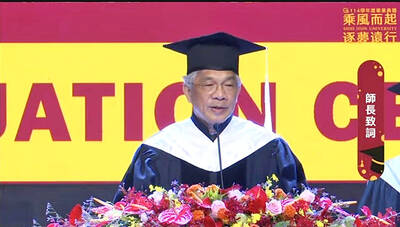
Shih Hsin University President Chen Ching-he (陳清河) yesterday issued a public apology for comments made in his commencement speech last week, stating that he has asked the school to suspend his duties and halt his wages for two months as a show of contrition. At the commencement ceremony on May 30, Chen said, “If you don’t manage your time well, or your own emotions, or your health, then I am telling every one of you — put a quick end to ‘you,’ because the world has no need for ‘you.’” The comments have sparked significant controversy online, and Chen through an open


 RSS
RSS