


Thai authorities arrested a Taiwanese teenager at an airport in Bangkok for allegedly smuggling 30 protected tortoises valued at about US$9,000 by taping them under her clothing, wildlife officials said on Wednesday.
Thailand is a major transit hub for wildlife smugglers who often sell highly prized endangered animals on the black market.
The 19-year-old’s unusual movements as she prepared to board a flight to Taipei early on Tuesday caught authorities’ attention, Thailand’s wildlife conservation department said in a statement.
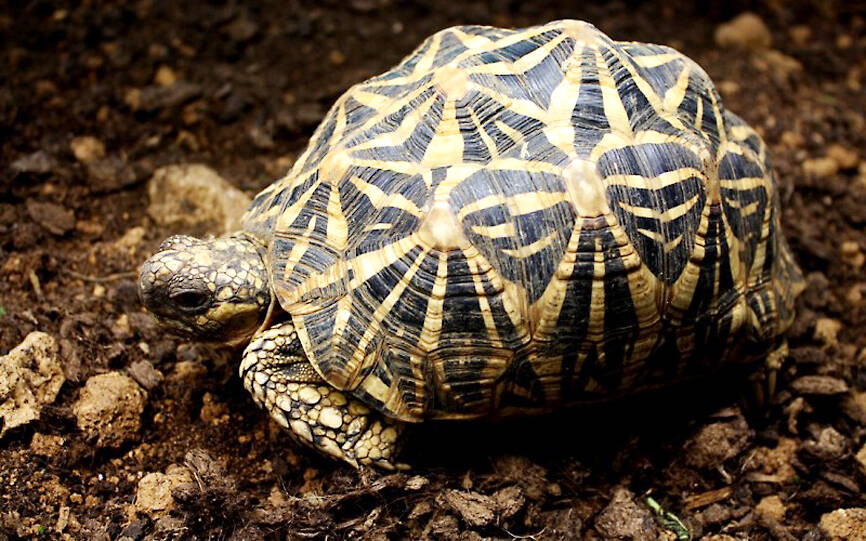
Photo courtesy of Taipei Zoo
A search of the teen at the Suvarnabhumi Airport’s departure terminal found that she had strapped Indian star tortoises — 29 alive and one dead — to her body, the department said.
“The suspect had used adhesive tape to immobilize the animals, packed them into cloth bags and attached them to her body to evade detection,” it added.
The Thai customs department said the tortoises — protected under the Convention on International Trade in Endangered Species of Wild Fauna and Flora — fetched a high price on the black market, and placed their total estimated value at about US$9,000.
The teen was charged with illegally transporting animals and evading customs controls.
Authorities said they were investigating whether she was part of a wider smuggling network.
Indian star tortoises are classified as a vulnerable species by the International Union for Conservation of Nature, which says that the tortoises have been targeted to meet international demand for “exotic pets.”
The surviving tortoises were transferred to wildlife conservation officials for care and to serve as evidence.

The military has spotted two Chinese warships operating in waters near Penghu County in the Taiwan Strait and sent its own naval and air forces to monitor the vessels, the Ministry of National Defense (MND) said. Beijing sends warships and warplanes into the waters and skies around Taiwan on an almost daily basis, drawing condemnation from Taipei. While the ministry offers daily updates on the locations of Chinese military aircraft, it only rarely gives details of where Chinese warships are operating, generally only when it detects aircraft carriers, as happened last week. A Chinese destroyer and a frigate entered waters to the southwest

Japanese Prime Minister Sanae Takaichi’s comment last year on Tokyo’s potential reaction to a Taiwan-China conflict has forced Beijing to rewrite its invasion plans, a retired Japanese general said. Takaichi told the Diet on Nov. 7 last year that a Chinese naval blockade or military attack on Taiwan could constitute a “survival-threatening situation” for Japan, potentially allowing Tokyo to exercise its right to collective self-defense. Former Japan Ground Self-Defense Force general Kiyofumi Ogawa said in a recent speech that the remark has been interpreted as meaning Japan could intervene in the early stages of a Taiwan Strait conflict, undermining China’s previous assumptions
Taiwan Railways Corp (TRC) today announced that Shin Kong Mitsukoshi has been selected as the preferred bidder to operate the Taipei Railway Station shopping mall, replacing the current operator, Breeze Development Co Ltd. Among eight qualified firms that delivered presentations and were evaluated by a review committee, Shin Kong Mitsukoshi was ranked first, while Breeze was named the runner-up, the rail company said in a statement. Contract negotiations are to proceed in accordance with regulations, it said, adding that if negotiations with the top bidder fail, it could invite the second-ranked applicant to enter talks. Breeze in a statement today expressed doubts over

UNFOUNDED CONCERNS: Public concerns that allowing Indian workers to come and work in Taiwan would lead to increased sex crimes are baseless, the labor ministry said Amid public concern over the government’s plan to bring Indian workers to Taiwan, the Ministry of Labor (MOL) pointed to past intake and said that public safety remained stable. Minister of Labor Hung Sun-han (洪申翰) on April 9 told the legislature that the first group of Indian workers could arrive as early as the end of this year. Taiwan and India signed a memorandum of understanding (MOU) in February 2024 to address Taiwan’s labor shortage. The MOU was sent to the Legislative Yuan for review in mid-2024 and received cross-party backing, prompting the MOL to begin follow-up negotiations with India, Hung said. Public


 RSS
RSS