


Minister of Agriculture Chen Junne-jih (陳駿季) yesterday pledged support for domestic peanut farmers amid concerns over the impact of a policy to eliminate tariffs on select US imports.
The policy, part of the Taiwan-US Agreement on Reciprocal Trade (ART), has yet to take effect, but has raised fears of increased competition.
Speaking ahead of a legislative meeting, Chen said the government would promote Taiwanese peanuts by highlighting their distinct qualities and bolstering marketing efforts.
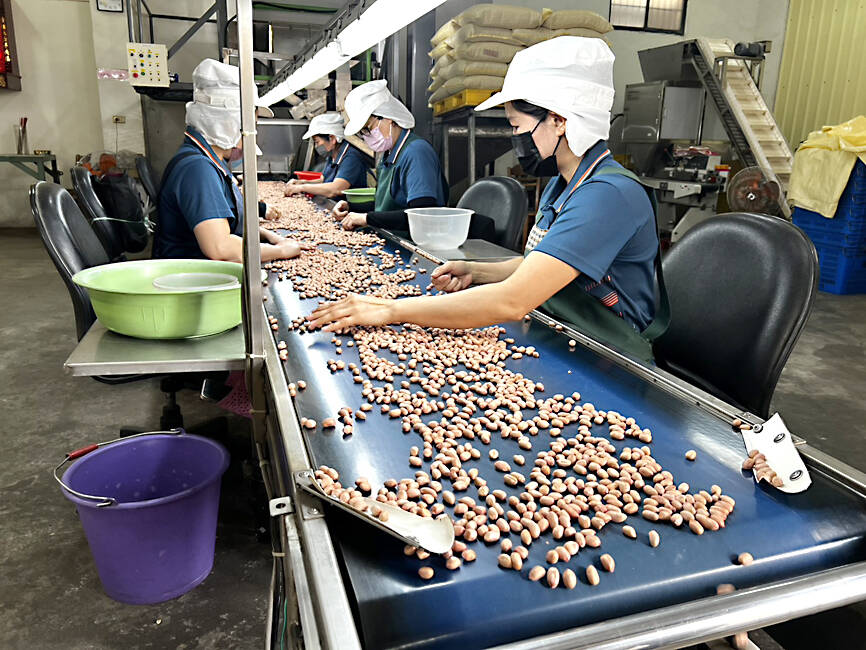
Photo: Huang Shu-li, Taipei Times
Local peanuts account for about 75 percent of the domestic market, he said, adding that tariff-free imports would not mean abandoning local producers.
At the meeting of the legislature’s Economics Committee, Chinese Nationalist Party (KMT) Legislator Chang Chia-chun (張嘉郡) said that domestic peanuts cost about three times more than US imports and raised concerns about “origin washing.”
Chen said processed products would be required to clearly indicate their country of origin.
He added that the government is purchasing fresh peanut pods and setting up drying centers to help reduce costs.
Deputy Minister of Agriculture Hu Jong-i (胡忠一) said that about 20 to 30 percent of domestic production could be affected.
Imported US peanuts cost significantly less than local products, but Taiwan relies on imports for only 30 percent of consumption, Hu said.
Price is not the only factor that affects agricultural sales, the Ministry of Agriculture said, citing quality and consumer preferences.
Meanwhile, the Democratic Progressive Party (DPP) caucus yesterday said that the ART could affect some industries, despite its broader benefits to Taiwan.
DPP caucus chief executive Chuang Jui-hsiung (莊瑞雄) said additional support for peanut farmers would be needed, adding that the Cabinet has set up a NT$30 billion (US$951 million) agricultural stabilization fund.
Ministry data showed that the Yunlin County is the primary cultivation area for peanuts in Taiwan, followed by Changhua County, with total cultivated area shrinking from about 19,000 hectares in 2020 to 15,000 hectares last year.
Most Taiwanese prefer peanuts with large kernels and a rich flavor, the ministry said, adding that about 70 percent of domestically produced peanuts are used for processing, 20 percent are consumed fresh — often steamed or roasted — and 10 percent are reserved for seed stock.
Domestic peanuts are harvested twice a year, with the first crop harvested between June and July, and the second crop harvested between October and November, it said.
The dominant variety grown in Yunlin is “Tainan No. 14,” which features larger kernels and is suitable either for processing into peanut oil or consuming fresh after being steamed, the ministry said.
Total peanut cultivation in Changhua is about 3,200 hectares, and the primary peanut variety grown in the county is “Tainung No. 9,” which has smaller kernels, but a more intense aroma, making it suitable for roasting, it said.
New varieties such as “Tainan No. 18” and “Tainan No. 19” have been developed in recent years.
High in oleic acid and rich in unsaturated fatty acids, they have significantly longer shelf life when made into peanut oil, it added.
Most imported peanuts in Taiwan come from India, Argentina and Brazil, with US imports accounting for less than 1 percent.
Additional reporting by Yang Yuan-ting

Yangmingshan National Park authorities yesterday urged visitors to respect public spaces and obey the law after a couple was caught on a camera livestream having sex at the park’s Qingtiangang (擎天崗) earlier in the day. The Shilin Police Precinct in Taipei said it has identified a suspect and his vehicle registration number, and would summon him for questioning. The case would be handled in accordance with public indecency charges, it added. The couple entered the park at about 11pm on Thursday and began fooling around by 1am yesterday, the police said, adding that the two were unaware of the park’s all-day live

Yangmingshan National Park’s Qingtiangang (擎天崗) nature area has gone viral after a park livestream camera observed a couple in the throes of intimate congress, which was broadcast live on YouTube, drawing large late-night crowds and sparking a backlash over noise, bright lights and disruption to wildlife habitat. The area’s livestream footage appeared to show a couple engaging in sexual activity on a picnic table in the park on Friday last week, with the uncensored footage streamed publicly online. The footage quickly spread across social media, prompting a tide of visitors to travel to the site to “check in” and recreate the
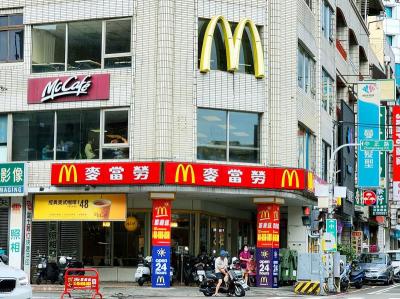
Fast food chain McDonald's is to raise prices by up to NT$5 on some products at its restaurants across Taiwan, starting on Wednesday next week, the company announced today. The prices of all extra value meals and sharing boxes are to increase by NT$5, while breakfast combos and creamy corn soup would go up by NT$3, the company said in a statement. The price of the main items of those meals, if ordered individually, would remain the same. Meanwhile, the price of a medium-sized lemon iced tea and hot cappuccino would rise by NT$3, extra dipping sauces for chicken nuggets would go up

Minister of Digital Affairs Lin Yi-ching (林宜敬) yesterday cited regulatory issues and national security concerns as an expert said that Taiwan is among the few Asian regions without Starlink. Lin made the remarks on Facebook after funP Innovation Group chief executive officer Nathan Chiu (邱繼弘) on Friday said Taiwan and four other countries in Asia — China, North Korea, Afghanistan and Syria — have no access to Starlink. Starlink has become available in 166 countries worldwide, including Ukraine, Malaysia, the Philippines and Vietnam, in the six years since it became commercial, he said. While China and North Korea block Starlink, Syria is not


 RSS
RSS