


Taiwan Railway Corp (TRC) yesterday announced that it would spend NT$3.95 billion (US$125.2 million) to build a next-generation centralized traffic control (CTC) system, which would combine automatic route setting functions with a real-time monitoring system for slopes, rockfall, level crossings and platforms.
The new CTC system would be built by Tokyo-based Nippon Signal in collaboration with Taiwan-based Allies Electric Co and HwaCom System.
TRC chairman James Jeng (鄭光遠) inked the contract with Nippon Signal CEO Ryuichi Goto at a ceremony at the Grand Hotel in Taipei yesterday morning, which was witnessed by Deputy Minister of Transportation and Communications Wu Sheng-yuan (伍勝園).

Photo: Huang Yi-ching, Taipei Times
The company’s current CTC system has been in use for more than 20 years, TRC president Feng Hui-sheng (馮輝昇) said, adding that the system’s core hardware has become gradually obsolete and manufacturers have ceased production of critical spare parts.
“The TRC operates more than 1,000 train services daily, but the current CTC system still requires manual data entry, and cannot conduct real-time monitoring and data analysis,” Feng said.
The system also lacks an off-site backup mechanism, making it less resilient in times of natural or human-caused disasters, he said, adding that the vulnerability could easily cause the entire system to halt during a crisis.
Feng highlighted three capabilities of the new CTC system.
First, it is an open framework that adopts the IEEE 802.3 standard, ensuring compatibility with the current system and flexibility for future expansion, he said.
Second, it fully integrates traffic control, electricity supervisory control and data acquisition, and video management systems, making it possible to monitor the three systems through one platform, he said.
Third, the resilience of the new system would be greatly enhanced by establishing an off-site backup center at the company’s Fugang (富岡) Vehicle Depot in Taoyuan, he said, adding that the facility would ensure that the TRC could continue deploying train services whenever the main system malfunctions.
The new system would enable fully automated train scheduling management, with timetables automatically updated in real time, Feng said.
This would eliminate potential errors from manual input and ensure precise execution of operating plans, he said.
The system would also make it possible to track the locations and statuses of trains on all TRC railways and block sections, he said.
It would feature a next-generation human-machine interface, replacing traditional mosaic panels with computerized visual displays, allow flexible adjustment of track layouts and improve dispatcher operational efficiency, he added.
The new system’s automated route setting (ARS) function would also be able to detect and resolve scheduling conflicts in real time, he said.
The ARS would greatly shorten the railway operator’s reaction time for train deployment and increase the capacity of railway lines, he said.
The new CTC system would further enable full-line safety monitoring through a single interface by integrating real-time images from slopes, rockfall areas, level crossings and platforms, Feng said.
“It uses data analyses to detect and warn of equipment anomalies in advance, reducing the risk of service disruptions,” he said.
The TRC needs more advanced tools to deal with mounting challenges facing railway transportation, Feng said, adding that the project is scheduled to be completed in 2029.
Wu said the TRC would spend NT$3.95 billion not only to replace an old system, but also to bring in an open system.
That would be key for the development of railway systems in Taiwan, Wu added.
“We would also encourage the construction team of the new CTC system to use more Taiwan-developed technology and products,” Wu said.
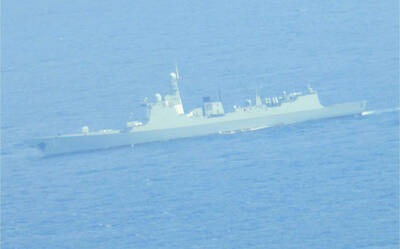
The military has spotted two Chinese warships operating in waters near Penghu County in the Taiwan Strait and sent its own naval and air forces to monitor the vessels, the Ministry of National Defense (MND) said. Beijing sends warships and warplanes into the waters and skies around Taiwan on an almost daily basis, drawing condemnation from Taipei. While the ministry offers daily updates on the locations of Chinese military aircraft, it only rarely gives details of where Chinese warships are operating, generally only when it detects aircraft carriers, as happened last week. A Chinese destroyer and a frigate entered waters to the southwest
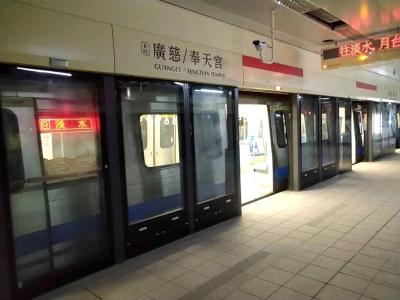
The eastern extension of the Taipei MRT Red Line could begin operations as early as late June, the Taipei Department of Rapid Transit Systems said yesterday. Taipei Rapid Transit Corp said it is considering offering one month of free rides on the new section to mark its opening. Construction progress on the 1.4km extension, which is to run from the current terminal Xiangshan Station to a new eastern terminal, Guangci/Fengtian Temple Station, was 90.6 percent complete by the end of last month, the department said in a report to the Taipei City Council's Transportation Committee. While construction began in October 2016 with an
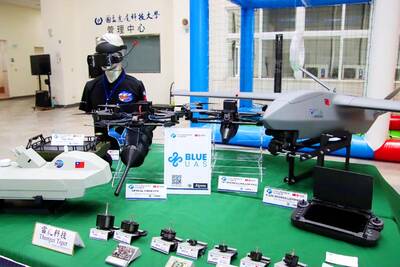
NON-RED SUPPLY: Boosting the nation’s drone industry is becoming increasingly urgent as China’s UAV dominance could become an issue in a crisis, an analyst said Taiwan’s drone exports to Europe grew 41.7-fold from 2024 to last year, with demand from Ukraine’s fight against Russian aggression the most likely driver of growth, a study showed. The Institute for Democracy, Society and Emerging Technology (DSET) in a statement on Wednesday said it found that many of Taiwan’s uncrewed aerial vehicle (UAV) sales were from Poland and the Czech Republic. These countries likely transferred the drones to Ukraine to aid it in its fight against the Russian invasion that started in 2022, it said. Despite the gains, Taiwan is not the dominant drone exporter to these markets, ranking second and fourth

Japanese Prime Minister Sanae Takaichi’s comment last year on Tokyo’s potential reaction to a Taiwan-China conflict has forced Beijing to rewrite its invasion plans, a retired Japanese general said. Takaichi told the Diet on Nov. 7 last year that a Chinese naval blockade or military attack on Taiwan could constitute a “survival-threatening situation” for Japan, potentially allowing Tokyo to exercise its right to collective self-defense. Former Japan Ground Self-Defense Force general Kiyofumi Ogawa said in a recent speech that the remark has been interpreted as meaning Japan could intervene in the early stages of a Taiwan Strait conflict, undermining China’s previous assumptions


 RSS
RSS