


Taiwanese scientists have made progress in decoding a claw-waving communication system used by a fiddler crab species endemic to Taiwan, National Chung Hsing University said yesterday.
Xeruca formosensis, commonly known as the Taiwanese fiddler crab, is an endemic crustacean that inhabits the nation’s tidal mudflats.
University biology professor Shih Hsin-te (施習德) and doctoral candidate Chang Kai (張凱) analyzed 20 types of interactions among the crabs and found that they communicate by waving their dominant claws, the university said.
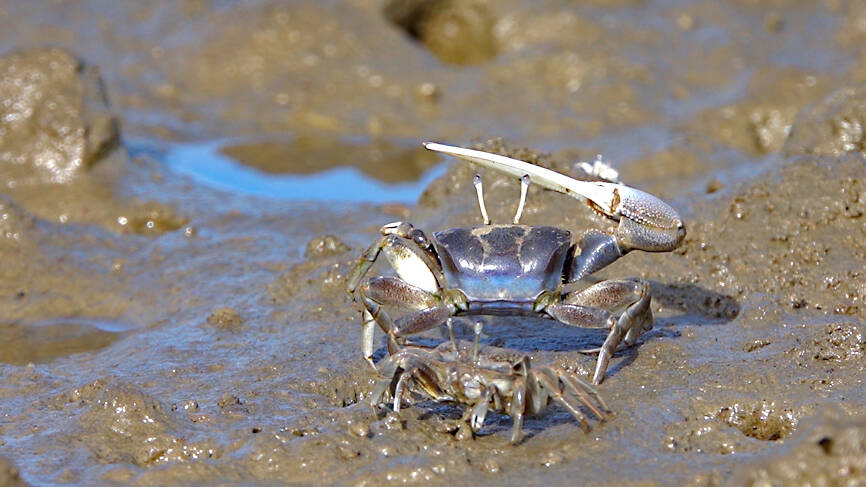
Photo courtesy of the National Chung Hsin University
Males of the species are distinguished by their asymmetrical claws, including a prominent white oversized pincer that they wave continuously in a seemingly repetitive motion, Shih said.
By analyzing male behavior in context, the team found that claw-waving is used to mark territory, challenge rivals, and attract females for mating.
The study suggests the crabs rely on a complex system of visual signals and environmental modification to communicate, Shih said.
Male crabs construct chimney-like burrows, while females build pyramid-shaped nests, which may play a role in mating rituals and communication, he added.
The project is the first attempt to develop an ethogram — a systematic catalogue of a species’ behavior — for the Taiwanese fiddler crab, Shih said.
Beyond scientific curiosity, the findings suggest that human activity that disrupts the crabs’ ability to shape their habitat could negatively affect their reproduction.
Environmental authorities could also use the structure of crab burrows as an indicator of population size and potential disruptions to mating behavior, he added.
The study was published earlier this year in the journal Nauplius.

Yangmingshan National Park authorities yesterday urged visitors to respect public spaces and obey the law after a couple was caught on a camera livestream having sex at the park’s Qingtiangang (擎天崗) earlier in the day. The Shilin Police Precinct in Taipei said it has identified a suspect and his vehicle registration number, and would summon him for questioning. The case would be handled in accordance with public indecency charges, it added. The couple entered the park at about 11pm on Thursday and began fooling around by 1am yesterday, the police said, adding that the two were unaware of the park’s all-day live
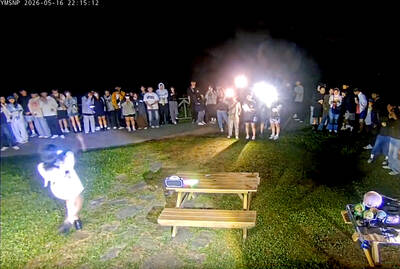
Yangmingshan National Park’s Qingtiangang (擎天崗) nature area has gone viral after a park livestream camera observed a couple in the throes of intimate congress, which was broadcast live on YouTube, drawing large late-night crowds and sparking a backlash over noise, bright lights and disruption to wildlife habitat. The area’s livestream footage appeared to show a couple engaging in sexual activity on a picnic table in the park on Friday last week, with the uncensored footage streamed publicly online. The footage quickly spread across social media, prompting a tide of visitors to travel to the site to “check in” and recreate the

Fast food chain McDonald's is to raise prices by up to NT$5 on some products at its restaurants across Taiwan, starting on Wednesday next week, the company announced today. The prices of all extra value meals and sharing boxes are to increase by NT$5, while breakfast combos and creamy corn soup would go up by NT$3, the company said in a statement. The price of the main items of those meals, if ordered individually, would remain the same. Meanwhile, the price of a medium-sized lemon iced tea and hot cappuccino would rise by NT$3, extra dipping sauces for chicken nuggets would go up

Minister of Digital Affairs Lin Yi-ching (林宜敬) yesterday cited regulatory issues and national security concerns as an expert said that Taiwan is among the few Asian regions without Starlink. Lin made the remarks on Facebook after funP Innovation Group chief executive officer Nathan Chiu (邱繼弘) on Friday said Taiwan and four other countries in Asia — China, North Korea, Afghanistan and Syria — have no access to Starlink. Starlink has become available in 166 countries worldwide, including Ukraine, Malaysia, the Philippines and Vietnam, in the six years since it became commercial, he said. While China and North Korea block Starlink, Syria is not


 RSS
RSS