


Chinese Nationalist Party (KMT) lawmakers yesterday boycotted cross-caucus negotiations on the special defense budget, instead submitting a supplementary resolution that demands all US arms sales undergo separate legislative reviews — a move Democratic Progressive Party (DPP) legislators criticized as an attempt to stall vital military funding.
The supplementary resolution stated that it was proposed in response to the US government’s announcement on Dec. 18 last year of a US$11.1 billion military package to Taiwan — the largest it has ever provided.
The resolution, to provide better legislative oversight of US arms sales, proposes that competent authorities draft a special act on strengthening national defense and second-stage procurement from the US, and forward the draft to the Legislative Yuan immediately.

Photo: Lo Pei-de, Taipei Times
At least 15 KMT legislators signed the resolution.
The KMT resolution also says that once the draft act has been delivered to the Legislative Yuan, the legislature must convene cross-caucus negotiations to debate whether it should be placed on the roster for debate and to expedite the bill’s third reading.
The proposal would mean that every large-sum military purchase must be debated across multiple stages and discussed item by item, effectively bypassing existing methods for the government to add funding directly.
DPP Legislator Wang Ting-yu (王定宇) said that the Executive Yuan’s draft act has been blocked at least 10 times, and the KMT’s original NT$380 billion (US$11.97 billion) version was evidently a ploy to stall the process and propose a new version.
The KMT’s previous proposal capped defense spending at NT$380 billion and would allow special funding to be added later. The KMT proposal was far lower than the Executive Yuan’s proposal of NT$1.25 trillion over eight years.
DPP Legislator Michelle Lin (林楚茵) criticized the resolution, saying that the KMT was withholding funding that the nation and frontline troops desperately need.

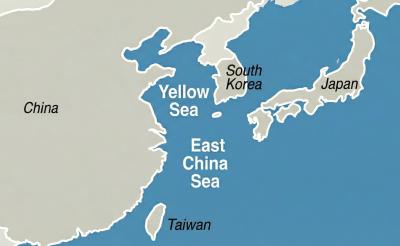
China has reserved offshore airspace in the Yellow Sea and East China Sea from March 27 to May 6, issuing alerts usually used to warn of military exercises, although no such exercises have been announced, the Wall Street Journal (WSJ) reported yesterday. Reserving such a large area for 40 days without explanation is an “unusual step,” as military exercises normally only last a few days, the paper said. These alerts, known as Notice to Air Missions (Notams), “are intended to inform pilots and aviation authorities of temporary airspace hazards or restrictions,” the article said. The airspace reserved in the alert is

NAMING SPAT: The foreign ministry called on Denmark to propose an acceptable solution to the erroneous nationality used for Taiwanese on residence permits Taiwan has revoked some privileges for Danish diplomatic staff over a Danish permit that lists “Taiwan” as “China,” Eric Huang (黃鈞耀), head of the Ministry of Foreign Affairs’ Department of European Affairs, told a news conference in Taipei yesterday. Reporters asked Huang whether the Danish government had responded to the ministry’s request that it correct the nationality on Danish residence permits of Taiwanese, which has been listed as “China” since 2024. Taiwan’s representative office in Denmark continues to communicate with the Danish government, and the ministry has revoked some privileges previously granted to Danish representatives in Taiwan and would continue to review

More than 6,000 Taiwanese students have participated in exchange programs in China over the past two years, despite the Mainland Affairs Council’s (MAC) “orange light” travel advisory, government records showed. The MAC’s publicly available registry showed that Taiwanese college and university students who went on exchange programs across the Strait numbered 3,592 and 2,966 people respectively. The National Immigration Agency data revealed that 2,296 and 2,551 Chinese students visited Taiwan for study in the same two years. A review of the Web sites of publicly-run universities and colleges showed that Taiwanese higher education institutions continued to recruit students for Chinese educational programs without

China has reserved offshore airspace over the Yellow Sea and East China Sea from March 27 to May 6, issuing alerts that are usually used to warn of military exercises, although no such exercises have been announced, the Wall Street Journal (WSJ) reported on Sunday. Reserving such a large area for 40 days without explanation is an “unusual step,” as military exercises normally only last a few days, the paper said. The alerts, known as notice to air missions (NOTAMs), “are intended to inform pilots and aviation authorities of temporary airspace hazards or restrictions,” the article said. The airspace reserved in the alert


 RSS
RSS