


The nation’s domestically developed subsonic anti-ship cruise missile system is expected to enter initial capability assessment later this year, a source said yesterday.
The prototype missile system is designed primarily to be launched by vehicles to attack ships at a range of 900km to 1,000km, a source familiar with the work of the Chunghsan Institute of Science and Technology said on condition of anonymity.
The Kratos Defense Mighty Hornet IV uncrewed aerial vehicle could potentially carry this heavy missile if the drone sacrifices some of its aviation fuel storage in favor of weapon payload, they said.
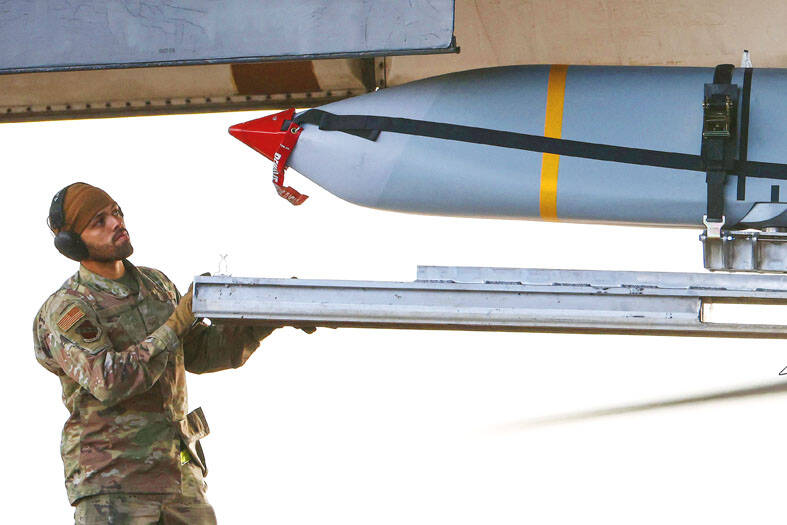
Photo: AFP
The as-yet unnamed long-range subsonic cruise missile was developed by leveraging technologies utilized in existing long-range strike weapons and was documented for the first time by the Ministry of National Defense in a list of funded programs last year, the source said.
That the system is ready for testing is credit to the institute’s ability to conduct research and development at speed, they said.
The Yun Feng hypersonic land-attack cruise missile and the extended range variant of the Hsiung Feng IIE missile, which respectively have an effective range of 2,000km and 1,000km, are the only systems with superior range than the prototype in the military’s arsenal, they added.
The successful development of an indigenous alternative could spur Washington to approve the export authorization of the AGM-158C Joint Air-to-Surface Standoff Missile, which Taiwan has sought without success, the source said.
The armed forces have long expressed an interest in obtaining the AGM-158C anti-ship missile, as the weapon possesses stealth capabilities, carries a 1 tonne warhead and is based on a battle-proven family of systems in service since 2004, they said.

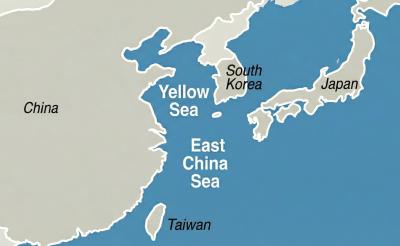
China has reserved offshore airspace in the Yellow Sea and East China Sea from March 27 to May 6, issuing alerts usually used to warn of military exercises, although no such exercises have been announced, the Wall Street Journal (WSJ) reported yesterday. Reserving such a large area for 40 days without explanation is an “unusual step,” as military exercises normally only last a few days, the paper said. These alerts, known as Notice to Air Missions (Notams), “are intended to inform pilots and aviation authorities of temporary airspace hazards or restrictions,” the article said. The airspace reserved in the alert is

NAMING SPAT: The foreign ministry called on Denmark to propose an acceptable solution to the erroneous nationality used for Taiwanese on residence permits Taiwan has revoked some privileges for Danish diplomatic staff over a Danish permit that lists “Taiwan” as “China,” Eric Huang (黃鈞耀), head of the Ministry of Foreign Affairs’ Department of European Affairs, told a news conference in Taipei yesterday. Reporters asked Huang whether the Danish government had responded to the ministry’s request that it correct the nationality on Danish residence permits of Taiwanese, which has been listed as “China” since 2024. Taiwan’s representative office in Denmark continues to communicate with the Danish government, and the ministry has revoked some privileges previously granted to Danish representatives in Taiwan and would continue to review

More than 6,000 Taiwanese students have participated in exchange programs in China over the past two years, despite the Mainland Affairs Council’s (MAC) “orange light” travel advisory, government records showed. The MAC’s publicly available registry showed that Taiwanese college and university students who went on exchange programs across the Strait numbered 3,592 and 2,966 people respectively. The National Immigration Agency data revealed that 2,296 and 2,551 Chinese students visited Taiwan for study in the same two years. A review of the Web sites of publicly-run universities and colleges showed that Taiwanese higher education institutions continued to recruit students for Chinese educational programs without

China has reserved offshore airspace over the Yellow Sea and East China Sea from March 27 to May 6, issuing alerts that are usually used to warn of military exercises, although no such exercises have been announced, the Wall Street Journal (WSJ) reported on Sunday. Reserving such a large area for 40 days without explanation is an “unusual step,” as military exercises normally only last a few days, the paper said. The alerts, known as notice to air missions (NOTAMs), “are intended to inform pilots and aviation authorities of temporary airspace hazards or restrictions,” the article said. The airspace reserved in the alert


 RSS
RSS