


China has reserved offshore airspace over the Yellow Sea and East China Sea from March 27 to May 6, issuing alerts that are usually used to warn of military exercises, although no such exercises have been announced, the Wall Street Journal (WSJ) reported on Sunday.
Reserving such a large area for 40 days without explanation is an “unusual step,” as military exercises normally only last a few days, the paper said.
The alerts, known as notice to air missions (NOTAMs), “are intended to inform pilots and aviation authorities of temporary airspace hazards or restrictions,” the article said.
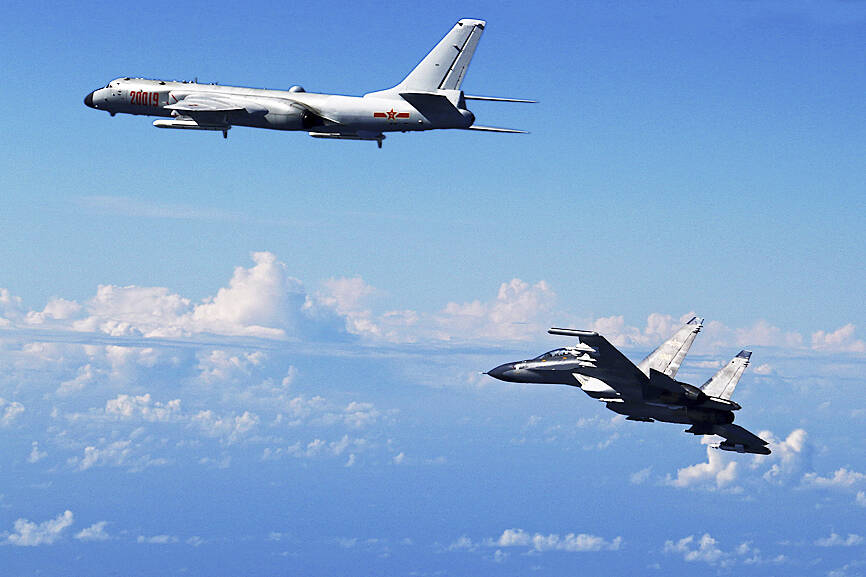
Photo: Shao Jing, Xinhua news agency via AP
The airspace reserved in the alert is hundreds of kilometers north of Taiwan and extends south from the Yellow Sea facing South Korea, to waters of the East China Sea facing Japan, the WSJ said, citing information from the US Federal Aviation Administration.
The reserved airspace has no vertical ceiling and is designated within NOTAMs as “SFC-UNL” (surface unlimited), it said, adding that while civil aviation seems unaffected, it would take coordination for aircraft to transit such areas.
Ray Powell, director of Stanford University’s SeaLight Project, which tracks Chinese maritime activity, told the paper that the SFC-UNL with “an extraordinary 40-day duration” combined with no announced exercise makes the alerts notable.
“That suggests not a discrete exercise, but a sustained operational readiness posture — and one that China apparently doesn’t feel the need to explain,” the WSJ quoted Powell as saying.
If the reserved airspace is linked to exercises, it “would represent a meaningful shift in how Beijing uses airspace control as a tool of military signaling,” he told the paper.
The Chinese Ministry of National Defense and the Chinese Civil Aviation Administration have not issued statements about the NOTAMs.
Past Chinese drills have focused on controlling routes that could be used by the US military in the event of a conflict over Taiwan, which the Journal said was not unusual.
The airspace could “provide an opportunity to practice the kinds of air combat maneuvers that would be required” to control routes that might be used by the US military in a potential conflict over Taiwan, the report quoted US Naval War College China Maritime Studies Institute director Christopher Sharman as saying.
China could be increasing its military presence while US attention is focused on the Middle East, the article said, citing a senior Taiwanese security official.
The airspace reservation is “clearly aimed at Japan,” as China attempts to deter US allies and erode US military influence in the Indo-Pacific region, the official said.
Lin Ying-yu (林穎佑), an associate professor in Tamkang University’s Graduate Institute of International Affairs and Strategic Studies, yesterday said that April is typically the peak period for Chinese military exercises.
That the air warning zones are closer to Japan and South Korea, suggest that potential exercises are not necessarily aimed at Taiwan nor are they related to Chinese Nationalist Party (KMT) Chairwoman Cheng Li-wun’s (鄭麗文) visit to China today.
China might resume “joint combat readiness patrols” to pressure Taiwan during or after Cheng’s potential meeting with Chinese President Xi Jinping (習近平), signaling that its military pressure and deterrence remain in place regardless of the state of cross-strait communications, he said.
Additional reporting Huang Chin-hsuan

Yangmingshan National Park authorities yesterday urged visitors to respect public spaces and obey the law after a couple was caught on a camera livestream having sex at the park’s Qingtiangang (擎天崗) earlier in the day. The Shilin Police Precinct in Taipei said it has identified a suspect and his vehicle registration number, and would summon him for questioning. The case would be handled in accordance with public indecency charges, it added. The couple entered the park at about 11pm on Thursday and began fooling around by 1am yesterday, the police said, adding that the two were unaware of the park’s all-day live

Yangmingshan National Park’s Qingtiangang (擎天崗) nature area has gone viral after a park livestream camera observed a couple in the throes of intimate congress, which was broadcast live on YouTube, drawing large late-night crowds and sparking a backlash over noise, bright lights and disruption to wildlife habitat. The area’s livestream footage appeared to show a couple engaging in sexual activity on a picnic table in the park on Friday last week, with the uncensored footage streamed publicly online. The footage quickly spread across social media, prompting a tide of visitors to travel to the site to “check in” and recreate the

A former soldier and an active-duty army officer were yesterday indicted for allegedly selling classified military training materials to a Chinese intelligence operative for a total of NT$79,440. The Taipei District Prosecutors’ Office indicted Chen Tai-yin (陳泰尹) and Lee Chun-ta (李俊達) for contravening the National Security Act (國家安全法) and the Anti-Corruption Act (貪污治罪條例). Chen left the military in September 2013 after serving alongside then-staff sergeant Lee, now an army lieutenant, at the 21st Artillery Command of the army’s Sixth Corps from 2011 to 2013, according to the indictment. Chen met a Chinese intelligence operative identified as “Wang” (王) through a friend in November

Minister of Digital Affairs Lin Yi-ching (林宜敬) yesterday cited regulatory issues and national security concerns as an expert said that Taiwan is among the few Asian regions without Starlink. Lin made the remarks on Facebook after funP Innovation Group chief executive officer Nathan Chiu (邱繼弘) on Friday said Taiwan and four other countries in Asia — China, North Korea, Afghanistan and Syria — have no access to Starlink. Starlink has become available in 166 countries worldwide, including Ukraine, Malaysia, the Philippines and Vietnam, in the six years since it became commercial, he said. While China and North Korea block Starlink, Syria is not


 RSS
RSS