


China’s infiltration of Taiwan is systematic, planned and targeted, with recent activity shifting from recruiting mid-level military officers to rank-and-file enlisted personnel, National Security Bureau (NSB) Director-General Tsai Ming-yen (蔡明彥) said today.
The Legislative Yuan invited Tsai to deliver a report on bureau operations to its Foreign Affairs and National Defense Committee.
China’s infiltration is systematic, in that it integrates national security, intelligence operations and “united front” work into a dense network to conduct intelligence gathering and espionage in Taiwan, he said.

Photo: Tu Chien-jung, Taipei Times
It is also planned, with China using specific networks to screen targets through various exchange activities and recruiting local collaborators to establish intelligence-gathering organizations, he said.
Third, it is targeted, with those targets shifting toward lower-ranking military personnel on the grassroots level, he added.
Before the meeting, Tsai was asked by reporters about China’s reservation of five airspace zones for 40 days from March 27 until May 6.
Beijing is using military and political aims to probe US activities, Tsai said.
The designation would remain in place until almost exactly one week before a planned meeting between US President Donald Trump and Chinese President Xi Jinping (習近平), he said.
The zones stretch south from the Yellow Sea, facing South Korea, to the East China Sea, facing Japan, the Wall Street Journal reported on Monday.
Beijing has not given an official explanation or confirmed military exercises during this time, it said.
A US reconnaissance aircraft entered one of the reserved airspaces on Monday to conduct operations, indicating that China could be using the opportunity to test the US response, Tsai said.
Taiwan has also established an inter-agency notification mechanism to combat China’s “gray zone” maritime harassment and is actively exchanging Maritime Domain Awareness experience with international partners, he added.
Additional reporting by Fang Wei-li

The military has spotted two Chinese warships operating in waters near Penghu County in the Taiwan Strait and sent its own naval and air forces to monitor the vessels, the Ministry of National Defense (MND) said. Beijing sends warships and warplanes into the waters and skies around Taiwan on an almost daily basis, drawing condemnation from Taipei. While the ministry offers daily updates on the locations of Chinese military aircraft, it only rarely gives details of where Chinese warships are operating, generally only when it detects aircraft carriers, as happened last week. A Chinese destroyer and a frigate entered waters to the southwest
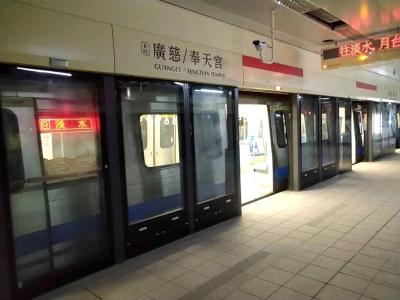
The eastern extension of the Taipei MRT Red Line could begin operations as early as late June, the Taipei Department of Rapid Transit Systems said yesterday. Taipei Rapid Transit Corp said it is considering offering one month of free rides on the new section to mark its opening. Construction progress on the 1.4km extension, which is to run from the current terminal Xiangshan Station to a new eastern terminal, Guangci/Fengtian Temple Station, was 90.6 percent complete by the end of last month, the department said in a report to the Taipei City Council's Transportation Committee. While construction began in October 2016 with an
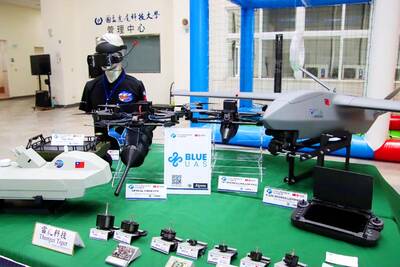
NON-RED SUPPLY: Boosting the nation’s drone industry is becoming increasingly urgent as China’s UAV dominance could become an issue in a crisis, an analyst said Taiwan’s drone exports to Europe grew 41.7-fold from 2024 to last year, with demand from Ukraine’s fight against Russian aggression the most likely driver of growth, a study showed. The Institute for Democracy, Society and Emerging Technology (DSET) in a statement on Wednesday said it found that many of Taiwan’s uncrewed aerial vehicle (UAV) sales were from Poland and the Czech Republic. These countries likely transferred the drones to Ukraine to aid it in its fight against the Russian invasion that started in 2022, it said. Despite the gains, Taiwan is not the dominant drone exporter to these markets, ranking second and fourth
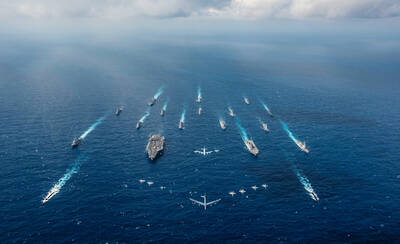
Japanese Prime Minister Sanae Takaichi’s comment last year on Tokyo’s potential reaction to a Taiwan-China conflict has forced Beijing to rewrite its invasion plans, a retired Japanese general said. Takaichi told the Diet on Nov. 7 last year that a Chinese naval blockade or military attack on Taiwan could constitute a “survival-threatening situation” for Japan, potentially allowing Tokyo to exercise its right to collective self-defense. Former Japan Ground Self-Defense Force general Kiyofumi Ogawa said in a recent speech that the remark has been interpreted as meaning Japan could intervene in the early stages of a Taiwan Strait conflict, undermining China’s previous assumptions


 RSS
RSS