


Premier Cho Jung-tai (卓榮泰) yesterday refused to accept questions from Taiwan People’s Party Legislator Li Zhenxiu (李貞秀) during her first general interpellation session, saying that Li is not legally a legislator of Taiwan, as she has not renounced her Chinese citizenship and household registration.
During the session at the Legislative Yuan, Li stepped up to the podium and asked Cho, Minister of the Interior Liu Shyh-fang (劉世芳) and Mainland Affairs Council Minister Chiu Chui-cheng (邱垂正) to come forward for questioning.
Cho motioned for Liu and Chiu to remain in place, but said he personally stepped forward out of respect for Legislative Speaker Han Kuo-yu’s (韓國瑜) role in maintaining order.
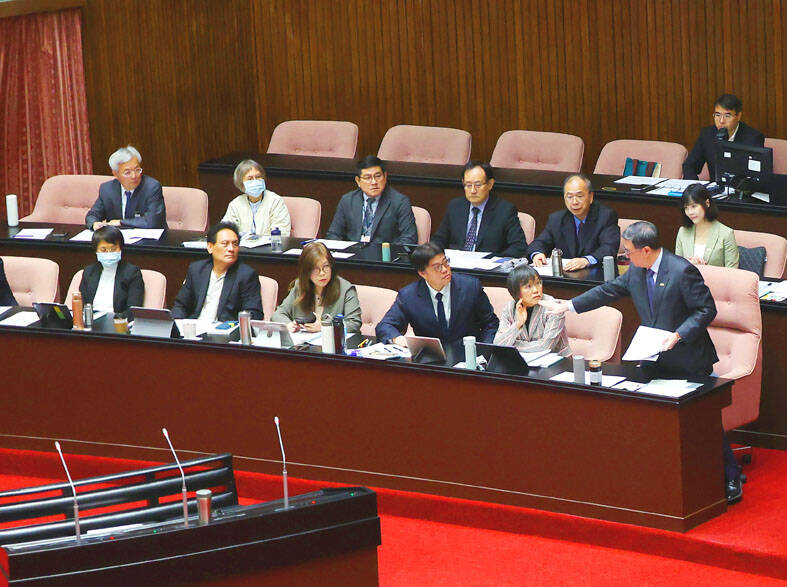
Photo: CNA
Li has not legally renounced her Chinese citizenship and household registration, which is inconsistent with the Act Governing Relations Between the People of the Taiwan Area and the Mainland Area (臺灣地區與大陸地區人民關係條例) and the Nationality Act (國籍法), Cho said.
She does not meet the legal qualifications to be a legislator, he said, adding that responsibility for the situation lies with the Chinese government, not Taiwan’s government.
Li has said she filed an application with local authorities in China to renounce her People’s Republic of China (PRC) citizenship, but was rejected.
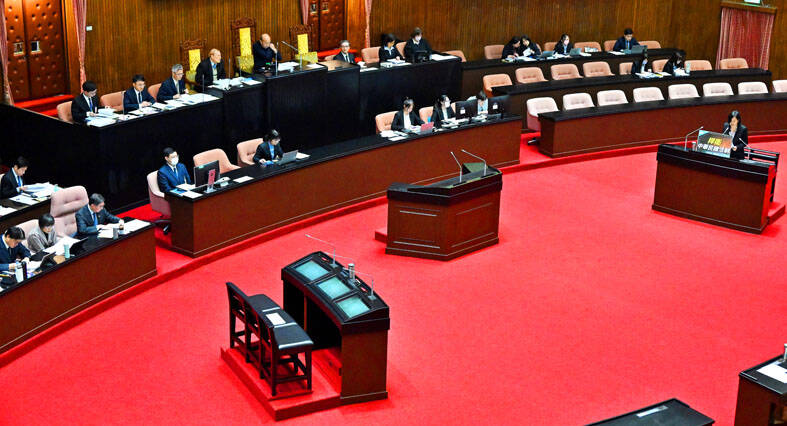
Photo: Liu Hsin-de, Taipei Times
Anyone holding Chinese nationality is subject to the constitution of the PRC and its national security laws, and is obligated to promote unification and gather intelligence for the PRC, Cho said.
Han said the Cabinet should respect the right of legislators to question Cabinet members.
Li remained at the podium alone and spoke until the end of her time without Cho or any ministers coming forward to respond to questions.
The events send a message to all immigrants that their voices and those of Chinese spouses can be suppressed, Li said.
“Are Chinese spouses second-class citizens?” she asked.
Li said she is loyal to the Republic of China, and would defend its democracy and freedoms.
Her standing at the podium is a source of pride for Taiwan’s democracy, she added.

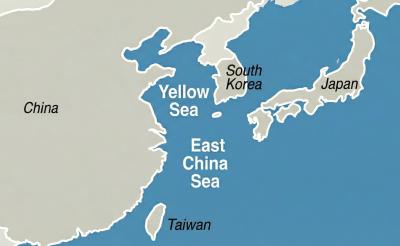
China has reserved offshore airspace in the Yellow Sea and East China Sea from March 27 to May 6, issuing alerts usually used to warn of military exercises, although no such exercises have been announced, the Wall Street Journal (WSJ) reported yesterday. Reserving such a large area for 40 days without explanation is an “unusual step,” as military exercises normally only last a few days, the paper said. These alerts, known as Notice to Air Missions (Notams), “are intended to inform pilots and aviation authorities of temporary airspace hazards or restrictions,” the article said. The airspace reserved in the alert is
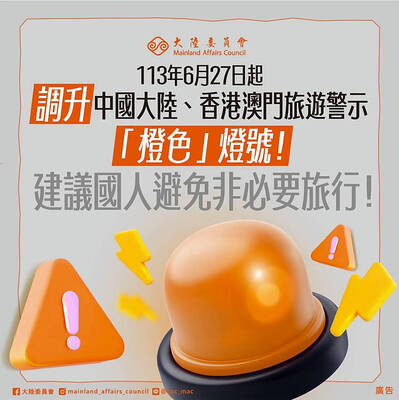
More than 6,000 Taiwanese students have participated in exchange programs in China over the past two years, despite the Mainland Affairs Council’s (MAC) “orange light” travel advisory, government records showed. The MAC’s publicly available registry showed that Taiwanese college and university students who went on exchange programs across the Strait numbered 3,592 and 2,966 people respectively. The National Immigration Agency data revealed that 2,296 and 2,551 Chinese students visited Taiwan for study in the same two years. A review of the Web sites of publicly-run universities and colleges showed that Taiwanese higher education institutions continued to recruit students for Chinese educational programs without

A bipartisan group of US senators has introduced a bill to enhance cooperation with Taiwan on drone development and to reduce reliance on supply chains linked to China. The proposed Blue Skies for Taiwan Act of 2026 was introduced by Republican US senators Ted Cruz and John Curtis, and Democratic US senators Jeff Merkley and Andy Kim. The legislation seeks to ease constraints on Taiwan-US cooperation in uncrewed aerial systems (UAS), including dependence on China-sourced components, limited access to capital and regulatory barriers under US export controls, a news release issued by Cruz on Wednesday said. The bill would establish a "Blue UAS
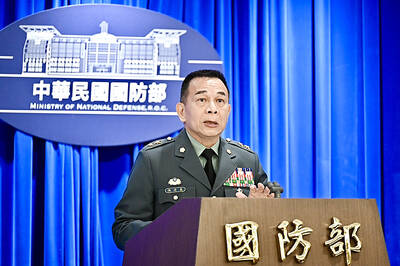
The Republic of China Army Command yesterday relieved Kinmen Defense Battalion commander after authorities indicted the officer on charges connected to using methamphetamine. The Kinmen District Prosecutors’ Office on Wednesday detained Colonel He (何) after the Coast Guard linked him to drug shipments and proceeded to charge him yesterday for using and possessing crystal meth. The man was released on a NT$50,000 bail and banned from leaving Kinmen, the office said. Army Chief of Staff Lieutenant General Chen Chien-yi (陳建義) told a news conference yesterday that He has been removed and another officer is taking over the unit as the acting commander. The military


 RSS
RSS