


The Republic of China Army Command yesterday relieved Kinmen Defense Battalion commander after authorities indicted the officer on charges connected to using methamphetamine.
The Kinmen District Prosecutors’ Office on Wednesday detained Colonel He (何) after the Coast Guard linked him to drug shipments and proceeded to charge him yesterday for using and possessing crystal meth.
The man was released on a NT$50,000 bail and banned from leaving Kinmen, the office said.
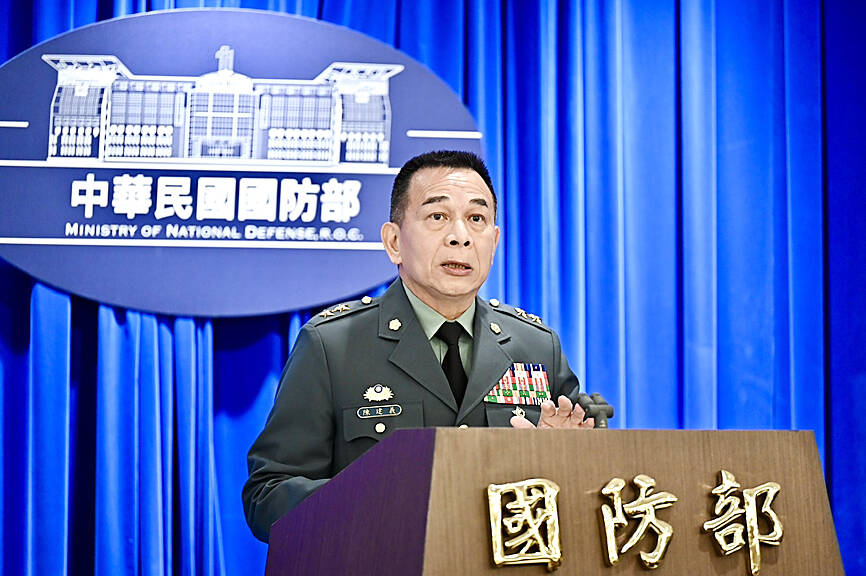
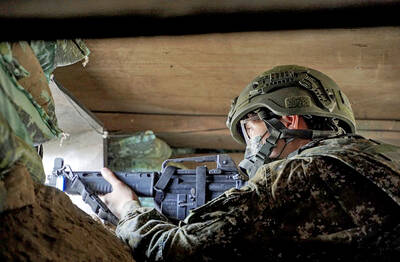
Photo: Tu Chien-jung, Taipei Times
Army Chief of Staff Lieutenant General Chen Chien-yi (陳建義) told a news conference yesterday that He has been removed and another officer is taking over the unit as the acting commander.
The military is committed to rooting out drugs in its ranks by swiftly and severely dealing with any service member found guilty of their use, he said.
Disciplinary proceedings against the officer would be conducted depending on the judgement of the justice system with no leniency or compromise, Chen said.
The army is organizing a task force to investigate whether He had any accomplices and the evaluation procedure utilized for promotions is being scrutinized to exclude unsuitable candidates from leadership, he said.
The man was not recently tested for drugs as he was not required to undergo regular mandatory screenings and only became the commanding officer a month ago, Chen said.
Army personnel not included in the mandatory regular drug screening list are subjected to urine tests at random, and He was tested when serving as a staff officer, Chen added.
The Army Command cannot disclose past results of He’s tests as such matters are potential evidence used in the ongoing legal investigation, Chen said.
Separately, Lu Hsin-ting (盧星廷), an inspector at the Ministry of National Defense’s Department of Resource Planning, said that the ministry is working with the Ministry of the Interior to amend laws governing penalties for evading the military draft.
Changes to the Military Service System Violation Punishment Act (妨害兵役治罪條例) must be calibrated to align with Enforcement Statute for Substitute Services (替代役實施條例) to ensure legal consistency, he said.
The two ministries would announce the proposed changes to the law when ready, he said.
Additional reporting by Wu Chung-ting
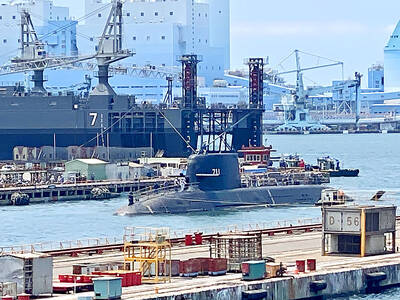
AGING: While Japan has 22 submarines, Taiwan only operates four, two of which were commissioned by the US in 1945 and 1946, and transferred to Taiwan in 1973 Taiwan would need at least 12 submarines to reach modern fleet capabilities, CSBC Corp, Taiwan chairman Chen Cheng-hung (陳政宏) said in an interview broadcast on Friday, citing a US assessment. CSBC is testing the nation’s first indigenous defense submarine, the Hai Kun (海鯤, Narwhal), which is scheduled to be delivered to the navy next month or in July. The Hai Kun has completed torpedo-firing tests and is scheduled to undergo overnight sea trials, Chen said on an SET TV military affairs program. Taiwan would require at least 12 submarines to establish a modern submarine force after assessing the nation’s operational environment and defense
Yangmingshan National Park authorities yesterday urged visitors to respect public spaces and obey the law after a couple was caught on a camera livestream having sex at the park’s Qingtiangang (擎天崗) earlier in the day. The Shilin Police Precinct in Taipei said it has identified a suspect and his vehicle registration number, and would summon him for questioning. The case would be handled in accordance with public indecency charges, it added. The couple entered the park at about 11pm on Thursday and began fooling around by 1am yesterday, the police said, adding that the two were unaware of the park’s all-day live
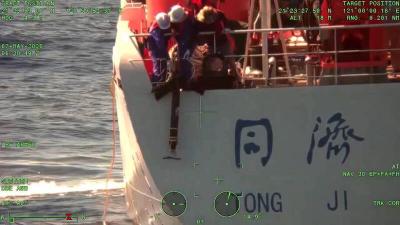
The coast guard today said that it had disrupted "illegal" operations by a Chinese research ship in waters close to the nation and driven it away, part of what Taipei sees a provocative pattern of China's stepped up maritime activities. The coast guard said that it on Thursday last week detected the Chinese ship Tongji (同濟號), which was commissioned only last year, 29 nautical miles (54km) southeast of the southern tip of Taiwan, although just outside restricted waters. The ship was observed lowering ropes into the water, suspected to be the deployment of scientific instruments for "illegal" survey operations, and the coast
A former soldier and an active-duty army officer were yesterday indicted for allegedly selling classified military training materials to a Chinese intelligence operative for a total of NT$79,440. The Taipei District Prosecutors’ Office indicted Chen Tai-yin (陳泰尹) and Lee Chun-ta (李俊達) for contravening the National Security Act (國家安全法) and the Anti-Corruption Act (貪污治罪條例). Chen left the military in September 2013 after serving alongside then-staff sergeant Lee, now an army lieutenant, at the 21st Artillery Command of the army’s Sixth Corps from 2011 to 2013, according to the indictment. Chen met a Chinese intelligence operative identified as “Wang” (王) through a friend in November


 RSS
RSS