


Premier Cho Jung-tai (卓榮泰) yesterday criticized Chinese Nationalist Party (KMT) Chairwoman Cheng Li-wun’s (鄭麗文) upcoming trip to China, saying that departing for an authoritarian country on Taiwan’s Freedom of Speech Day strikes a “raw nerve.”
Cheng is scheduled to lead a KMT delegation to China from Saturday next week to April 12 on the invitation of Chinese President Xi Jinping (習近平).
The itinerary includes stops in Jiangsu Province, Shanghai and Beijing. It did not specify a meeting with Xi, which Cheng has been pushing for.
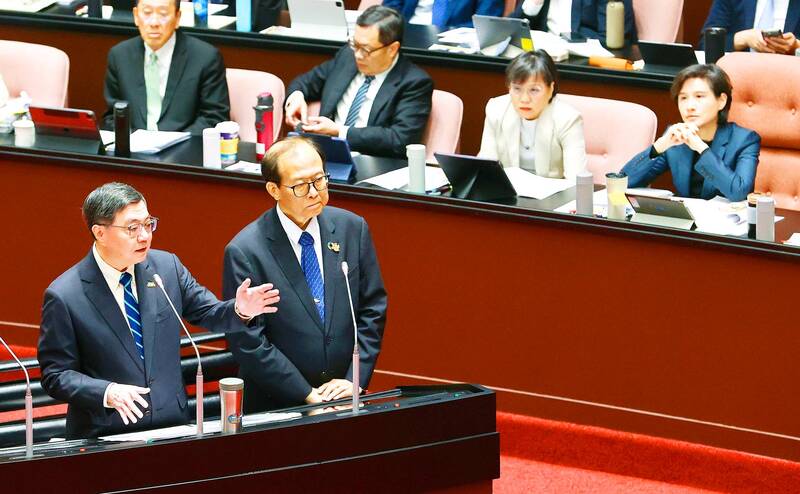
Photo: Liao Chen-huei, Taipei Times
Speaking during a legislative session in Taipei, Cho criticized the schedule as provocative.
“April 7 is Taiwan’s Freedom of Speech Day, yet she is traveling to a country without freedom of speech,” Cho said. “This timing, arranged by the other side, is clearly meant to touch a raw nerve domestically.”
The premier also warned the KMT against acceding to Beijing’s political framework.
If Cheng approaches any dialogue supporting the so-called “1992 consensus” and Beijing’s “one China” principle, it would be detrimental to Taiwan’s national interests, he said.
Polling consistently shows that Taiwanese do not accept the “1992 consensus,” nor does the international community universally subscribe to Beijing’s “one China” principle, Cho added.
He was responding to Cheng’s comments the day before that “the entire world follows the ‘one China’ policy and does not support Taiwanese independence.”
The so-called “1992 consensus” — a term that former Mainland Affairs Council (MAC) chairman Su Chi (蘇起) in 2006 admitted making up in 2000 — refers to a tacit understanding between the KMT and the Chinese Communist Party (CCP) that both sides of the Taiwan Strait acknowledge that there is “one China,” with each side having its own interpretation of what “China” means.
MAC Minister Chiu Chui-cheng (邱垂正) echoed the premier’s concerns, urging the KMT delegation to defend Taiwan’s sovereignty and avoid falling into the CCP’s “united front” trap.
Accepting Beijing’s narrative would only divide Taiwanese society, damage national morale and send misleading signals to the global community, Chiu said.
Cho and Chiu reminded the KMT that any cross-strait interactions must strictly adhere to the Act Governing Relations Between the People of the Taiwan Area and the Mainland Area (臺灣地區與大陸地區人民關係條例), under which unauthorized political agreements with China are prohibited, and contraventions could result in up to five years in prison.
Democratic Progressive Party Legislator Chiu Yi-ying (邱議瑩) questioned the trip’s transparency, saying that the sudden invitation coincides with the legislature’s review of the defense budget and expressions of concern from the US.
Demanding transparency regarding the delegation’s roster, she expressed concern over whether members of the legislature’s Foreign Affairs and National Defense Committee would participate and potentially compromise classified information.
“My worry is not about what agreements she might sign, but that she is going there to receive orders from Xi to continue disrupting the government and weakening Taiwan’s national defense,” she said.

Yangmingshan National Park authorities yesterday urged visitors to respect public spaces and obey the law after a couple was caught on a camera livestream having sex at the park’s Qingtiangang (擎天崗) earlier in the day. The Shilin Police Precinct in Taipei said it has identified a suspect and his vehicle registration number, and would summon him for questioning. The case would be handled in accordance with public indecency charges, it added. The couple entered the park at about 11pm on Thursday and began fooling around by 1am yesterday, the police said, adding that the two were unaware of the park’s all-day live
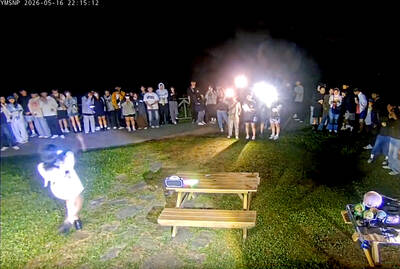
Yangmingshan National Park’s Qingtiangang (擎天崗) nature area has gone viral after a park livestream camera observed a couple in the throes of intimate congress, which was broadcast live on YouTube, drawing large late-night crowds and sparking a backlash over noise, bright lights and disruption to wildlife habitat. The area’s livestream footage appeared to show a couple engaging in sexual activity on a picnic table in the park on Friday last week, with the uncensored footage streamed publicly online. The footage quickly spread across social media, prompting a tide of visitors to travel to the site to “check in” and recreate the

Fast food chain McDonald's is to raise prices by up to NT$5 on some products at its restaurants across Taiwan, starting on Wednesday next week, the company announced today. The prices of all extra value meals and sharing boxes are to increase by NT$5, while breakfast combos and creamy corn soup would go up by NT$3, the company said in a statement. The price of the main items of those meals, if ordered individually, would remain the same. Meanwhile, the price of a medium-sized lemon iced tea and hot cappuccino would rise by NT$3, extra dipping sauces for chicken nuggets would go up

Minister of Digital Affairs Lin Yi-ching (林宜敬) yesterday cited regulatory issues and national security concerns as an expert said that Taiwan is among the few Asian regions without Starlink. Lin made the remarks on Facebook after funP Innovation Group chief executive officer Nathan Chiu (邱繼弘) on Friday said Taiwan and four other countries in Asia — China, North Korea, Afghanistan and Syria — have no access to Starlink. Starlink has become available in 166 countries worldwide, including Ukraine, Malaysia, the Philippines and Vietnam, in the six years since it became commercial, he said. While China and North Korea block Starlink, Syria is not


 RSS
RSS