


The Sunflower movement prompted Taiwanese to re-examine the dangers of overrelying on the Chinese market and the shift toward participation in the global trade system, which paved the way for economic growth and societal stability, President William Lai (賴清德) said yesterday, on the 12th anniversary of the movement.
Lai made the remarks at the Democratic Progressive Party’s (DPP) Central Standing Committee meeting yesterday, party spokeswoman Han Ying (韓瑩) said after the meeting.
March 16 is the 36th anniversary of the Wild Lily Student Movement in 1990, which drove the full re-election of the legislature and paved the way for the direct popular presidential election in 1996, she cited Lai as saying.
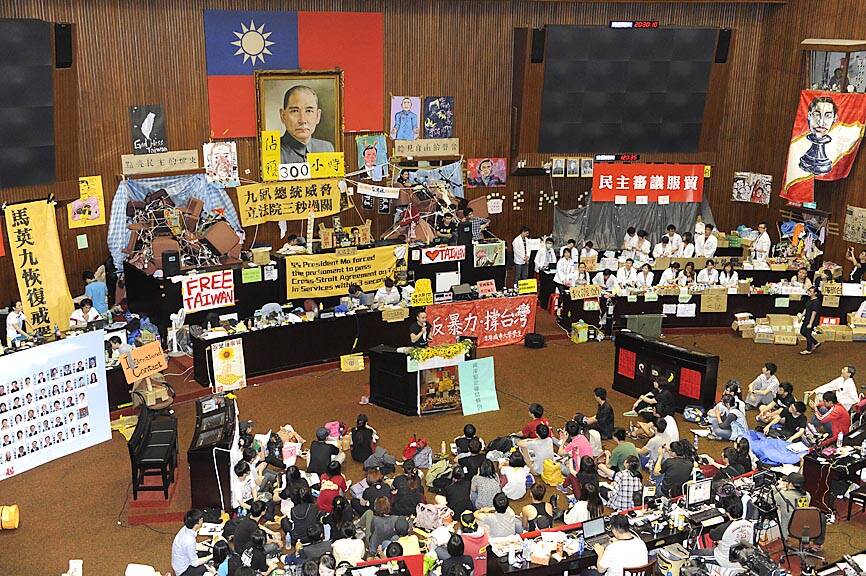
Photo: Chen Chih-chu, Taipei Times
Taiwan achieved its first peaceful transfer of power between political parties in 2000, establishing that “the people are the masters of the nation,” he said.
The Sunflower movement, which began on March 18, 2014, and the courage of the students and civil society stopped Chinese Nationalist Party (KMT) lawmakers from rushing the approval of a cross-strait trade agreement, forcing a national conversation on Taiwan’s economic trajectory, Lai said.
Before the movement, the KMT administration had closely tied Taiwan’s economy to China, causing the country’s economic development to grind to a halt, he said, adding that the DPP’s decade of governance has pushed for businesses to “stay rooted in Taiwan while expanding and investing globally.”
This strategy helped Taiwan break free from depending on China and to reach out to the world, allowing development to become more multifaceted and resilient, and resulting in a flourishing and robust economy, Lai said.
Separately, the DPP wrote on social media that by reflecting on history, the value of Taiwan’s hard-won freedom becomes even more apparent, adding that the party remains committed to standing alongside the people in defending the nation’s way of life.
The movement helped Taiwan steer clear of deeper economic integration and dependence on China, allowing it to preserve its industrial edge and economic safety as global supply chains shifted, it said, adding that the DPP vows to never let the nation’s economy and security return to the old path of being shackled to China again.
National Security Council Deputy Secretary-General Lin Fei-fan (林飛帆), a prominent leader of the Sunflower movement, in a social media post thanked the people who participated in the movement, saying it helped to reshape Taiwan’s economic and international trajectory.
The nation shifted from a China-oriented export structure — which accounted for 83.8 percent of exports in 2014 — to a more diverse model, lowering Chinese exports to 3.75 percent and expanding trade with the US, the EU, Japan and Southeast Asia, he said.
This diversification has helped sustain Taiwan’s economic growth and mitigate the impact of China’s economic slowdown, Lin said.
Monday next week would mark the 30th anniversary of Taiwan’s first direct presidential election, he said, adding that the milestone reflects the progress of the nation’s democracy.
Despite ongoing domestic political divisions and external pressure from China, Taiwan should remain proactive and confident in its ability to contribute to the international community, an approach supported by the DPP and Lai, he added.
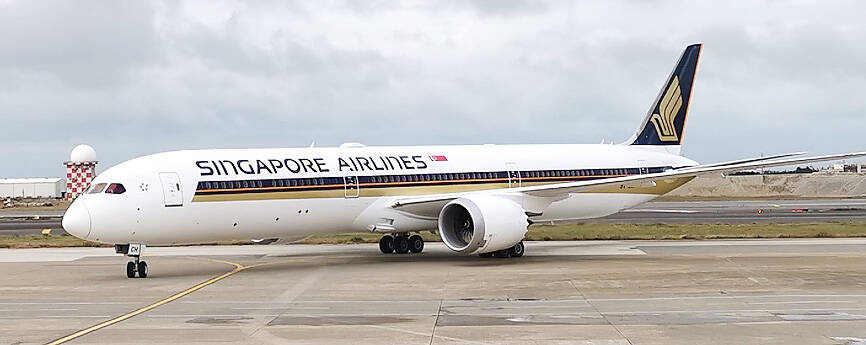
INCREASED CAPACITY: The flights on Mondays, Wednesdays, Fridays and Sundays would leave Singapore in the morning and Taipei in the afternoon Singapore Airlines is adding four supplementary flights to Taipei per week until May to meet increased tourist and business travel demand, the carrier said on Friday. The addition would raise the number of weekly flights it operates to Taipei to 18, Singapore Airlines Taiwan general manager Timothy Ouyang (歐陽漢源) said. The airline has recorded a steady rise in tourist and business travel to and from Taipei, and aims to provide more flexible travel arrangements for passengers, said Ouyang, who assumed the post in July last year. From now until Saturday next week, four additional flights would depart from Singapore on Monday, Wednesday, Friday
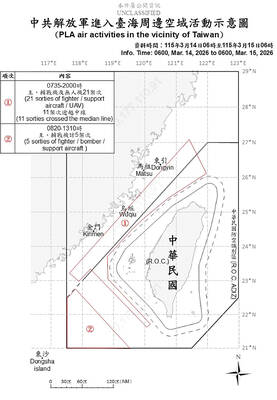
The Ministry of National Defense yesterday reported the return of large-scale Chinese air force activities after their unexplained absence for more than two weeks, which had prompted speculation regarding Beijing’s motives. China usually sends fighter jets, drones and other military aircraft around the nation on a daily basis. Interruptions to such routine are generally caused by bad weather. The Ministry of National Defense said it had detected 26 Chinese military aircraft in the Taiwan Strait over the previous 24 hours. It last reported that many aircraft on Feb. 25, when it spotted 30 aircraft, saying Beijing was carrying out another “joint combat

Taiwan successfully defended its women’s 540 kilogram title and won its first-ever men’s 640 kg title at the 2026 World Indoor Tug of War Championships in Taipei yesterday. In the women’s event, Taiwan’s eight-person squad reached the final following a round-robin preliminary round and semifinals featuring teams from Ukraine, Japan, Thailand, Vietnam, the Basque Country and South Korea. In the finals, they swept the Basque team 2-0, giving the team composed mainly of National Taiwan Normal University students and graduates its second championship in a row, and its fourth in five years. Team captain
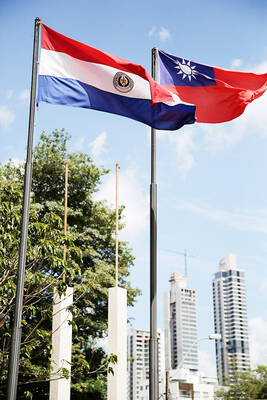
When Paraguayan opposition lawmaker Leidy Galeano returned from an all-expenses-paid tour of six Chinese cities late last year, she was convinced Paraguay risked missing out on major economic gains by sticking with longtime ally Taipei over Beijing — a message that participants on the trip heard repeatedly from Chinese officials. “Everything I saw there, I wanted for my country,” said Galeano, a member of the newly-formed Yo Creo party whose senior figures have spoken favorably about China. This trip and others like it — which people familiar with the visits said were at the invitation of the Chinese consulate in Sao Paulo


 RSS
RSS