


Taiwan Outstanding Women in Science Awards held an award ceremony in Taipei yesterday, highlighting achievements by the country’s female scientists.
The “Outstanding Researcher Award” was presented to Chang Zee-fen (張智芬), a chair professor at National Taiwan University (NTU) College of Medicine Institute of Molecular Medicine.
NTU Department of Pharmacy assistant professor Cheng Chi-an (程吉安) and National Yang Ming Chiao Tung University assistant professor Yuan Wei-chien (袁維謙) received the Young Scientist of Excellence Award (新秀 獎).
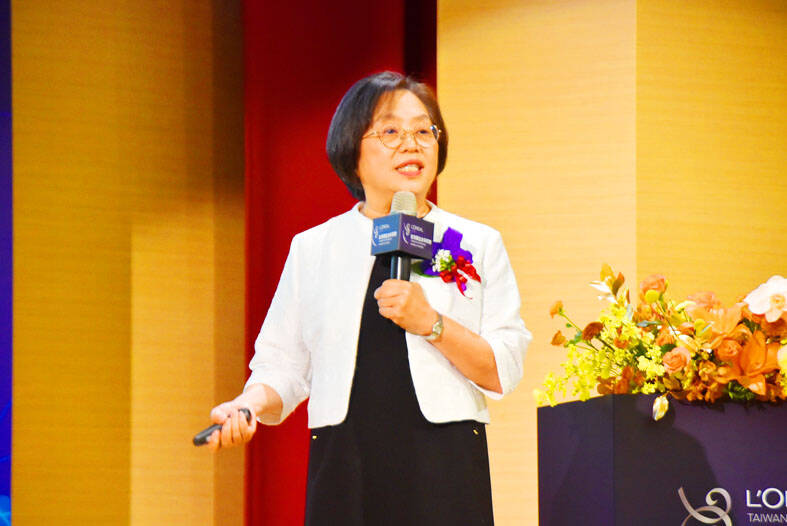
Photo: Wu Po-hsuan, Taipei Times
Co-founded by L’Oreal Taiwan and the Wu Chien- Shiung Education Foundation in 2007, Taiwan Outstanding Women in Science Awards have been called Taiwan’s Nobel Prize for women.
Each year, one recipient is chosen for the Outstanding Researcher Award and two for the Young Scientist of Excellence Award.
This year, Chang was honored for her contributions to the field of nucleotide metabolism and to research on how dysfunctional mitochondria affect the repair of nuclear genes.
Chang said that while many people are frustrated by failures during the research process, she believes the unknown mysteries of science are intriguing.
She also encourages her students to explore things outside of science.
Cheng was recognized for leading her lab in establishing Taiwan’s first exosome ultrasensitive single-molecule protein spatial analysis platform (eSimoa).
She is currently working on applying exosomes to the diagnosis and treatment of cancer.
Cheng, a chemistry graduate who once worked at Taiwan Semiconductor Manufacturing Co. and later as a patent engineer at another company, said her cross-disciplinary experience broadened her imagination in later scientific research.
“Life is a vast wilderness, not a track,” she added, encouraging students to explore without needing to find the right direction on the first try.
Yuan, meanwhile, led her team in identifying the key gene and signal transport path involved in liver cell regeneration and liver tumor formation.
She also led an international team to uncover the molecular mechanism that promotes liver injury reprogramming.
Comparing conducting research to running a marathon, Yuan said as long as researchers keep going, they can overcome all barriers and find their own way.

Yangmingshan National Park authorities yesterday urged visitors to respect public spaces and obey the law after a couple was caught on a camera livestream having sex at the park’s Qingtiangang (擎天崗) earlier in the day. The Shilin Police Precinct in Taipei said it has identified a suspect and his vehicle registration number, and would summon him for questioning. The case would be handled in accordance with public indecency charges, it added. The couple entered the park at about 11pm on Thursday and began fooling around by 1am yesterday, the police said, adding that the two were unaware of the park’s all-day live

A former soldier and an active-duty army officer were yesterday indicted for allegedly selling classified military training materials to a Chinese intelligence operative for a total of NT$79,440. The Taipei District Prosecutors’ Office indicted Chen Tai-yin (陳泰尹) and Lee Chun-ta (李俊達) for contravening the National Security Act (國家安全法) and the Anti-Corruption Act (貪污治罪條例). Chen left the military in September 2013 after serving alongside then-staff sergeant Lee, now an army lieutenant, at the 21st Artillery Command of the army’s Sixth Corps from 2011 to 2013, according to the indictment. Chen met a Chinese intelligence operative identified as “Wang” (王) through a friend in November
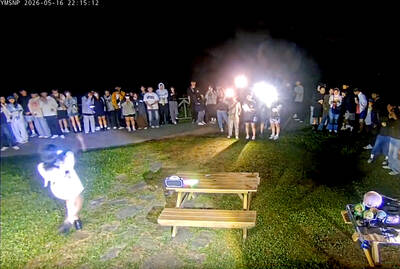
Yangmingshan National Park’s Qingtiangang (擎天崗) nature area has gone viral after a park livestream camera observed a couple in the throes of intimate congress, which was broadcast live on YouTube, drawing large late-night crowds and sparking a backlash over noise, bright lights and disruption to wildlife habitat. The area’s livestream footage appeared to show a couple engaging in sexual activity on a picnic table in the park on Friday last week, with the uncensored footage streamed publicly online. The footage quickly spread across social media, prompting a tide of visitors to travel to the site to “check in” and recreate the

Minister of Digital Affairs Lin Yi-ching (林宜敬) yesterday cited regulatory issues and national security concerns as an expert said that Taiwan is among the few Asian regions without Starlink. Lin made the remarks on Facebook after funP Innovation Group chief executive officer Nathan Chiu (邱繼弘) on Friday said Taiwan and four other countries in Asia — China, North Korea, Afghanistan and Syria — have no access to Starlink. Starlink has become available in 166 countries worldwide, including Ukraine, Malaysia, the Philippines and Vietnam, in the six years since it became commercial, he said. While China and North Korea block Starlink, Syria is not


 RSS
RSS