


Taiwanese-American outfielder Stuart Fairchild, whose powerhouse performance at this year’s World Baseball Classic (WBC) helped propel the national team to key victories, has revealed that he has indigenous roots.
The 29-year-old Seattle-born hitter, affectionately nicknamed “Fei-zai” (費仔) by local fans, emerged as a national hero at the Tokyo Dome after hitting two home runs to help secure wins for Taiwan at the WBC.
While Fairchild’s heritage was previously described as being half-Taiwanese through his mother, who immigrated from Taichung to the US at age 12, a deeper family history recently came to light.

Photo: AFP
During a celebratory dinner hosted by his agency, his mother shared that his maternal grandmother is a Pangcah (Amis) woman from Hualien County.
Fairchild said the overwhelming support from Taiwanese crowds — characterized by choreographed chants and rhythmic drumming — offered a sense of belonging he had not anticipated.
The Cleveland Guardians outfielder, who has returned to the US to prepare for the upcoming MLB season, said through his agency that the experience was an “unforgettable journey.”
He expressed a profound emotional bond with the nation and said he would be “extremely interested and absolutely willing” to represent the national team again in the future.
Beyond his professional commitments, Fairchild said he is already planning a return trip to Taiwan during the off-season for a homecoming journey.
The visit would allow him to explore his grandmother’s ancestral lands and better understand his Amis heritage, he said.

Yangmingshan National Park authorities yesterday urged visitors to respect public spaces and obey the law after a couple was caught on a camera livestream having sex at the park’s Qingtiangang (擎天崗) earlier in the day. The Shilin Police Precinct in Taipei said it has identified a suspect and his vehicle registration number, and would summon him for questioning. The case would be handled in accordance with public indecency charges, it added. The couple entered the park at about 11pm on Thursday and began fooling around by 1am yesterday, the police said, adding that the two were unaware of the park’s all-day live
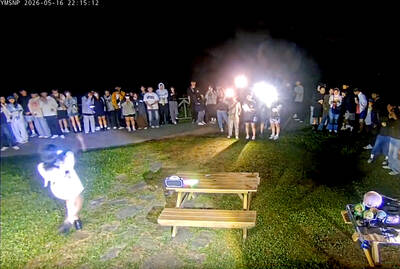
Yangmingshan National Park’s Qingtiangang (擎天崗) nature area has gone viral after a park livestream camera observed a couple in the throes of intimate congress, which was broadcast live on YouTube, drawing large late-night crowds and sparking a backlash over noise, bright lights and disruption to wildlife habitat. The area’s livestream footage appeared to show a couple engaging in sexual activity on a picnic table in the park on Friday last week, with the uncensored footage streamed publicly online. The footage quickly spread across social media, prompting a tide of visitors to travel to the site to “check in” and recreate the

Fast food chain McDonald's is to raise prices by up to NT$5 on some products at its restaurants across Taiwan, starting on Wednesday next week, the company announced today. The prices of all extra value meals and sharing boxes are to increase by NT$5, while breakfast combos and creamy corn soup would go up by NT$3, the company said in a statement. The price of the main items of those meals, if ordered individually, would remain the same. Meanwhile, the price of a medium-sized lemon iced tea and hot cappuccino would rise by NT$3, extra dipping sauces for chicken nuggets would go up

Minister of Digital Affairs Lin Yi-ching (林宜敬) yesterday cited regulatory issues and national security concerns as an expert said that Taiwan is among the few Asian regions without Starlink. Lin made the remarks on Facebook after funP Innovation Group chief executive officer Nathan Chiu (邱繼弘) on Friday said Taiwan and four other countries in Asia — China, North Korea, Afghanistan and Syria — have no access to Starlink. Starlink has become available in 166 countries worldwide, including Ukraine, Malaysia, the Philippines and Vietnam, in the six years since it became commercial, he said. While China and North Korea block Starlink, Syria is not


 RSS
RSS