


Having a prostate-specific antigen (PSA) test result above 4.0 ng/mL is considered abnormal and it is worth closer testing, a physician said yesterday, as he suggested individuals with a family history of prostate cancer begin regular screening from an earlier age.
A 42-year-old man, surnamed Chen (陳), was tested with a PSA level of 5.4 ng/mL more than a year ago, but he did not experience any discomfort, while other tests, including a digital rectal examination, showed no signs of prostate inflammation, but a ultrasound showed a mildly enlarged prostate with a small nodule of about 7.9mm, Shu Tien Clinic Department of Urology director Chou Ku (周固) said.
In a follow-up visit, Chen’s PSA level was tested to be even higher at 5.57 ng/mL and his free PSA level was 13 percent, so the doctor suggested he get a biopsy to investigate the condition, but he refused, Chou said.

Photo: CNA
Chen was again tested with a higher PSA level of 5.29ng/mL in the next follow-up visit, and he agreed to get a biopsy, confirming it was prostate cancer, Chou said, adding that he was referred to a larger hospital for radical prostatectomy and radiation therapy.
Prostate cancer is generally found in men aged 65 or older, while the incidence rate for men aged 40 to 44 is approximately two to five per 100,000 men and lower than one per 100,000 in men aged younger than 40, he said.
However, men with a family history or lifestyle risk factors, including smoking or high consumption of alcohol or processed meat, risk of developing the disease at a younger age, he added.
“Prostate cancer in younger men tends to be more aggressive, faster-growing and poses a higher risk of spreading [metastasis],” Chou said
Younger people have more remaining life expectancy, so active treatment is recommended, he added.
Chou said most early-stage prostate cancers do not have any symptoms and when they do, they often share similar symptoms with benign prostatic hyperplasia (BPH, noncancerous prostate enlargement), such as frequent urination (particularly at night) or weak urine flow.
Tested with a high level of PSA does not necessarily indicate the presence of prostate cancer, as benign conditions such as BPH, inflammation, infection or sexual activity might affect PSA levels, so getting examinations for confirmation is recommended, he said.
Meanwhile, men with a family history — particularly if a first-degree relative (father or brother) has had the disease — are recommended to start getting PSA tests regularly from 10 years before the age that their family member was diagnosed with it and avoid lifestyle risk factors to better prevent prostate cancer, Chou said.

LOUD AND PROUD Taiwan might have taken a drubbing against Australia and Japan, but you might not know it from the enthusiasm and numbers of the fans Taiwan might not be expected to win the World Baseball Classic (WBC) but their fans are making their presence felt in Tokyo, with tens of thousands decked out in the team’s blue, blowing horns and singing songs. Taiwanese fans have packed out the Tokyo Dome for all three of their games so far and even threatened to drown out home team supporters when their team played Japan on Friday. They blew trumpets, chanted for their favorite players and had their own cheerleading squad who dance on a stage during the game. The team struggled to match that exuberance on the field, with
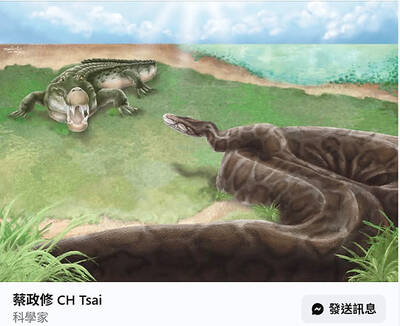
Taiwanese paleontologists have discovered fossil evidence that pythons up to 4m long inhabited Taiwan during the Pleistocene epoch, reporting their findings in the international scientific journal Historical Biology. National Taiwan University (NTU) Institute of Ecology and Evolutionary Biology associate professor Tsai Cheng-hsiu (蔡政修) led the team that discovered the largest snake fossil ever found in Taiwan. The single trunk vertebra was discovered in Tainan at the Chiting Formation, dated to between 400,000 and 800,000 years ago in the Middle Pleistocene, the paper said. The area also produced Taiwan’s first avian fossil, as well as crocodile, mammoth, saber-toothed cat and rhinoceros fossils, it said. Discoveries

Taiwanese paleontologists have discovered fossil evidence that pythons up to 4m long inhabited Taiwan during the Pleistocene epoch, reporting their findings in the international scientific journal Historical Biology. National Taiwan University (NTU) Institute of Ecology and Evolutionary Biology associate professor Tsai Cheng-hsiu (蔡政修) led the team that discovered the largest snake fossil ever found in Taiwan. A single trunk vertebra was discovered in Tainan at the Chiting Formation, dated to between 800,000 to 400,000 years ago in the Middle Pleistocene, the paper said. The area also produced Taiwan’s first avian fossil, as well as crocodile, mammoth, sabre-toothed cat and rhinoceros fossils, it said. Discoveries

Whether Japan would help defend Taiwan in case of a cross-strait conflict would depend on the US and the extent to which Japan would be allowed to act under the US-Japan Security Treaty, former Japanese minister of defense Satoshi Morimoto said. As China has not given up on the idea of invading Taiwan by force, to what extent Japan could support US military action would hinge on Washington’s intention and its negotiation with Tokyo, Morimoto said in an interview with the Liberty Times (sister paper of the Taipei Times) yesterday. There has to be sufficient mutual recognition of how Japan could provide


 RSS
RSS