


A proposed revision of military physical classifications is still under review, the Ministry of the Interior (MOI) said yesterday, amid criticism that the rules violate human rights by reclassifying transgender people as subject to alternative military service, rather than granting an exemption.
The Ministry of National Defense (MND) in December last year announced that it would change physical classification standards for conscripts, after news broke of several celebrities evading military service by presenting forged medical documents.
The National Human Rights Commission previously raised concerns that these revisions would require transgender people — who have until now been exempt — to undergo alternate military service.
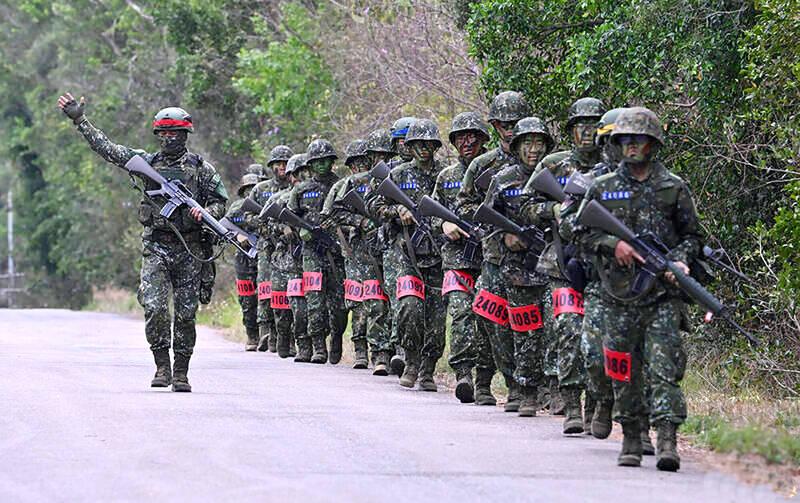
Photo: Taipei Times
These changes could undermine human rights, as examinations, physical classification processes, basic training and assignments lack gender-friendly protections, the commission said.
Transgender people at Chenggong Ling (成功嶺) military training camp face communal living arrangements, a male-centered management model and are forced to expose their bodies, Taiwan People’s Party Legislator Liu Shu-bin (劉書彬) said.
Over the course of this year, doctors would assess whether individual cases are suitable for alternative service or should be exempt, and transgender-friendly accommodations at Chenggong Ling would be improved, Minister of the Interior Liu Shyh-fang (劉世芳) said yesterday.
The defense and interior ministries are jointly handling revisions to the physical classification standards, with the Ministry of Health and Welfare, medical associations and human rights groups participating to ensure medical expertise, fairness and human rights protections, the MOI said in a news release.
When the physical classification standards were revised in 2006, the exemption rate was 8 percent, but now it is 16 percent, the interior ministry said.
The government has been reviewing the fairness of military conscription and considering other countries’ policies, such as Singapore with an exemption rate of 3 percent and Korea and Israel with exemption rates of 5 percent, the ministry said.
It would continue to consider the views of medical professionals and gender rights groups, and work with the MND to balance human rights with fairness, it said.
Alternative service classifications would be further divided by service type and nature, so that placements better match conscripts’ physical conditions and practical needs, it added.
The government would also strengthen gender-friendly environments and ensure healthcare and medical safety for conscripts during training, MOI said.
Measures include assessing conscripts’ needs before entry, improving facilities and management during basic training, expanding gender equality and human rights training for officers, and refining service arrangements and supporting measures, an MOI official said.

Yangmingshan National Park authorities yesterday urged visitors to respect public spaces and obey the law after a couple was caught on a camera livestream having sex at the park’s Qingtiangang (擎天崗) earlier in the day. The Shilin Police Precinct in Taipei said it has identified a suspect and his vehicle registration number, and would summon him for questioning. The case would be handled in accordance with public indecency charges, it added. The couple entered the park at about 11pm on Thursday and began fooling around by 1am yesterday, the police said, adding that the two were unaware of the park’s all-day live
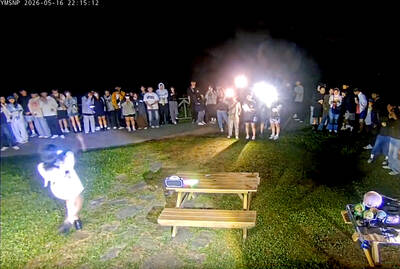
Yangmingshan National Park’s Qingtiangang (擎天崗) nature area has gone viral after a park livestream camera observed a couple in the throes of intimate congress, which was broadcast live on YouTube, drawing large late-night crowds and sparking a backlash over noise, bright lights and disruption to wildlife habitat. The area’s livestream footage appeared to show a couple engaging in sexual activity on a picnic table in the park on Friday last week, with the uncensored footage streamed publicly online. The footage quickly spread across social media, prompting a tide of visitors to travel to the site to “check in” and recreate the

A former soldier and an active-duty army officer were yesterday indicted for allegedly selling classified military training materials to a Chinese intelligence operative for a total of NT$79,440. The Taipei District Prosecutors’ Office indicted Chen Tai-yin (陳泰尹) and Lee Chun-ta (李俊達) for contravening the National Security Act (國家安全法) and the Anti-Corruption Act (貪污治罪條例). Chen left the military in September 2013 after serving alongside then-staff sergeant Lee, now an army lieutenant, at the 21st Artillery Command of the army’s Sixth Corps from 2011 to 2013, according to the indictment. Chen met a Chinese intelligence operative identified as “Wang” (王) through a friend in November

Minister of Digital Affairs Lin Yi-ching (林宜敬) yesterday cited regulatory issues and national security concerns as an expert said that Taiwan is among the few Asian regions without Starlink. Lin made the remarks on Facebook after funP Innovation Group chief executive officer Nathan Chiu (邱繼弘) on Friday said Taiwan and four other countries in Asia — China, North Korea, Afghanistan and Syria — have no access to Starlink. Starlink has become available in 166 countries worldwide, including Ukraine, Malaysia, the Philippines and Vietnam, in the six years since it became commercial, he said. While China and North Korea block Starlink, Syria is not


 RSS
RSS