


The Executive Yuan’s proposal to allocate NT$1.25 trillion (US$39.3 billion) for defense over eight years is reasonable, especially compared with the defense budgets of Japan and South Korea, President William Lai (賴清德) said yesterday.
Speaking during a visit to Jieyun Temple (接雲寺) in New Taipei City, Lai compared increased defense spending to installing security systems at home to prevent burglaries.
With a “bad neighbor” like China, strengthening national defense is essential, he said, calling on the public to unite in safeguarding national security.
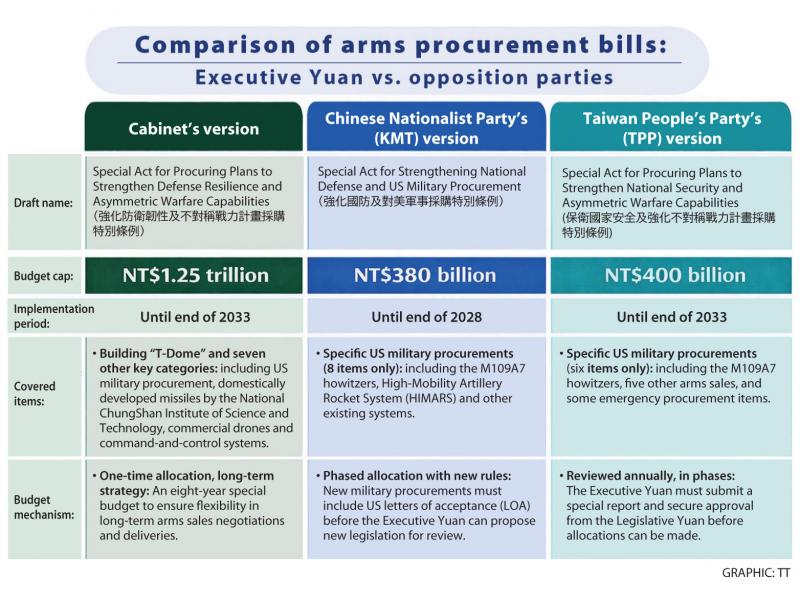
The Executive Yuan’s version of the proposed defense special budget was referred to committee on Thursday after being blocked for more than three months by the Chinese Nationalist Party (KMT) and the Taiwan People’s Party (TPP).
Both opposition parties have introduced their own versions of the budget, with proposed funding levels less than one-third of the Executive Yuan’s proposal.
Lai said the Executive Yuan’s plan would enable the armed forces to acquire improved weapons and systems to better safeguard national and social security. Spread over eight years, the proposal would amount to only NT$156 billion per year, he said.
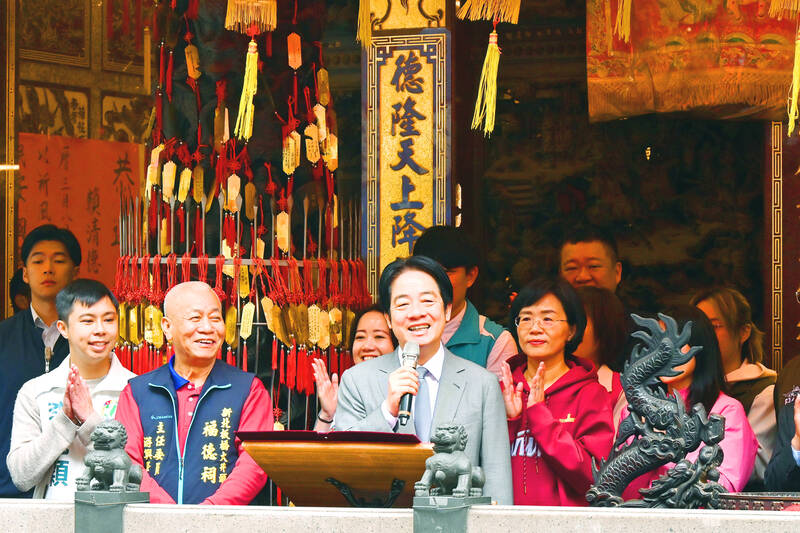
Photo: George Tsorng, Taipei Times
“Because our economy is improving and tax revenues are increasing, we absolutely have the ability” to make such arrangements, Lai said. “In comparison, South Korea’s defense budget this year is also about NT$1.4 trillion, while Japan’s is about NT$1.8 trillion.”
In related developments, the Legislative Yuan is to hold elections on Wednesday for conveners of its eight standing committees. The Foreign Affairs and National Defense Committee is widely seen by the ruling and opposition camps as a key battleground, as it reviews issues related to US-Taiwan tariffs and the proposed special defense budget.
According to committee member lists submitted by the Democratic Progressive Party (DPP) and the KMT, both parties have increased their representation on the committee by one to two seats.
The committee is expected to comprise seven DPP lawmakers, seven KMT lawmakers and one TPP lawmaker, raising the possibility that Legislative Speaker Han Kuo-yu (韓國瑜) could personally attend meetings to cast a vote.
According to the submitted lists, DPP members would include Wang Ting-yu (王定宇), Chen Kuan-ting (陳冠廷), Chen Chun-yu (陳俊宇), Lo Mei-ling (羅美玲), Lin Chu-yin (林楚茵), Puma Shen (沈伯洋) and Wang Yi-chuan (王義川).
KMT members would include Han, Ma Wen-chun (馬文君), Hsu Chiao-hsin (徐巧芯), Chen Yeong-kang (陳永康), Huang Jen (黃仁), Niu Hsu-ting (牛煦庭) and Huang Chien-pin (黃建賓).
The TPP has assigned deputy caucus whip Wang An-hsiang (王安祥) to the committee.
During the previous four legislative sessions, the committee comprised six DPP lawmakers, five KMT lawmakers and one TPP lawmaker. Although Han and Legislative Yuan Deputy Speaker Johnny Chiang (江啟臣) were listed as members, they did not participate in committee operations in accordance with legislative convention.
Chen Kuan-ting, who is expected to be selected as one of the committee’s new conveners, said in an interview that the DPP increased its representation in hopes of strengthening policy discussions and professional review at a time when national security concerns and international developments are rapidly evolving.
The committee handles not only military affairs, but international developments, foreign cooperation and efforts to strengthen security resilience, he said, adding the aim is to ensure national security policies receive comprehensive and professional deliberation.

The military has spotted two Chinese warships operating in waters near Penghu County in the Taiwan Strait and sent its own naval and air forces to monitor the vessels, the Ministry of National Defense (MND) said. Beijing sends warships and warplanes into the waters and skies around Taiwan on an almost daily basis, drawing condemnation from Taipei. While the ministry offers daily updates on the locations of Chinese military aircraft, it only rarely gives details of where Chinese warships are operating, generally only when it detects aircraft carriers, as happened last week. A Chinese destroyer and a frigate entered waters to the southwest

The eastern extension of the Taipei MRT Red Line could begin operations as early as late June, the Taipei Department of Rapid Transit Systems said yesterday. Taipei Rapid Transit Corp said it is considering offering one month of free rides on the new section to mark its opening. Construction progress on the 1.4km extension, which is to run from the current terminal Xiangshan Station to a new eastern terminal, Guangci/Fengtian Temple Station, was 90.6 percent complete by the end of last month, the department said in a report to the Taipei City Council's Transportation Committee. While construction began in October 2016 with an

NON-RED SUPPLY: Boosting the nation’s drone industry is becoming increasingly urgent as China’s UAV dominance could become an issue in a crisis, an analyst said Taiwan’s drone exports to Europe grew 41.7-fold from 2024 to last year, with demand from Ukraine’s fight against Russian aggression the most likely driver of growth, a study showed. The Institute for Democracy, Society and Emerging Technology (DSET) in a statement on Wednesday said it found that many of Taiwan’s uncrewed aerial vehicle (UAV) sales were from Poland and the Czech Republic. These countries likely transferred the drones to Ukraine to aid it in its fight against the Russian invasion that started in 2022, it said. Despite the gains, Taiwan is not the dominant drone exporter to these markets, ranking second and fourth
Japanese Prime Minister Sanae Takaichi’s comment last year on Tokyo’s potential reaction to a Taiwan-China conflict has forced Beijing to rewrite its invasion plans, a retired Japanese general said. Takaichi told the Diet on Nov. 7 last year that a Chinese naval blockade or military attack on Taiwan could constitute a “survival-threatening situation” for Japan, potentially allowing Tokyo to exercise its right to collective self-defense. Former Japan Ground Self-Defense Force general Kiyofumi Ogawa said in a recent speech that the remark has been interpreted as meaning Japan could intervene in the early stages of a Taiwan Strait conflict, undermining China’s previous assumptions


 RSS
RSS