


US President Donald Trump should stand by Washington’s commitment to provide defensive weapons to Taiwan, former US ambassador to China Nicholas Burns said on Friday at a conference at George Washington University on US-China ties ahead of Trump’s planned meeting with Chinese President Xi Jinping (習近平) in Beijing from March 31 to April 2.
Taiwan is likely to be on the agenda for both leaders, he said.
“I hope that President Trump and his administration will defend the long-standing, half-century ... one-China policy and our obligations under the Taiwan Relations Act for the United States to provide defensive military technology to Taiwan to expand its deterrence ... and our obligation to keep sufficient military forces in the western Pacific to do that,” Burns said.
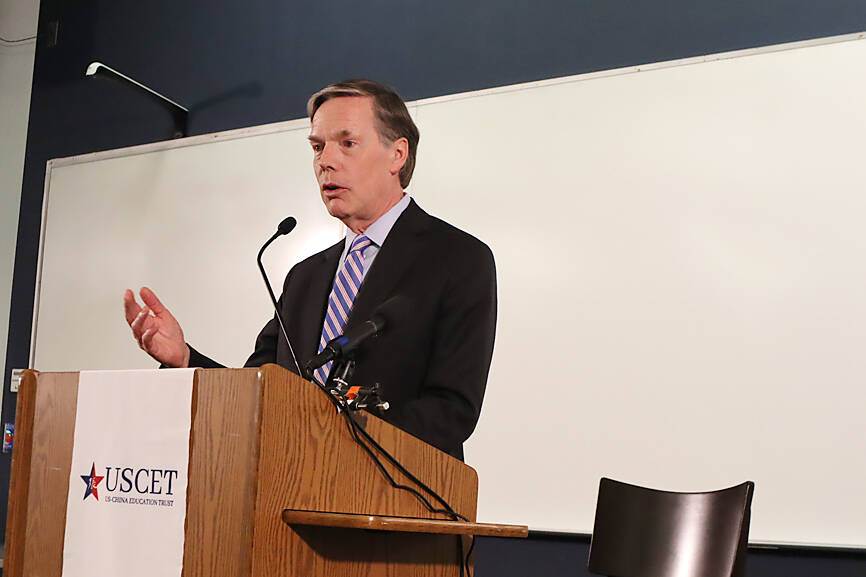
Photo: CNA
Trump should also discuss China’s support for Russia’s war in Ukraine with Xi, he said.
“China’s support for the Russian defense industrial base through the use of ... microelectronics has helped [Russian President Vladimir] Putin to conduct his brutal war in Ukraine,” he said.
The US’ agenda at the meeting with Xi should also include Beijing’s harassment of “atolls belonging to the Philippines” in the South China Sea, he said.
Burns said that the China policy framework of former US president Joe Biden was correct, as it emphasized the competition between the two countries, as well as the need to cooperate in climate change and other important global matters.
However, the strategic competition is of tantamount importance and Washington cannot afford negligence in insisting on US security interests and those of its allies, he said, adding he is concerned about Beijing’s human rights record.
China’s “outrageous” move to sentence Hong Kong media mogul Jimmy Lai (黎智英) to what is “effectively a life sentence” and the forced Sinicization of Tibetan children were evidence of a disregard for human rights by Beijing, he said.
“There are no more civil rights for ... Hong Kong,” he said, citing his experience during a personal visit to the territory last year.
China reneged on its promise to the world to respect Hong Kong’s rights and traditions, which it made before the territory’s transfer in 1997, he said.
The Chinese Communist Party is in the middle of a large-scale operation to arrest and jail Christian leaders for their religious beliefs, he said.
Citing a visit in 2024, Burns said that authorities in China are enforcing policies in Inner Mongolia, with the aim of erasing the local culture.
He said that he agrees with Trump that the US must take action to stabilize global economic unrest in conjunction with China, but that cannot be at the expense of keeping silent about human rights.
Former US ambassador to Russia Thomas Pickering told the event that the US cannot turn a blind eye to the threat China poses to Taiwan, even if the matter can seemingly be delayed.
The 1992 Shanghai Communique stipulates that Washington’s “one China” policy and a framework of dialogue that calls for regular and institutionalized exchanges between Taiwan and China, Pickering said.
Such exchanges require a degree of secrecy to keep the two sides’ differences under control, and should serve as a tool for both to seek common ground and develop their relationship, not provocation, he said.
Pickering said he does not mean that Taiwan should give up its aspiration for independence or that China should accept a situation it has long opposed, but that the two sides should find issues they can discuss.

Yangmingshan National Park authorities yesterday urged visitors to respect public spaces and obey the law after a couple was caught on a camera livestream having sex at the park’s Qingtiangang (擎天崗) earlier in the day. The Shilin Police Precinct in Taipei said it has identified a suspect and his vehicle registration number, and would summon him for questioning. The case would be handled in accordance with public indecency charges, it added. The couple entered the park at about 11pm on Thursday and began fooling around by 1am yesterday, the police said, adding that the two were unaware of the park’s all-day live

A former soldier and an active-duty army officer were yesterday indicted for allegedly selling classified military training materials to a Chinese intelligence operative for a total of NT$79,440. The Taipei District Prosecutors’ Office indicted Chen Tai-yin (陳泰尹) and Lee Chun-ta (李俊達) for contravening the National Security Act (國家安全法) and the Anti-Corruption Act (貪污治罪條例). Chen left the military in September 2013 after serving alongside then-staff sergeant Lee, now an army lieutenant, at the 21st Artillery Command of the army’s Sixth Corps from 2011 to 2013, according to the indictment. Chen met a Chinese intelligence operative identified as “Wang” (王) through a friend in November

Minister of Digital Affairs Lin Yi-ching (林宜敬) yesterday cited regulatory issues and national security concerns as an expert said that Taiwan is among the few Asian regions without Starlink. Lin made the remarks on Facebook after funP Innovation Group chief executive officer Nathan Chiu (邱繼弘) on Friday said Taiwan and four other countries in Asia — China, North Korea, Afghanistan and Syria — have no access to Starlink. Starlink has become available in 166 countries worldwide, including Ukraine, Malaysia, the Philippines and Vietnam, in the six years since it became commercial, he said. While China and North Korea block Starlink, Syria is not

Yangmingshan National Park’s Qingtiangang (擎天崗) nature area has gone viral after a park livestream camera observed a couple in the throes of intimate congress, which was broadcast live on YouTube, drawing large late-night crowds and sparking a backlash over noise, bright lights and disruption to wildlife habitat. The area’s livestream footage appeared to show a couple engaging in sexual activity on a picnic table in the park on Friday last week, with the uncensored footage streamed publicly online. The footage quickly spread across social media, prompting a tide of visitors to travel to the site to “check in” and recreate the


 RSS
RSS