


Three years after Honduras parted ways with Taiwan and forged diplomatic ties with China in hope of economic gain, shrimp farmers in the Central American country are in revolt.
Their sales to Taiwan fell to a mere US$16 million last year, down from more than US$100 million in 2022, and China did not fill the void as hoped.
“We were deceived,” said Javier Amador, executive director of the National Aquaculture Association of Honduras, as he described the promises of former Honduran president Xiomara Castro of better opportunities with China when she severed ties with Taiwan and opened an embassy in Beijing in 2023.
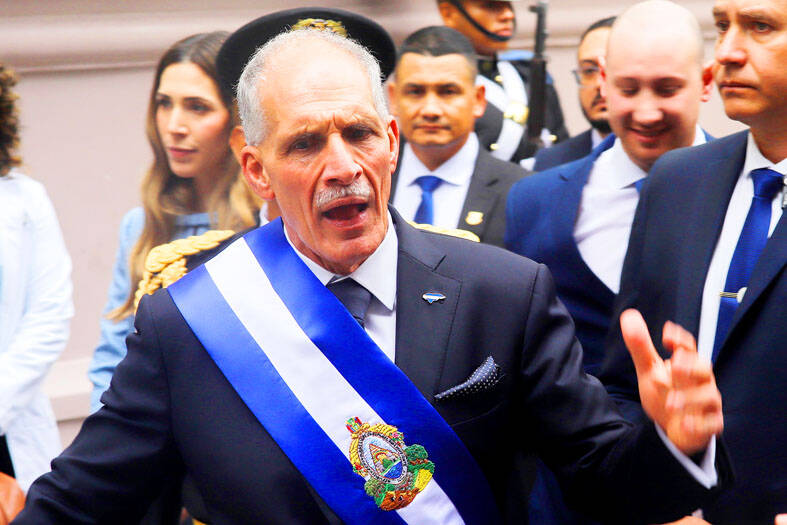
Photo: AP
Honduran President Nasry Asfura, who was elected with the backing of US President Donald Trump and sworn into office in January, has ordered a review of agreements between Tegucigalpa and Beijing. This has fueled expectations that Honduras would distance itself from China, in line with a Trump administration campaign to reduce Chinese influence and economic clout in Latin America.
Asfura is expected to join other regional leaders for a security summit Trump is hosting at his golf course near Miami today.
“Honduras is probably the most likely country in the world right now to switch diplomatic recognition back to Taiwan,” said Francisco Urdinez, an associate professor at the Political Science Institute of the Pontifical Catholic University of Chile. “President Asfura campaigned on it, he met Trump at Mar-a-Lago within days of taking office and his vice president has confirmed the government’s intention.”
However, “it’s not as simple as flipping a switch,” Urdinez said, adding that Honduras has signed more than a dozen agreements with China since 2023.
Taipei and Beijing were diplomatic in responding to questions about a potential shift in allegiance.
The Taipei Economic and Cultural Representative Office said that Taiwan would continue to advance relations with Honduras “in an open and pragmatic manner, without preconditions, and on the basis of equality and reciprocity.”
Liu Pengyu (劉鵬宇), spokesman for the Chinese embassy in Washington, said that Honduras has better prospects for its long-term development since establishing diplomatic ties with China and both countries have “reaped fruitful cooperation outcomes in various fields.”
The Honduras government has not responded to a request for comment.
Latin America’s ties with Taiwan have gained attention because they have become a barometer of the power balance between the world’s two largest economies.
Of the 12 governments that still recognize Taiwan’s statehood, seven are in Latin America: Guatemala, Paraguay and five in the Caribbean.
US Secretary of State Marco Rubio, during a visit to Guatemala last month, thanked the country for sticking with Taiwan.
“It’s not easy in a world where there is a lot of pressure to change that recognition and to break those ties, but you have always stood firm,” Rubio said, as he promised to work with Guatemala to deepen its economic ties with Taiwan.
US Representative John Moolenaar, chair of the US House of Representatives Select Committee on the Chinese Communist Party, had a similar message when hosting a delegation from Guatemala in November last year.
“While too many countries bow to the bullying of Beijing, Guatemala stands with the people of Taiwan and prospers through a strong trade relationship,” Moolenaar said. “I support Guatemala’s efforts to oppose Chinese aggression in our hemisphere and look forward to working with Guatemala on areas of common ground.”
US lawmakers have introduced a bill that could provide US$120 million over three years in assistance to Taiwan’s partners.
In 2016 and 2017, Panama, the Dominican Republic and El Salvador all switched their allegiance from Taipei to Beijing. Nicaragua flipped in 2021 and Honduras in 2023.
The loss of the Taiwanese market led to the closure of at least 95 shrimp farms and one processing plant, the loss of more than 25,000 direct and indirect jobs, and the loss of millions of dollars in foreign exchange for the Central American country, Amador said.
“Most of the companies closed in 2024 because many couldn’t ship to other markets and China hasn’t been the answer, because we’re not competitive for them,” he said.
Amador hopes that Asfura restores ties with Taiwan for the benefit of the 330 shrimp farming companies that are still operating.
“The issue of returning to Taiwan is not about recovering what we have already lost, but about whether we are going to start over to reactivate industry, improve productivity and generate foreign currency and employment,” he said.
For Asfura, who campaigned on severing ties with Beijing, there is more to untangle. China has hundreds of millions of dollars of investments in Honduras.
Enrique Millan-Mejia, senior fellow on economic development at the Atlantic Council’s Adrienne Arsht Latin America Center, said that Honduras could confer “a special status” on Taiwan and withdraw from Beijing’s global infrastructure project, the Belt and Road Initiative, which has helped the Chinese government open markets and extend its influence.
Last year, Panama became the first Latin American country to quit the Belt and Road Initiative, prompting an angry response from Beijing, which accused the US of using “pressure and coercion” to undermine the cooperation.
Urdinez said that Asfura might go further and rebuild formal ties with Taiwan.
“Asfura’s calculus is fundamentally about the US, not about Taiwan per se,” Urdinez said. “Taiwan recognition is essentially the price of admission to Trump’s good graces.”

Taiwan has received more than US$70 million in royalties as of the end of last year from developing the F-16V jet as countries worldwide purchase or upgrade to this popular model, government and military officials said on Saturday. Taiwan funded the development of the F-16V jet and ended up the sole investor as other countries withdrew from the program. Now the F-16V is increasingly popular and countries must pay Taiwan a percentage in royalties when they purchase new F-16V aircraft or upgrade older F-16 models. The next five years are expected to be the peak for these royalties, with Taiwan potentially earning
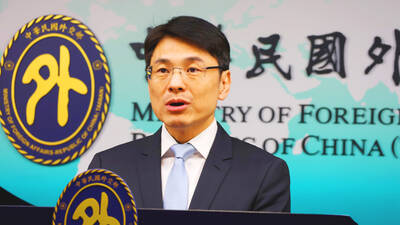
STAY IN YOUR LANE: As the US and Israel attack Iran, the ministry has warned China not to overstep by including Taiwanese citizens in its evacuation orders The Ministry of Foreign Affairs (MOFA) yesterday rebuked a statement by China’s embassy in Israel that it would evacuate Taiwanese holders of Chinese travel documents from Israel amid the latter’s escalating conflict with Iran. Tensions have risen across the Middle East in the wake of US and Israeli airstrikes on Iran beginning Saturday. China subsequently issued an evacuation notice for its citizens. In a news release, the Chinese embassy in Israel said holders of “Taiwan compatriot permits (台胞證)” issued to Taiwanese nationals by Chinese authorities for travel to China — could register for evacuation to Egypt. In Taipei, the ministry yesterday said Taiwan
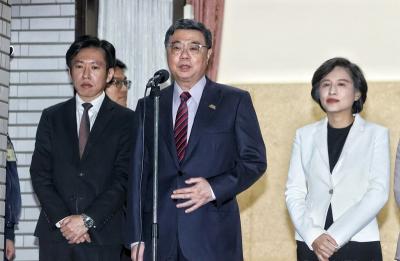
Taiwan is awaiting official notification from the US regarding the status of the Agreement on Reciprocal Trade (ART) after the US Supreme Court ruled US President Donald Trump's global tariffs unconstitutional. Speaking to reporters before a legislative hearing today, Premier Cho Jung-tai (卓榮泰) said that Taiwan's negotiation team remains focused on ensuring that the bilateral trade deal remains intact despite the legal challenge to Trump's tariff policy. "The US has pledged to notify its trade partners once the subsequent administrative and legal processes are finalized, and that certainly includes Taiwan," Cho said when asked about opposition parties’ doubts that the ART was
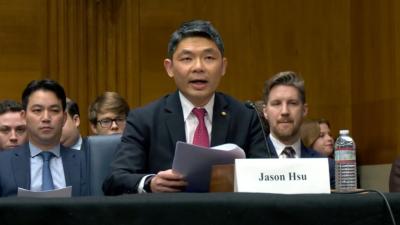
If China chose to invade Taiwan tomorrow, it would only have to sever three undersea fiber-optic cable clusters to cause a data blackout, Jason Hsu (許毓仁), a senior fellow at the Hudson Institute and former Chinese Nationalist Party (KMT) legislator, told a US security panel yesterday. In a Taiwan contingency, cable disruption would be one of the earliest preinvasion actions and the signal that escalation had begun, he said, adding that Taiwan’s current cable repair capabilities are insufficient. The US-China Economic and Security Review Commission (USCC) yesterday held a hearing on US-China Competition Under the Sea, with Hsu speaking on


 RSS
RSS