


A large Chinese military drone has conducted regular flights over the South China Sea while transmitting transponder signals that made it appear to be other aircraft, including a sanctioned Belarusian cargo plane and a British Typhoon fighter jet.
Military attaches and security analysts scrutinizing the operations say the flights represent a shift in China’s “gray zone” tactics in the contested airspace and appear to be testing possible decoy capabilities in the event of a Chinese invasion of Taiwan.
Since August last year, at least 23 flights have been logged under the call sign YILO4200, a known long-endurance Chinese military drone, but the aircraft transmitted registration numbers of other aircraft, according to analysis of data from flight-tracking Web site Flightradar24.
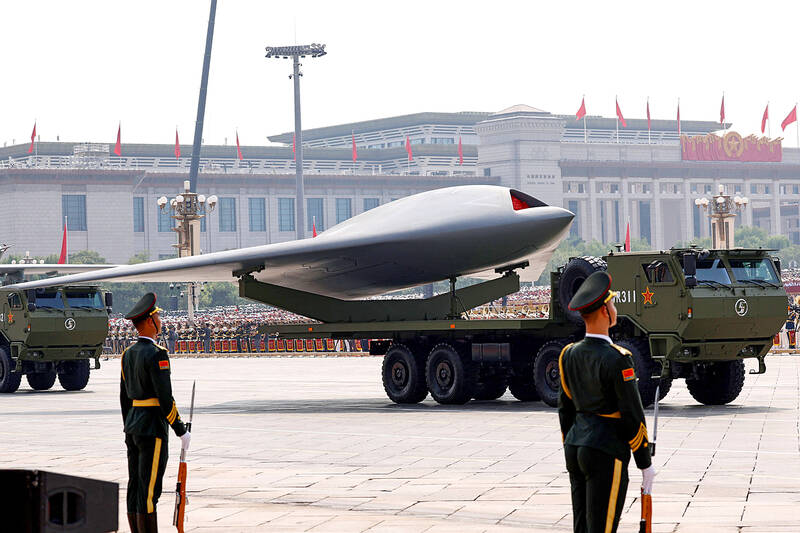
Photo: Reuters
The flight paths often head east from the Chinese province of Hainan toward the Philippines, near the disputed Paracel Islands (Xisha Islands, 西沙群島), and down Vietnam’s coast, the flight analysis showed.
The operations represent a new and elaborate element in China’s expanding presence across the South China Sea and the region as the Taiwanese military responds to Chinese Communist Party pressure, according to three regional diplomats, four open-source intelligence analysts and three security academics familiar with the flight data.
The activities include exploiting electronic warfare and deception tactics in real time, they said.
While the masking is unlikely to fully deceive air traffic controllers or military radars, it could create time-wasting confusion in a conflict, conceal sensitive surveillance activity or be used for propaganda or misinformation, they said.
“We’ve not seen anything like this before,” said Ben Lewis, founder of the open-source data platform PLATracker.
“It’s ... a kind of deception trial being carried out in real time using aircraft that are not exactly low profile. It does not appear to be at all accidental.”
China’s Ministry of National Defense did not respond to media inquiries about the flights and their purpose.
The flights have mostly appeared on Flightradar24 as an Ilyushin-62 cargo plane operated by Rada Airlines of Belarus, but also as a Royal Air Force Typhoon, a North Korean Il-62 passenger jet and an anonymous Gulfstream executive jet.
Since mid-December, YILO4200 has made several flights in northwest China, most recently on Feb. 15 when it appeared as an anonymous Pilatus PC-12, a small turboprop passenger aircraft. Aircraft registration numbers stem from a coded 24-bit address governed by the International Civil Aviation Organization (ICAO). Broadcast via transponders, the numbers help show an aircraft’s position, direction and speed.
While unique to each aircraft, the addresses are publicly known and two pilots and two analysts say recoding a transponder to give it a different registration is possible.
Rada was sanctioned by the US Office of Foreign Assets Control in August 2024 for flying cargo in and out of Africa that included Wagner Group personnel linked to the Russian military, as well as exotic wildlife trafficking.
The real Belarusian Il-62 has been active throughout the period with a different call sign and was once airborne at the same time as the Chinese drone flying under its transponder code, the Flightradar24 data showed.
Rada Airlines did not respond to a request for comment and the British Ministry of Defence said it could not comment.
An ICAO spokesperson said the body does not comment on issues or speculation concerning specific member states.
Flying out of Hainan’s Qionghai Boao International Airport, the aircraft frequently remained airborne for hours, flying geometric patterns over the same areas.
The flight profiles matched those typically associated with large military drones on surveillance operations and covered sensitive parts of the South China Sea, including areas frequented by submarines, four intelligence analysts familiar with the data said.
The Chinese military generally flies its drones “dark,” transmitting neither call signs nor registration numbers.
Two flights among the 23 reviewed by Reuters appeared to be particularly unusual: In one from Aug. 5 to Aug. 6, the drone initially transmitted a code belonging to the RAF Typhoon, then switched its signal to three other planes over about 20 minutes, eventually landing as the Rada Airlines plane.
In another, on Nov. 18, the drone was airborne purporting to be the Belarusian plane when the actual Rada Il-62 plane took off near Belarus headed for Tehran.
Security analyst Alexander Neill said the Hainan operations appeared to be a fresh tactic in a suite of Chinese digital options to “muddy the waters” should regional tensions escalate into conflict.
“They don’t appear to be exercises as much as the kind of action the US Indo-Pacific Command has described as rehearsals for a confrontation — anything the Chinese can do to sow confusion in the minds of their rivals is to their advantage,” he said.
“The US and its allies know that given the realities of highly automated conventional conflict, even milliseconds count along the kill chain of escalation,” he said
The US Department of Defense did not respond to a request for comment about the Chinese drone flights.
Lewis and other open-source analysts said the YILO4200 call sign came from a long-endurance Wing Loong 2 uncrewed aerial vehicle, an aircraft similar to the US Reaper drone, with a 20.5m wingspan.
The Wing Loong is used mainly for surveillance, but can be fitted for other tasks, including command and control operations, precision missile strikes and anti-submarine operations.
It is produced by the state-linked Chengdu Aircraft Corp. The company said it would not be commenting on the issue.
Online flight tracker Amelia Smith first connected the Wing Loong 2 to the call sign by analyzing flight data, state press reports and government announcements.
Lewis, Smith and other analysts said it was unclear which agency was operating the aircraft out of Boao Airport, which is a dual-use commercial and military facility.
Satellite images from July, September and last month obtained by Reuters show large drones on the tarmac, alongside buildings in a part of the airport being expanded.
Flightradar24 communications director Ian Petchenik said the tracker had noticed the Hainan flights and had not seen such activity before, beyond apparently accidental miscodings, non-existent addresses or corrupted data.
“Based on the flight patterns and the kind of usage of these 24-bit addresses, it doesn’t seem like it is a mistake in the programming of the transponders,” Petchenik said.
Reuters could not determine whether the flights are running on programmed paths or being controlled from the ground. The paths run through areas of heavy naval activity, including the waters south of Hainan near Chinese submarine bases and east toward the Bashi Channel between Taiwan and the Philippines — a key choke point for the Chinese navy to access the Pacific.
The route patterns suggest a rehearsal for an operation over Taiwan, Neill said.
Overlaid on a map of Taiwan, the 23 flight paths pass multiple military points of interest, concentrated on Taipei but also extending along the nation’s southern coastline. The eastern trajectories bring the aircraft close to Japanese and US bases in Okinawa and other islands in the Ryukyu chain.
“It is a compelling image — extensive rehearsals across the South China Sea to be deployed over Taiwan’s key points,” Neill said.

Yangmingshan National Park authorities yesterday urged visitors to respect public spaces and obey the law after a couple was caught on a camera livestream having sex at the park’s Qingtiangang (擎天崗) earlier in the day. The Shilin Police Precinct in Taipei said it has identified a suspect and his vehicle registration number, and would summon him for questioning. The case would be handled in accordance with public indecency charges, it added. The couple entered the park at about 11pm on Thursday and began fooling around by 1am yesterday, the police said, adding that the two were unaware of the park’s all-day live

A former soldier and an active-duty army officer were yesterday indicted for allegedly selling classified military training materials to a Chinese intelligence operative for a total of NT$79,440. The Taipei District Prosecutors’ Office indicted Chen Tai-yin (陳泰尹) and Lee Chun-ta (李俊達) for contravening the National Security Act (國家安全法) and the Anti-Corruption Act (貪污治罪條例). Chen left the military in September 2013 after serving alongside then-staff sergeant Lee, now an army lieutenant, at the 21st Artillery Command of the army’s Sixth Corps from 2011 to 2013, according to the indictment. Chen met a Chinese intelligence operative identified as “Wang” (王) through a friend in November

Yangmingshan National Park’s Qingtiangang (擎天崗) nature area has gone viral after a park livestream camera observed a couple in the throes of intimate congress, which was broadcast live on YouTube, drawing large late-night crowds and sparking a backlash over noise, bright lights and disruption to wildlife habitat. The area’s livestream footage appeared to show a couple engaging in sexual activity on a picnic table in the park on Friday last week, with the uncensored footage streamed publicly online. The footage quickly spread across social media, prompting a tide of visitors to travel to the site to “check in” and recreate the

Minister of Digital Affairs Lin Yi-ching (林宜敬) yesterday cited regulatory issues and national security concerns as an expert said that Taiwan is among the few Asian regions without Starlink. Lin made the remarks on Facebook after funP Innovation Group chief executive officer Nathan Chiu (邱繼弘) on Friday said Taiwan and four other countries in Asia — China, North Korea, Afghanistan and Syria — have no access to Starlink. Starlink has become available in 166 countries worldwide, including Ukraine, Malaysia, the Philippines and Vietnam, in the six years since it became commercial, he said. While China and North Korea block Starlink, Syria is not


 RSS
RSS