


Taipei Zoo welcomes the Lunar New Year this year through its efforts to protect an endangered species of horse native to central Asia that was once fully extinct outside of captivity.
The festival ushering in the Year of the Horse would draw attention to the zoo’s four specimens of Przewalski’s horse, named for a Russian geographer who first encountered them in the late 19th century across the steppes of western Mongolia.
“Visitors will look at the horses and think that since this is the Year of the Horse: ‘I want to get to know horses,’” said zookeeper Chen Yun-chieh, who has been responsible for care of the horses for five years.
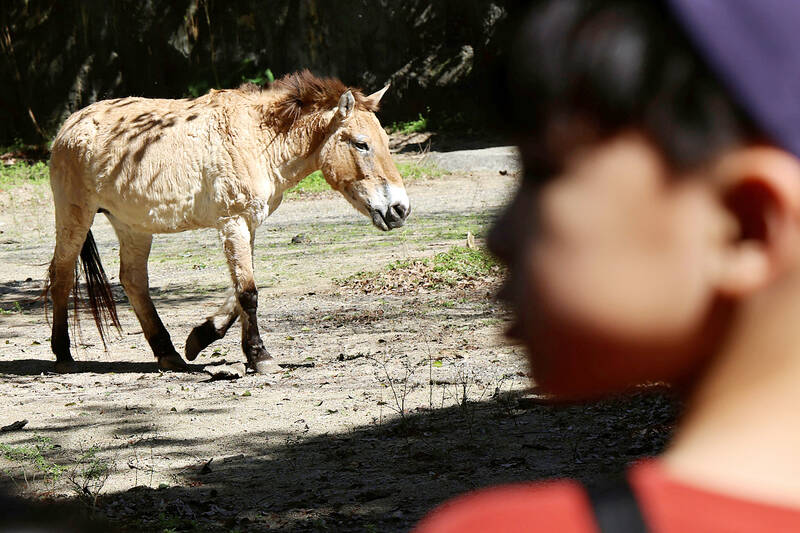
Photo: Reuters
The Year of the Horse in the Chinese zodiac begins on Feb. 17, ushered in with celebrations in Taiwan, China, South Korea and beyond.
“The happiest thing is that, when I show up, they come right over to me,” added Chen, 34, who has a close bond with the animals and holds talks to allow zoo visitors the chance to become better acquainted with the vanishingly small population of unique horses.
Przewalski’s horse, generally brown in color and smaller and shorter than domesticated horses, had disappeared from the wild by the end of the 1960s, but some remained in captivity.
Usually considered too wild to be ridden, they were reintroduced in China, Kazakhstan and western Mongolia, where the population now numbers at least 850 across the region.
Taipei Zoo has worked with Prague Zoo, which tracks breeding efforts for the species, in a global campaign to protect the horse, supporting efforts such as helping to arrange a 2018 release of horses in Mongolia by the Czech zoo.
Chen has experience with caring for other endangered species as well, such as white rhinos and giraffes.
Many visitors might mistake the horses, also known as Mongolian wild horses, for the breed that carried the warlord Genghis Khan’s hordes on their continent-spanning campaigns, Chen said, a misconception he is happy to dispel.
“Actually, they were not,” Chen said. “Visitors can take this chance to learn that they are a different species.”

Considering that most countries issue more than five denominations of banknotes, the central bank has decided to redesign all five denominations, the bank said as it prepares for the first major overhaul of the banknotes in more than 24 years. Central bank Governor Yang Chin-lung (楊金龍) is expected to report to the Legislative Yuan today on the bank’s operations and the redesign’s progress. The bank in a report sent to the legislature ahead of today’s meeting said it had commissioned a survey on the public’s preferences. Survey results showed that NT$100 and NT$1,000 banknotes are the most commonly used, while NT$200 and NT$2,000

The Centers for Disease Control (CDC) yesterday reported the first case of a new COVID-19 subvariant — BA.3.2 — in a 10-year-old Singaporean girl who had a fever upon arrival in Taiwan and tested positive for the disease. The girl left Taiwan on March 20 and the case did not have a direct impact on the local community, it said. The WHO added the BA.3.2 strain to its list of Variants Under Monitoring in December last year, but this was the first imported case of the COVID-19 variant in Taiwan, CDC Deputy Director-General Lin Ming-cheng (林明誠) said. The girl arrived in Taiwan on

South Korea is planning to revise its controversial electronic arrival card, a step Taiwanese officials said prompted them to hold off on planned retaliatory measures, a South Korean media report said yesterday. A Yonhap News Agency report said that the South Korean Ministry of Foreign Affairs is planning to remove the “previous departure place” and “next destination” fields from its e-arrival card system. The plan, reached after interagency consultations, is under review and aims to simplify entry procedures and align the electronic form with the paper version, a South Korean ministry official said. The fields — which appeared only on the electronic form

The Ministry of Foreign Affairs (MOFA) is suspending retaliation measures against South Korea that were set to take effect tomorrow, after Seoul said it is updating its e-arrival system, MOFA said today. The measures were to be a new round of retaliation after Taiwan on March 1 changed South Korea's designation on government-issued alien resident certificates held by South Korean nationals to "South Korea” from the "Republic of Korea," the country’s official name. The move came after months of protests to Seoul over its listing of Taiwan as "China (Taiwan)" in dropdown menus on its new online immigration entry system. MOFA last week


 RSS
RSS