


The Ministry of Environment’s 48-hour green talent training program has become the only program of its kind up to date with the latest regulatory development of carbon fees as local and international policies are incorporated into its updated version for this year, the ministry said yesterday.
The program was launched by the Alliance for Net Zero Green-Collar Talent Education last year, an organization established by the ministry, in cooperation with 32 universities, and run by the ministry’s National Environmental Research Academy.
The cooperation has expanded to 36 universities across Taiwan, with each city or county possessing at least one university offering the training locally for applicants, the ministry said, allowing up to 3,500 people to potentially cycle through the course nationwide this year.
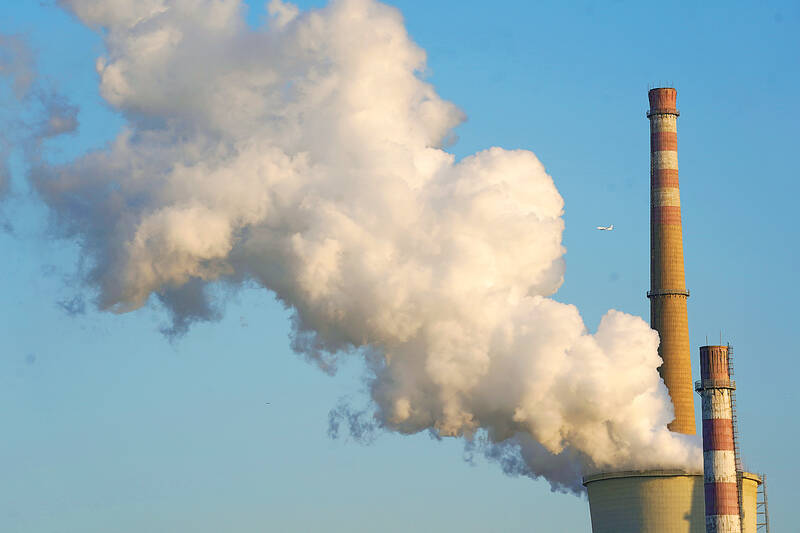
Photo: EPA
The updated course educates about internationally developing carbon fee schemes, including emissions trading systems (ETS), carbon border adjustment mechanisms (CBAM) and the Science-Based Targets initiative, it said.
It focuses on the three major carbon fee-related schemes the government announced in 2024, including the Regulations Governing the Collection of Carbon Fees (碳費收費辦法), the Regulations Governing Self-determined Reduction Plans (自主減量計畫管理辦法) and Designated Greenhouse Gas Reduction Goal for Entities Subject to Carbon Fees (碳費徵收對象溫室氣體減量指定目標), the ministry said.
A major change in the program is a realignment with the EU’s CBAM, enforced from the beginning of this year, as well as Taiwan’s upcoming carbon fee levy in May, it said.
Carbon emissions are no longer purely an environmental issue, as they are a key indicator that could affect a company’s cost structure and competitiveness, it added.
Academy acting president Wu Yueh-chuen (巫月春) said the updated program not only systematically analyzes the principles of ETS and CBAM and proposed countermeasures for industries, but also bases its courses on the Climate Change Adaptation Act (氣候變遷因應法) to look at a bigger picture that integrates domestic and international carbon fee schemes.
A core benefit of the updated program is trainees would learn about the latest policy developments and equip themselves with knowledge of the latest best practices in industries, she said.
For the 2,000 participants who went through the program last year, the academy would hold a refresher workshop in the first half of this year to provide them with updates, Wu said.
Separately, Minister of Environment Peng Chi-ming (彭?明) on Monday said the ministry would head to the EU on Feb. 21 to discuss issues related to the EU’s CBAM.
The goal is to ensure that the EU would accept certificates issued by verification mechanisms of carbon footprints or carbon credits established in Taiwan, he said.
The mission for the EU visit is to find out how and how much the carbon fees paid in Taiwan can offset the cost of the EU’s CBAM certificates, Peng said, adding that the EU has shown a welcoming attitude toward Taiwan’s carbon fee system and verification mechanisms.
Different countries have different carbon fee systems that must be negotiated with the EU, he said, adding that he expects Taiwan to achieve better results than most other countries by the middle of the year.
Additional reporting by CNA

Taiwan has received more than US$70 million in royalties as of the end of last year from developing the F-16V jet as countries worldwide purchase or upgrade to this popular model, government and military officials said on Saturday. Taiwan funded the development of the F-16V jet and ended up the sole investor as other countries withdrew from the program. Now the F-16V is increasingly popular and countries must pay Taiwan a percentage in royalties when they purchase new F-16V aircraft or upgrade older F-16 models. The next five years are expected to be the peak for these royalties, with Taiwan potentially earning
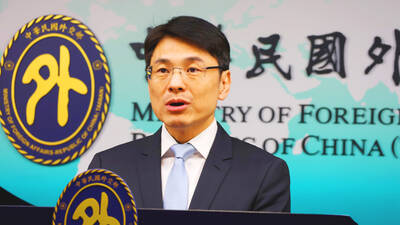
STAY IN YOUR LANE: As the US and Israel attack Iran, the ministry has warned China not to overstep by including Taiwanese citizens in its evacuation orders The Ministry of Foreign Affairs (MOFA) yesterday rebuked a statement by China’s embassy in Israel that it would evacuate Taiwanese holders of Chinese travel documents from Israel amid the latter’s escalating conflict with Iran. Tensions have risen across the Middle East in the wake of US and Israeli airstrikes on Iran beginning Saturday. China subsequently issued an evacuation notice for its citizens. In a news release, the Chinese embassy in Israel said holders of “Taiwan compatriot permits (台胞證)” issued to Taiwanese nationals by Chinese authorities for travel to China — could register for evacuation to Egypt. In Taipei, the ministry yesterday said Taiwan
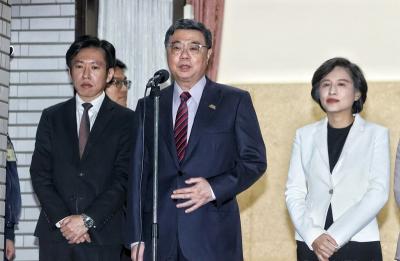
Taiwan is awaiting official notification from the US regarding the status of the Agreement on Reciprocal Trade (ART) after the US Supreme Court ruled US President Donald Trump's global tariffs unconstitutional. Speaking to reporters before a legislative hearing today, Premier Cho Jung-tai (卓榮泰) said that Taiwan's negotiation team remains focused on ensuring that the bilateral trade deal remains intact despite the legal challenge to Trump's tariff policy. "The US has pledged to notify its trade partners once the subsequent administrative and legal processes are finalized, and that certainly includes Taiwan," Cho said when asked about opposition parties’ doubts that the ART was
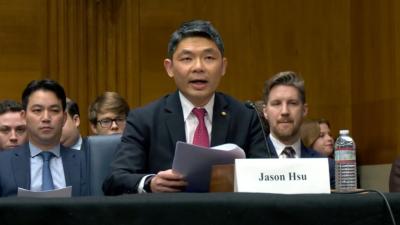
If China chose to invade Taiwan tomorrow, it would only have to sever three undersea fiber-optic cable clusters to cause a data blackout, Jason Hsu (許毓仁), a senior fellow at the Hudson Institute and former Chinese Nationalist Party (KMT) legislator, told a US security panel yesterday. In a Taiwan contingency, cable disruption would be one of the earliest preinvasion actions and the signal that escalation had begun, he said, adding that Taiwan’s current cable repair capabilities are insufficient. The US-China Economic and Security Review Commission (USCC) yesterday held a hearing on US-China Competition Under the Sea, with Hsu speaking on


 RSS
RSS