


A so-called “fourth US-China communique” proposed by a US political theorist would be a risk rather than a solution, as it would ignore Taiwan’s role in resisting authoritarian expansion, adopting Beijing’s narrative while failing to align with the strategic direction of the Trump administration, a Taiwanese academic said.
Speaking at the World Economic Forum, Harvard University professor of government Graham Allison, said the US and China recognize that Taiwan is a flashpoint and that a crisis would have major consequences for both sides.
Both countries might view President William Lai (賴清德) and any efforts he makes to push Taiwan toward independence as threats to stability, Allison said.
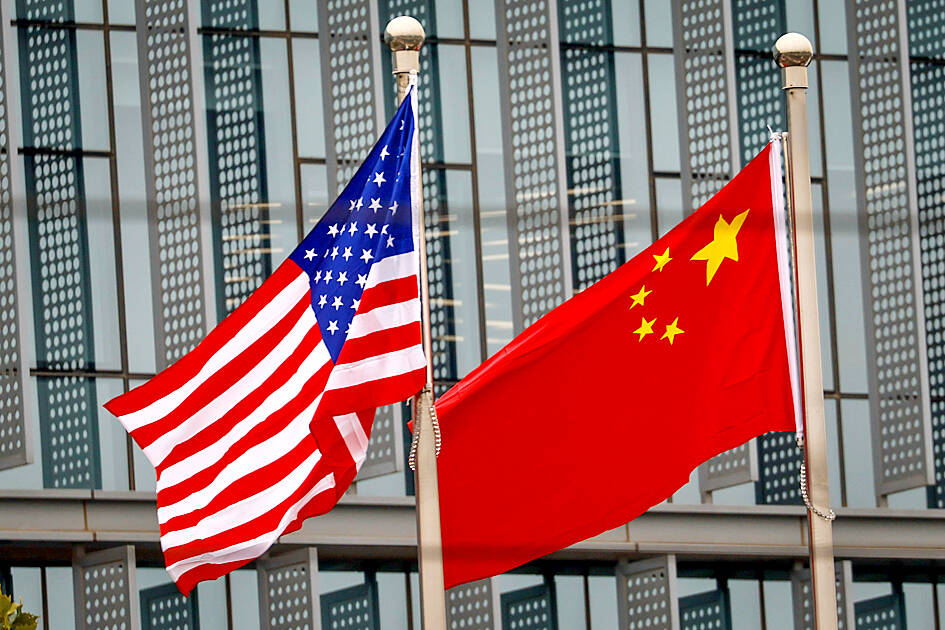
Photo: EPA
He said there could be a fourth communique between Washington and Beijing, with a more binding consensus on Taiwan to reduce the risk of war.
Wang Hung-jen (王宏仁), a professor at National Cheng Kung University’s Department of Political Science and executive director of the Institute for National Policy Research, commented on the proposal, saying the idea was an outdated strategy that misjudges geopolitical realities.
Allison’s analysis prioritizes stability in great-power relations, viewing Taiwan as a variable that could be managed and suppressed, failing to recognize Taiwan’s significance to the entire Western world, Wang said.
Taiwan is not merely a geopolitical chess piece, but a key indicator in the global contest between democracy and authoritarian expansion, he said.
If the US were to make concessions on Taiwan to trade for stability, the message sent to the world would not only represent a betrayal of Taiwan, but shake up the entire liberal international order, he said.
Washington’s core national security and defense strategies focus on constraining China and preventing it from unilaterally changing the “status quo,” but not restraining Taiwan, Wang said.
US President Donald Trump has gradually decoupled the Taiwan issue from the broader US-China relationship, rejecting the traditional framework of sacrificing Taiwan for the sake of US-China stability, he said.
The idea of jointly managing Taiwan through a fourth communique runs counter to this approach and is baseless in terms of political reality, Wang said.
Allison’s argument assumed that Taiwan is “gradually moving toward independence,” giving Washington and Beijing a shared interest in restraining Taiwan to avoid conflict, he said.
This premise is wrong, as China’s strategic goal has never been limited to Taiwan, but to expel US influence from the Western Pacific, reshape its sphere of influence and eventually surpass the US in the international system, Wang said.
This objective would not change regardless of whether Taiwan is kept under control, he added.
Allison advocated a “grand bargain” between the US and the former Soviet Union to stabilize bilateral relations during the Cold War and is applying the same logic to the trilateral relations between US, China and Taiwan, ignoring the change in the Indo-Pacific strategic environment, Wang said.
Even if Taiwan were to remain silent, Beijing would not abandon its broader strategic ambitions, he said.
Portraying Taiwan as a “troublemaker” is rhetoric used by China to justify its expansion, Wang said.

Yangmingshan National Park authorities yesterday urged visitors to respect public spaces and obey the law after a couple was caught on a camera livestream having sex at the park’s Qingtiangang (擎天崗) earlier in the day. The Shilin Police Precinct in Taipei said it has identified a suspect and his vehicle registration number, and would summon him for questioning. The case would be handled in accordance with public indecency charges, it added. The couple entered the park at about 11pm on Thursday and began fooling around by 1am yesterday, the police said, adding that the two were unaware of the park’s all-day live
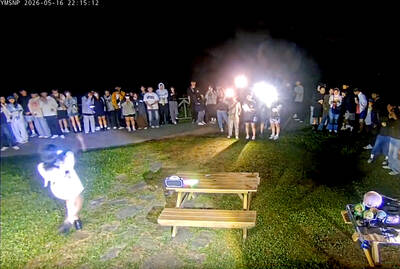
Yangmingshan National Park’s Qingtiangang (擎天崗) nature area has gone viral after a park livestream camera observed a couple in the throes of intimate congress, which was broadcast live on YouTube, drawing large late-night crowds and sparking a backlash over noise, bright lights and disruption to wildlife habitat. The area’s livestream footage appeared to show a couple engaging in sexual activity on a picnic table in the park on Friday last week, with the uncensored footage streamed publicly online. The footage quickly spread across social media, prompting a tide of visitors to travel to the site to “check in” and recreate the
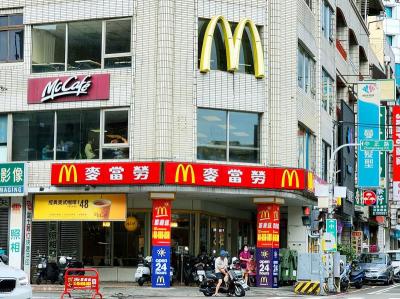
Fast food chain McDonald's is to raise prices by up to NT$5 on some products at its restaurants across Taiwan, starting on Wednesday next week, the company announced today. The prices of all extra value meals and sharing boxes are to increase by NT$5, while breakfast combos and creamy corn soup would go up by NT$3, the company said in a statement. The price of the main items of those meals, if ordered individually, would remain the same. Meanwhile, the price of a medium-sized lemon iced tea and hot cappuccino would rise by NT$3, extra dipping sauces for chicken nuggets would go up

Minister of Digital Affairs Lin Yi-ching (林宜敬) yesterday cited regulatory issues and national security concerns as an expert said that Taiwan is among the few Asian regions without Starlink. Lin made the remarks on Facebook after funP Innovation Group chief executive officer Nathan Chiu (邱繼弘) on Friday said Taiwan and four other countries in Asia — China, North Korea, Afghanistan and Syria — have no access to Starlink. Starlink has become available in 166 countries worldwide, including Ukraine, Malaysia, the Philippines and Vietnam, in the six years since it became commercial, he said. While China and North Korea block Starlink, Syria is not


 RSS
RSS