


A special defense budget proposed by the Taiwan People’s Party’s (TPP) is not viable, as it has no provisions for combat positions, maintenance or storage, the Ministry of National Defense said yesterday.
The TPP on Monday sponsored a NT$400 billion (US$12.71 billion) bill to fund procurements of High Mobility Artillery Rocket Systems (HIMARS), M109A7 self-propelled howitzers and other weapons.
However, the absence of key items means the ministry could not implement the proposal, Lieutenant General Huang Wen-chi, who heads the Department of Strategic Planning, told a news conference.
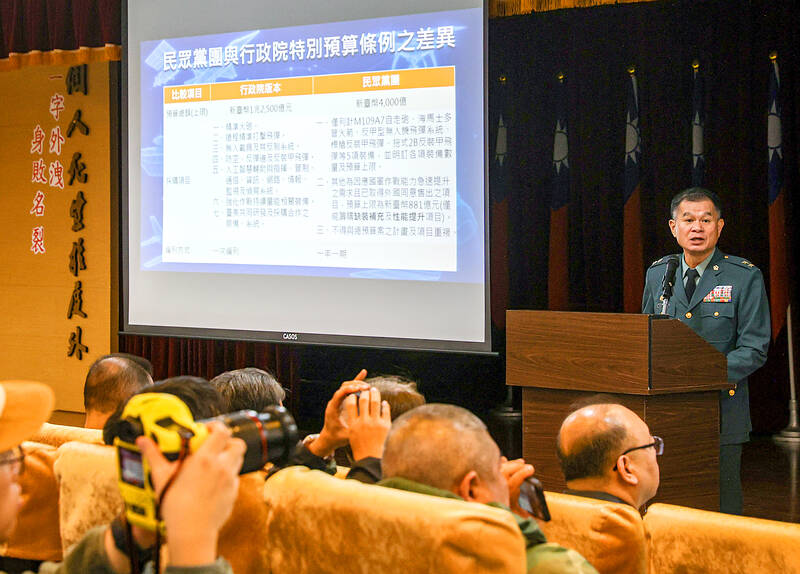
Photo: CNA
Citing the TPP’s budget for buying HIMARS as an example, Huang said that the bill fails to fund vehicle depots, and maintenance and repair facilities, as well as combat positions necessary to keep the artillery operational.
Without storage facilities, the systems would be subject to environmental damage, he said.
Government workers tasked with its implementation would be exposed to prosecutable negligence should the ministry enact a budget that only has funds for weapons purchases, he said.
The ministry’s budget proposal was written after careful assessment of operational realities, he said, adding that enacting the TPP’s bill would lead to problems.
The TPP bill lists details for systems to buy from the US, but does not include costs for construction, training and maintenance that must be done in Taiwan, said Lieutenant General Hsieh Chi-hsien (謝其賢), who heads the Comptroller Bureau.
The armed forces would not be able to field the systems if the TPP’s bill were passed, Hsieh said.
However, special budgets are legislation and cannot be amended until they go through the full legislative process, meaning that the military would have no way to make the weapons work unless it reduced the number purchased or waited for amendments, he said.
The TPP caucus in a statement called the ministry’s remarks “nonsense” and accused the government of lacking strategic vision.
The Democratic Progressive Party (DPP)-led government in 2019 asked the US to authorize the sale of M109A6s before bowing to Washington’s advice to purchase HIMARS, the statement said.
The government’s problem-prone submarine program and its proposal to buy US-made drones prone to frequency jamming are examples of wasteful spending, it said.
The government is spending money to pacify the public in lieu of military planning, the statement said.
“The DPP is using national defense and Taiwan-US ties as a pretext to pass a NT$1.25 trillion special budget to benefit foreign arms manufacturers,” it said.
The DPP caucus urged opposition lawmakers to allow the government’s budget to be deliberated concurrently with the TPP bill.
DPP Legislator Puma Shen (沈伯洋) said he respects the prerogative of TPP lawmakers to propose bills, but defense officials have knowledge that lawmakers might lack.
The ministry’s budget is a complete package that includes allocations for logistics, ammunition, Taiwan-US defense cooperation and efforts to secure national supply chains, Shen said.
“Putting off the matter further would be a show of policy indecision and lack of internal consensus,” DPP Legislator Fan Yun (范雲) said.
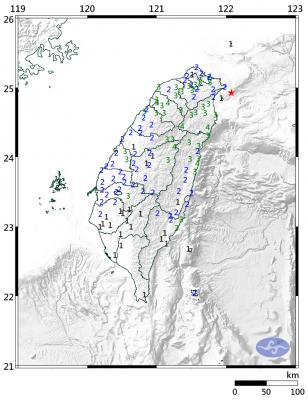
A magnitude 6.1 earthquake struck off the coast of Yilan County at 8:39pm tonight, the Central Weather Administration (CWA) said, with no immediate reports of damage or injuries. The epicenter was 38.7km east-northeast of Yilan County Hall at a focal depth of 98.3km, the CWA’s Seismological Center said. The quake’s maximum intensity, which gauges the actual physical effect of a seismic event, was a level 4 on Taiwan’s 7-tier intensity scale, the center said. That intensity level was recorded in Yilan County’s Nanao Township (南澳), Hsinchu County’s Guansi Township (關西), Nantou County’s Hehuanshan (合歡山) and Hualien County’s Yanliao (鹽寮). An intensity of 3 was
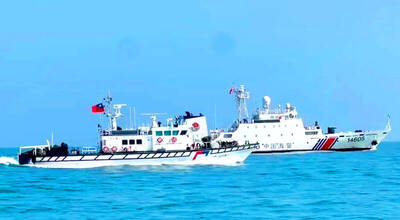
Instead of focusing solely on the threat of a full-scale military invasion, the US and its allies must prepare for a potential Chinese “quarantine” of Taiwan enforced through customs inspections, Stanford University Hoover fellow Eyck Freymann said in a Foreign Affairs article published on Wednesday. China could use various “gray zone” tactics in “reconfiguring the regional and ultimately the global economic order without a war,” said Freymann, who is also a nonresident research fellow at the US Naval War College. China might seize control of Taiwan’s links to the outside world by requiring all flights and ships entering or leaving Taiwan
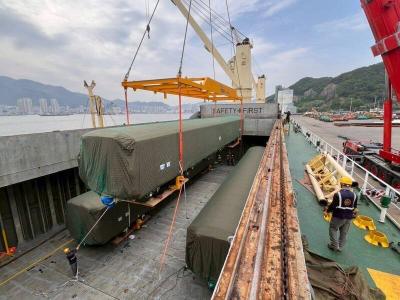
The first of 10 new high-capacity trains purchased from South Korea’s Hyundai Rotem arrived at the Port of Taipei yesterday to meet the demands of an expanding metro network, Taipei Rapid Transit Corp (TRTC) said yesterday. The train completed a three-day, 1,200km voyage from the Port of Masan in South Korea, the company said. Costing NT$590 million (US$18.79 million) each, the new six-carriage trains feature a redesigned interior based on "human-centric" transportation concepts, TRTC said. The design utilizes continuous longitudinal seating to widen the aisles and optimize passenger flow, while also upgrading passenger information displays and driving control systems for a more comfortable
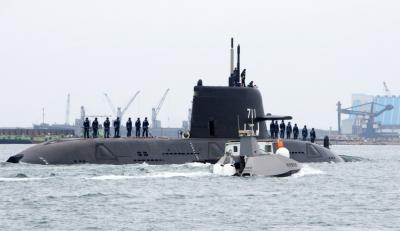
Taiwan's first indigenous defense submarine, the SS-711 Hai Kun (海鯤, or Narwhal), departed for its 13th sea trial at 7am today, marking its seventh submerged test, with delivery to the navy scheduled for July. The outing also marked its first sea deployment since President William Lai (賴清德) boarded the submarine for an inspection on March 19, drawing a crowd of military enthusiasts who gathered to show support. The submarine this morning departed port accompanied by CSBC Corp’s Endeavor Manta (奮進魔鬼魚號) uncrewed surface vessel and a navy M109 assault boat. Amid public interest in key milestones such as torpedo-launching operations and overnight submerged trials,


 RSS
RSS