


Former legislative speaker Su Jia-chyuan (蘇嘉全) on Friday took over as chairman of the Straits Exchange Foundation (SEF), and said that cross-strait relations should be based on mutual understanding rather than confrontation.
Su assumed the post in a special board meeting of the SEF, a semi-official body tasked with handling technical matters involving China.
He succeeded Frank Wu (吳豊山), who announced his resignation on Dec. 18 last year and stepped down on Dec. 31.
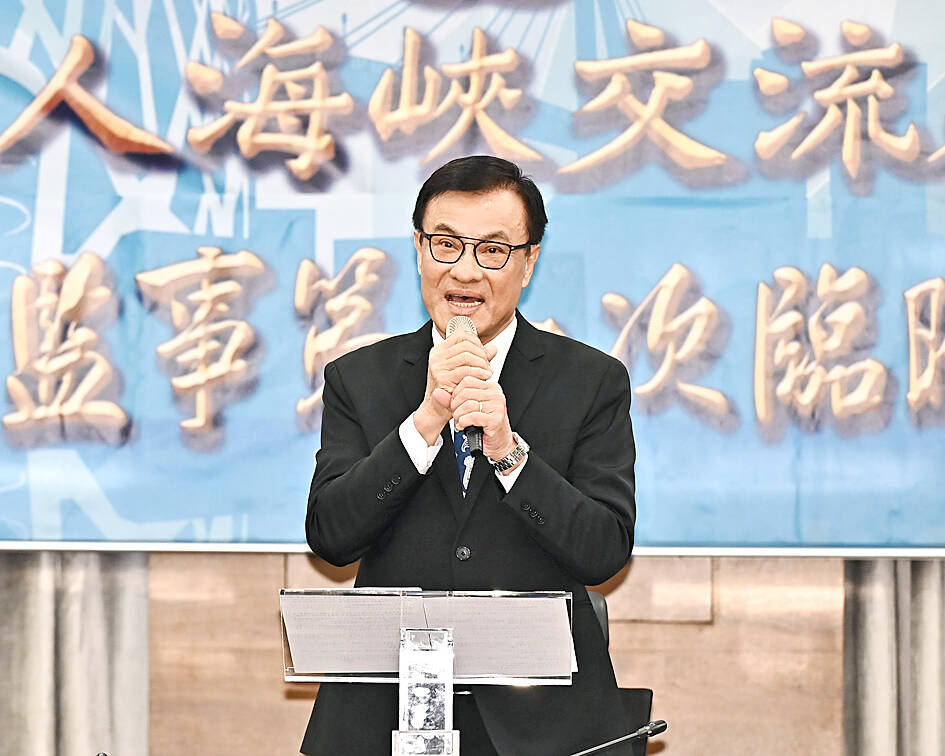
Photo: Tu Chien-jung, Taipei Times
The foundation’s 35th anniversary is this year, Su said, adding that regardless of cross-strait developments, its core mission remains to serve the people, promote exchanges and build conditions for peace.
The SEF would continue to focus on the people, with an emphasis on cross-strait dialogue and exchanges, he said, saying he hoped that China would do the same.
The foundation would also continue to express goodwill that promotes understanding and exchanges, efforts that aim to prevent conflicts and create opportunities to resolve problems, Su said.
SEF Secretary-General Luo Wen-jia (羅文嘉) said he hoped that the SEF and China’s Association for Relations Across the Taiwan Straits could engage in normal exchanges.
Communication between the SEF and the association has been suspended since former president Tsai Ing-wen (蔡英文) of the Democratic Progressive Party was elected in 2016.
The association said negotiations and communications with the SEF could only continue if the latter was authorized to confirm adherence to the so-called “1992 consensus,” a term former Mainland Affairs Council chairman Su Chi (蘇起) admitted to making up in 2000.
It refers to a tacit understanding between the KMT and China that both sides of the Strait acknowledge there is “one China,” with each side having its own interpretation of what “China” means.
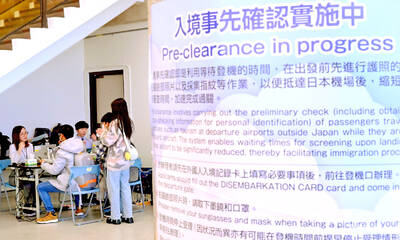
A preclearance service to facilitate entry for people traveling to select airports in Japan would be available from Thursday next week to Feb. 25 at Taiwan Taoyuan International Airport, Taoyuan International Airport Corp (TIAC) said on Tuesday. The service was first made available to Taiwanese travelers throughout the winter vacation of 2024 and during the Lunar New Year holiday. In addition to flights to the Japanese cities of Hakodate, Asahikawa, Akita, Sendai, Niigata, Okayama, Takamatsu, Kumamoto and Kagoshima, the service would be available to travelers to Kobe and Oita. The service can be accessed by passengers of 15 flight routes operated by

Chinese spouse and influencer Guan Guan’s (關關) residency permit has been revoked for repeatedly posting pro-China videos that threaten national security, the National Immigration Agency confirmed today. Guan Guan has said many controversial statements in her videos posted to Douyin (抖音), including “the red flag will soon be painted all over Taiwan” and “Taiwan is an inseparable part of China,” and expressing hope for expedited reunification. The agency last year received multiple reports alleging that Guan Guan had advocated for armed reunification. After verifying the reports, the agency last month issued a notice requiring her to appear and explain her actions. Guan

GIVE AND TAKE: Blood demand continues to rise each year, while fewer young donors are available due to the nation’s falling birthrate, a doctor said Blood donors can redeem points earned from donations to obtain limited edition Formosan black bear travel mugs, the Kaohsiung Blood Center said yesterday, as it announced a goal of stocking 20,000 units of blood prior to the Lunar New Year. The last month of the lunar year is National Blood Donation Month, when local centers seek to stockpile blood for use during the Lunar New Year holiday. The blood demand in southern Taiwan — including Tainan and Kaohsiung, as well as Chiayi, Pingtung, Penghu and Taitung counties — is about 2,000 units per day, the center said. The donation campaign aims to boost
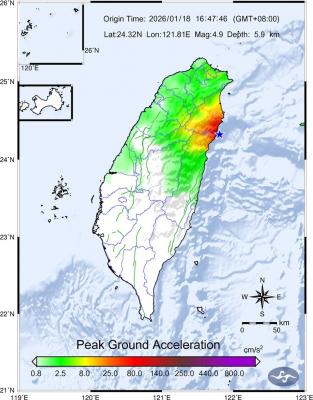
The Central Weather Administration (CWA) said a magnitude 4.9 earthquake that struck off the coast of eastern Taiwan yesterday was an independent event and part of a stress-adjustment process. The earthquake occurred at 4:47pm, with its epicenter at sea about 45.4km south of Yilan County Hall at a depth of 5.9km, the CWA said. The quake's intensity, which gauges the actual effects of a temblor, was highest in several townships in Yilan and neighboring Hualien County, where it measured 4 on Taiwan's seven-tier intensity scale, the CWA said. Lin Po-yu (林柏佑), a division chief at the CWA's Seismological Center, told a news conference


 RSS
RSS