


This year could see the Chinese People’s Liberation Army (PLA) undertaking “more aggressive, ambitious operations around Taiwan,” in preparation for Chinese President Xi Jinping’s (習近平) stated goal that the PLA would have the capability to invade Taiwan by next year, Global Taiwan Institute (GTI) director John Dotson said on Thursday.
It is the last year for the People’s Republic of China (PRC) to reach that capability goal, Ann Kowalewski, a senior non-resident fellow at the Washington-based GTI, told a panel discussion titled: “Looking Ahead for Taiwan Policy in 2026.”
Last year saw a mounting escalation in pressure from China against Taiwan, including the PLA’s “Justice Mission 2025” military exercises conducted around Taiwan last month, the GTI said.
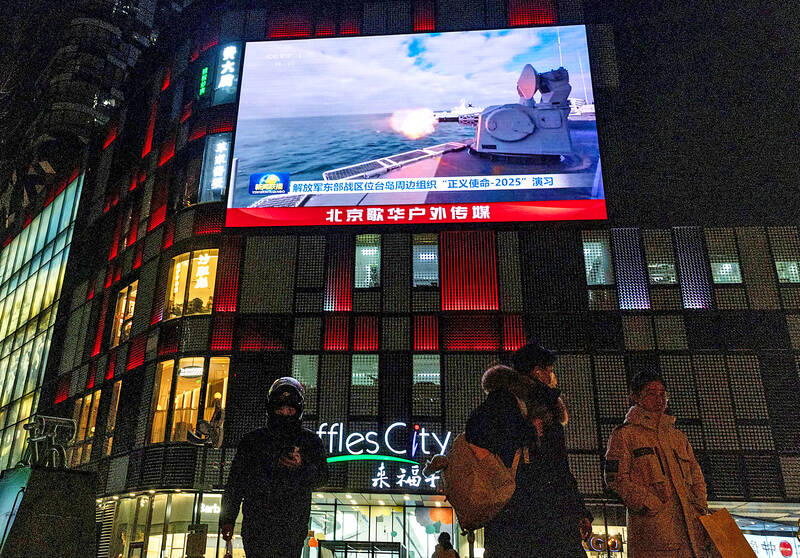
Photo: Reuters
Analysts expect next year to be a flashpoint in cross-strait relations, after then-US Indo-Pacific commander admiral Philip Davidson in 2021 warned that Xi had instructed the PLA to be ready to invade Taiwan by next year.
However, substantial political analysis shows that they are “not quite there yet,” Kowalewski said.
“What we might see is a massive ramp-up this year in PRC military capability,” she said.
It remains unclear whether Taiwan and the US would increase their military capabilities or think through unique postures to ensure they can asymmetrically keep the balance of power in a relatively stable area, she said.
Conversely, at the end of the year, China might have complete military dominance, she added.
An increase in military activity this year by the PLA might try to signal to Xi: “Hey boss, we got the message and look at the cool stuff we can do now,” Dotson said.
Dotson said that last year’s two PLA military exercises, held in April and last month, which were conducted toward the south and southeast of Taiwan, were in closer proximity to the nation’s main island, and featured more aggressive use of the China Coast Guard.
Deploying the coast guard serves China’s narrative, as it can be justified as law enforcement patrols rather than military incursions, he said.
China gives a “narrative justification” for each of its military exercises, such as blaming a speech by President William Lai (賴清德) on policies to target Chinese infiltration in March last year or an arms sale package with Washington last month, Dotson said.
He added that he recommends skepticism around these narratives, as large-scale exercises are planned out far in advance, but might have their exact dates adjusted to coincide with key events.
Meanwhile, Taiwan has maintained dialogue with Japan and the Philippines, and there is now “more of an opening on [South] Korea-Taiwan than we have seen previously,” Kowalewski said, adding that Seoul “may not want to fight, may not want to get involved in Taiwan.”
However, even if South Korea does not get involved militarily at the outset, its economy would be greatly affected if the waterways around Taiwan become a war zone, so it might have to get involved for its own national security reasons, she said.
Dotson is a former US Navy officer and was a staff member of the US-China Economic and Security Review Commission under the US Congress.
Kowalewski formerly led the Indo-Pacific portfolio as a senior professional staff member of the US House of Representatives Committee on Foreign Affairs.
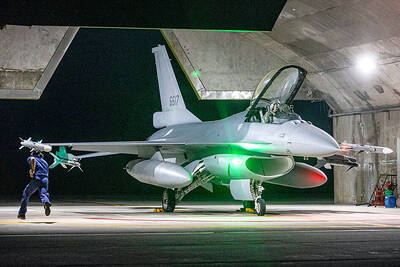
Taiwan has received more than US$70 million in royalties as of the end of last year from developing the F-16V jet as countries worldwide purchase or upgrade to this popular model, government and military officials said on Saturday. Taiwan funded the development of the F-16V jet and ended up the sole investor as other countries withdrew from the program. Now the F-16V is increasingly popular and countries must pay Taiwan a percentage in royalties when they purchase new F-16V aircraft or upgrade older F-16 models. The next five years are expected to be the peak for these royalties, with Taiwan potentially earning
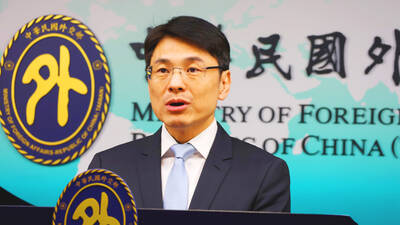
STAY IN YOUR LANE: As the US and Israel attack Iran, the ministry has warned China not to overstep by including Taiwanese citizens in its evacuation orders The Ministry of Foreign Affairs (MOFA) yesterday rebuked a statement by China’s embassy in Israel that it would evacuate Taiwanese holders of Chinese travel documents from Israel amid the latter’s escalating conflict with Iran. Tensions have risen across the Middle East in the wake of US and Israeli airstrikes on Iran beginning Saturday. China subsequently issued an evacuation notice for its citizens. In a news release, the Chinese embassy in Israel said holders of “Taiwan compatriot permits (台胞證)” issued to Taiwanese nationals by Chinese authorities for travel to China — could register for evacuation to Egypt. In Taipei, the ministry yesterday said Taiwan
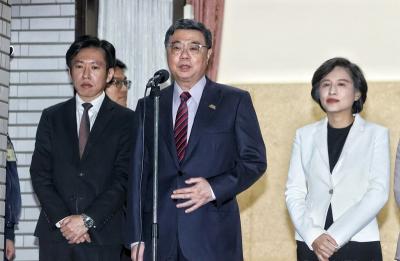
Taiwan is awaiting official notification from the US regarding the status of the Agreement on Reciprocal Trade (ART) after the US Supreme Court ruled US President Donald Trump's global tariffs unconstitutional. Speaking to reporters before a legislative hearing today, Premier Cho Jung-tai (卓榮泰) said that Taiwan's negotiation team remains focused on ensuring that the bilateral trade deal remains intact despite the legal challenge to Trump's tariff policy. "The US has pledged to notify its trade partners once the subsequent administrative and legal processes are finalized, and that certainly includes Taiwan," Cho said when asked about opposition parties’ doubts that the ART was
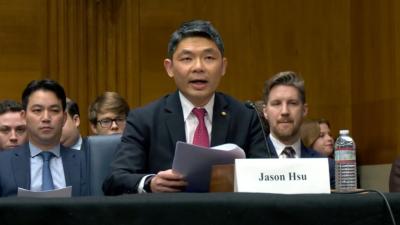
If China chose to invade Taiwan tomorrow, it would only have to sever three undersea fiber-optic cable clusters to cause a data blackout, Jason Hsu (許毓仁), a senior fellow at the Hudson Institute and former Chinese Nationalist Party (KMT) legislator, told a US security panel yesterday. In a Taiwan contingency, cable disruption would be one of the earliest preinvasion actions and the signal that escalation had begun, he said, adding that Taiwan’s current cable repair capabilities are insufficient. The US-China Economic and Security Review Commission (USCC) yesterday held a hearing on US-China Competition Under the Sea, with Hsu speaking on


 RSS
RSS