


The Taipei Women’s Rescue Foundation on Monday argued against the legalization of surrogacy, saying that the procedure “treats women’s wombs as tools.”
The foundation on social media said that “wombs should not be treated as tools or commodities for producing children for others,” and that it was necessary to “safeguard women’s reproductive autonomy and bodily autonomy.”
Surrogacy would introduce risks of physical and psychological harm, it said.
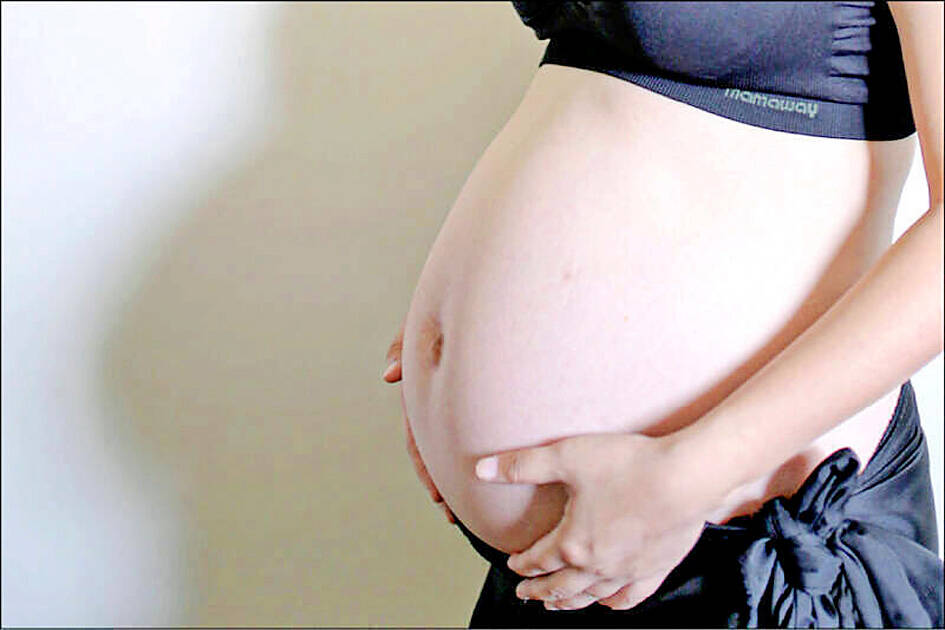
Photo: Taipei Times
“The Artificial Reproduction Act (人工生殖法) and surrogacy fall under different policy domains,” the foundation said.
Single women and married female couples should have access to assisted reproductive technologies to ensure a woman’s right to bear and raise her own biological children, it said.
The Executive Yuan last month proposed amendments to the act, which includes granting married female couples and single women access to legal assisted reproductive services.
However, the Taiwan People’s Party also proposed an amendment that would legalize surrogacy in addition to assisted reproductive treatment for married female couples and single women.
The foundation said assisted reproductive technologies are different from surrogacy, which could lead to the exploitation of women, particularly those from disadvantaged backgrounds.
“Pregnancy involves risks related to prenatal care and childbirth, as well as emotional attachment to the child, all of which can have significant impacts on women’s physical and mental health, and could even affect the fetus,” it said.
Those concerns involve not only the human rights of women and children, but also health, legal and other broader issues, and therefore should not be addressed through amendments to the Artificial Reproduction Act, the foundation said.
The most common assisted reproductive techniques used in surrogacy are artificial insemination and in vitro fertilization, it said.
“However, regardless of whether artificial insemination or in vitro fertilization is used, both involve renting or borrowing another woman’s womb, effectively treating it as a reproductive tool and giving rise to concerns about commodification,” the foundation said.
Even with the most comprehensive legal safeguards — such as screening requirements to ensure surrogate mothers have sound mental health and adequate family support — it would still be impossible to prevent women from being coerced into surrogacy, it said.
“Women facing economic hardship or at a social disadvantage might choose surrogacy as a means of increasing their income,” the foundation said. “While such choices might appear to be made freely, the power imbalances between the commissioning parties and surrogate mothers often result in the latter’s autonomy being overlooked.”

Taiwan has received more than US$70 million in royalties as of the end of last year from developing the F-16V jet as countries worldwide purchase or upgrade to this popular model, government and military officials said on Saturday. Taiwan funded the development of the F-16V jet and ended up the sole investor as other countries withdrew from the program. Now the F-16V is increasingly popular and countries must pay Taiwan a percentage in royalties when they purchase new F-16V aircraft or upgrade older F-16 models. The next five years are expected to be the peak for these royalties, with Taiwan potentially earning
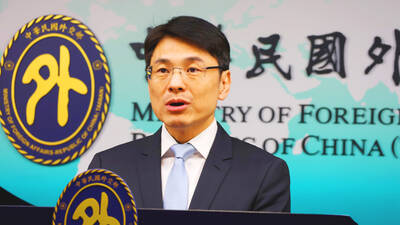
STAY IN YOUR LANE: As the US and Israel attack Iran, the ministry has warned China not to overstep by including Taiwanese citizens in its evacuation orders The Ministry of Foreign Affairs (MOFA) yesterday rebuked a statement by China’s embassy in Israel that it would evacuate Taiwanese holders of Chinese travel documents from Israel amid the latter’s escalating conflict with Iran. Tensions have risen across the Middle East in the wake of US and Israeli airstrikes on Iran beginning Saturday. China subsequently issued an evacuation notice for its citizens. In a news release, the Chinese embassy in Israel said holders of “Taiwan compatriot permits (台胞證)” issued to Taiwanese nationals by Chinese authorities for travel to China — could register for evacuation to Egypt. In Taipei, the ministry yesterday said Taiwan
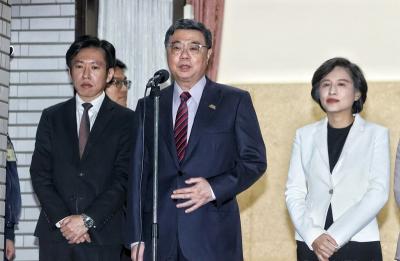
Taiwan is awaiting official notification from the US regarding the status of the Agreement on Reciprocal Trade (ART) after the US Supreme Court ruled US President Donald Trump's global tariffs unconstitutional. Speaking to reporters before a legislative hearing today, Premier Cho Jung-tai (卓榮泰) said that Taiwan's negotiation team remains focused on ensuring that the bilateral trade deal remains intact despite the legal challenge to Trump's tariff policy. "The US has pledged to notify its trade partners once the subsequent administrative and legal processes are finalized, and that certainly includes Taiwan," Cho said when asked about opposition parties’ doubts that the ART was
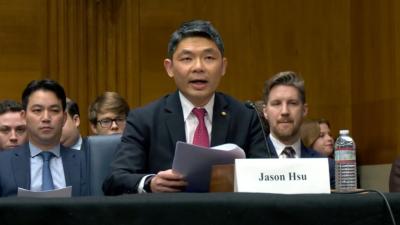
If China chose to invade Taiwan tomorrow, it would only have to sever three undersea fiber-optic cable clusters to cause a data blackout, Jason Hsu (許毓仁), a senior fellow at the Hudson Institute and former Chinese Nationalist Party (KMT) legislator, told a US security panel yesterday. In a Taiwan contingency, cable disruption would be one of the earliest preinvasion actions and the signal that escalation had begun, he said, adding that Taiwan’s current cable repair capabilities are insufficient. The US-China Economic and Security Review Commission (USCC) yesterday held a hearing on US-China Competition Under the Sea, with Hsu speaking on


 RSS
RSS