


Fewer social housing units are being built due to land scarcity, the Ministry of the Interior (MOI) said yesterday, adding that it is shifting focus to accelerating lease and management services.
President William Lai (賴清德) during his 2024 presidential campaign pledged to launch a “1 million renter household support program,” aiming to build 250,000 social housing units by 2032 — an additional 130,000 units on top of the 120,000 social housing units under former president Tsai Ing-wen (蔡英文) — place 250,000 units in the lease and management program, and provide 500,000 households with rent subsidies.
The government’s lease and management program aims to facilitate the rental of otherwise unused and empty properties to disadvantaged families, students and workers.
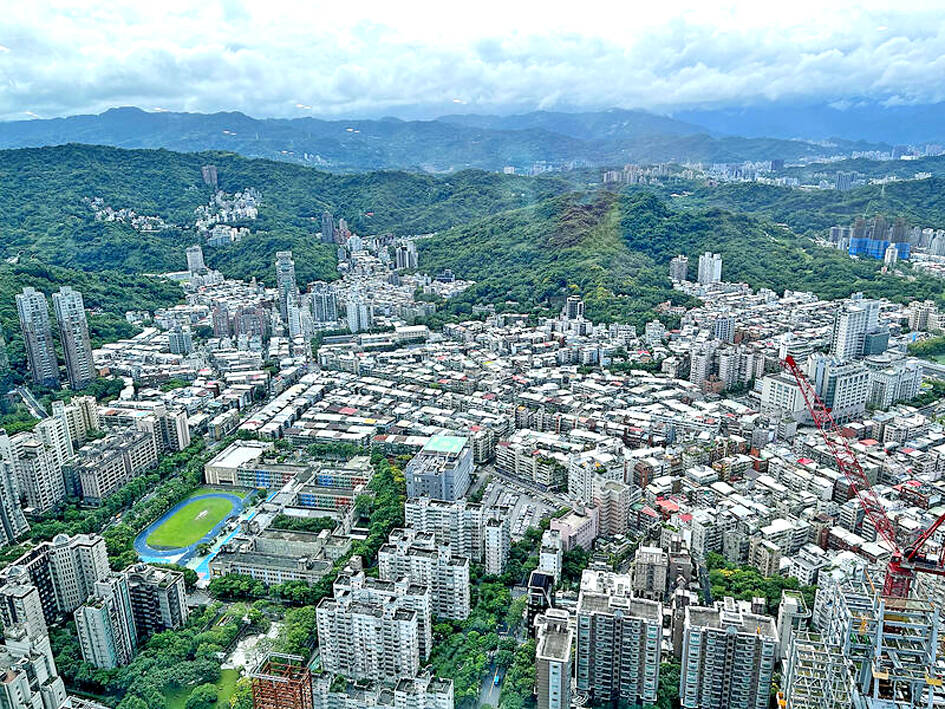
Photo: Hsu Yi-ping, Taipei Times
As of the end of last month, 122,680 units of new social welfare housing had been built, 104,803 units had been leased under the government’s lease program, and 913,867 people had applied for rental subsidies, ministry statistics showed.
The ministry in a release said that the government plans to expand the lease and management program to 320,000 units, adding that its goal of supporting 1 million renter households remains unchanged.
As a result of the targets set by the Presidential Office’s Climate Change Committee, the residential and commercial sectors’ carbon emissions must be reduced by 35 percent by 2030, the ministry said.
The adoption of the lease and management program is 30 to 40 percent more effective in reducing carbon emissions than building social housing, it said.
The program could help meet housing needs while supporting carbon reduction goals and environmental protection, it said.
Due to slow construction of social housing, scarce land and slow acquisition, fewer social housing units would be built, Minister of the Interior Liu Shyh-fang (劉世芳) said yesterday.
The ministry would focus on accelerating the lease and management program, she said.
The Tsai administration planned 120,000 social housing units, and the Lai administration is moving in the same direction, she said, adding that progress has been slow due to land scarcity, and existing projects would not be completed in the next two years.
The government is struggling to find plots of land in prime real-estate areas, Liu said.
If social welfare housing is built outside prime areas, it would struggle to attract residents, she added.
“The number of households to benefit from the three strategies combined would add up to 1 million,” she said.
Taiwan has about 910,000 vacant homes, she said.
The ministry has a goal for the lease and management program to reach 320,000 units, Liu said.
Deputy Minister of the Interior Dong Jian-hong (董建宏) said the ministry would work with local governments to provide housing for temporary residents such as students.
The government would also explore encouraging community-driven urban renewal programs and introducing old housing life-extension programs, he said.

Yangmingshan National Park authorities yesterday urged visitors to respect public spaces and obey the law after a couple was caught on a camera livestream having sex at the park’s Qingtiangang (擎天崗) earlier in the day. The Shilin Police Precinct in Taipei said it has identified a suspect and his vehicle registration number, and would summon him for questioning. The case would be handled in accordance with public indecency charges, it added. The couple entered the park at about 11pm on Thursday and began fooling around by 1am yesterday, the police said, adding that the two were unaware of the park’s all-day live

A former soldier and an active-duty army officer were yesterday indicted for allegedly selling classified military training materials to a Chinese intelligence operative for a total of NT$79,440. The Taipei District Prosecutors’ Office indicted Chen Tai-yin (陳泰尹) and Lee Chun-ta (李俊達) for contravening the National Security Act (國家安全法) and the Anti-Corruption Act (貪污治罪條例). Chen left the military in September 2013 after serving alongside then-staff sergeant Lee, now an army lieutenant, at the 21st Artillery Command of the army’s Sixth Corps from 2011 to 2013, according to the indictment. Chen met a Chinese intelligence operative identified as “Wang” (王) through a friend in November

Minister of Digital Affairs Lin Yi-ching (林宜敬) yesterday cited regulatory issues and national security concerns as an expert said that Taiwan is among the few Asian regions without Starlink. Lin made the remarks on Facebook after funP Innovation Group chief executive officer Nathan Chiu (邱繼弘) on Friday said Taiwan and four other countries in Asia — China, North Korea, Afghanistan and Syria — have no access to Starlink. Starlink has become available in 166 countries worldwide, including Ukraine, Malaysia, the Philippines and Vietnam, in the six years since it became commercial, he said. While China and North Korea block Starlink, Syria is not
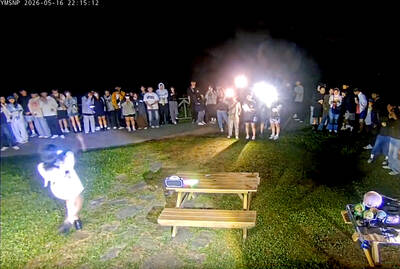
Yangmingshan National Park’s Qingtiangang (擎天崗) nature area has gone viral after a park livestream camera observed a couple in the throes of intimate congress, which was broadcast live on YouTube, drawing large late-night crowds and sparking a backlash over noise, bright lights and disruption to wildlife habitat. The area’s livestream footage appeared to show a couple engaging in sexual activity on a picnic table in the park on Friday last week, with the uncensored footage streamed publicly online. The footage quickly spread across social media, prompting a tide of visitors to travel to the site to “check in” and recreate the


 RSS
RSS