


China’s state-run Xinhua news agency’s near-exclusive coverage of Monday’s China-South Korea meeting highlighted Beijing’s anxiety over the political optics of the visit and its desire to control the narrative, Tunghai University Cross-Strait Research Center deputy executive director Hung Pu-chao (洪浦釗) said yesterday.
South Korean President Lee Jae-myung met with Chinese President Xi Jinping (習近平) as part of Lee’s four-day trip to China, his first since taking office in June last year.
Xinhua had near-exclusive coverage of the Lee-Xi meeting, showing that the Chinese Communist Party (CCP) was eager to set a positive tone for the event, Hung said.
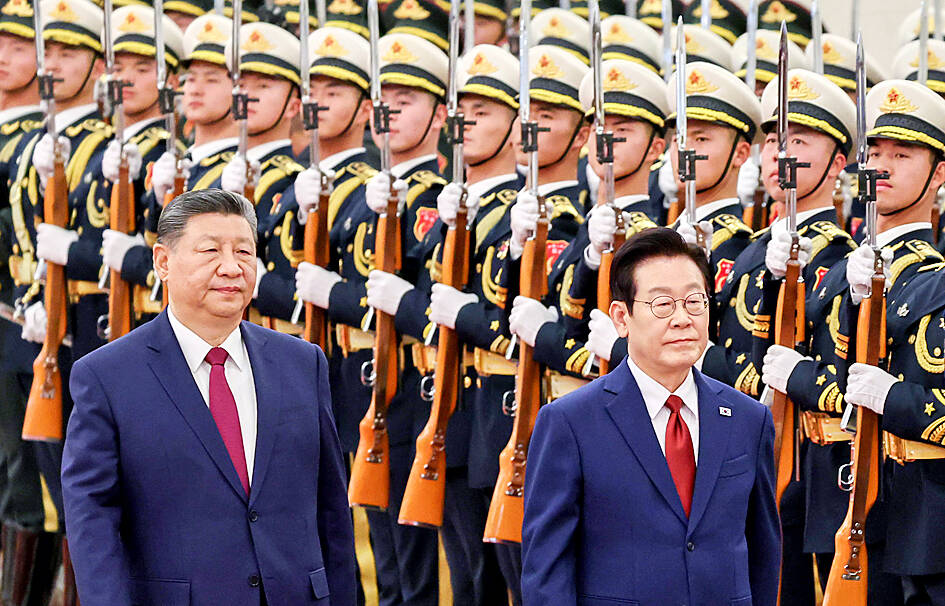
Photo: EPA
Lee’s comment that South Korea “respects” China’s “one China” policy during the meeting, as reported by Xinhua, does not indicate an abrupt change in South Korea’s Taiwan policy, nor is it a signal to other countries in the Indo-Pacific region that Seoul is changing its defense policies, he said.
South Korea’s economy and supply chains are highly interconnected with China, and it is more than willing to pay lip service for some diplomatic leeway, allowing Lee time to deal with more pressing issues, Hung said.
The CCP has consistently arranged for such statements to be made, he said, adding that Beijing is sending a message to its neighbors that, in light of an increasingly “hardline” Japan, it can still maintain its political narrative in the region.
The need for Xinhua to issue the first reports of the meeting underscores China’s anxiety about the political optics of the meeting and proves that Beijing “puts politics first” in diplomacy and economic collaboration, he said.
Taipei should not be overly concerned about other nations’ comments when meeting in China, but it should closely monitor whether their defense policies and actions have shifted toward a pro-China stance, Hung said.
Chun Kalim, a professor specializing in cross-strait relations at Hoseo University, said that Lee’s ambiguity on Taiwan during the meeting differed from his predecessor, Yoon Suk-yeol.
Lee said only that South Korea “respects” the CCP’s “one China” position, while Yoon invoked protests from Beijing after stating that any conflict over Taiwan should be resolved in accordance with international norms and rules, and that Seoul resolutely opposes unilateral attempts to alter the “status quo” in the Strait, Chun said.
Discussions between Xi and Lee were focused on “resolving bilateral disputes,” and, therefore, issues involving third parties were largely avoided, he added.
Additional reporting by CNA
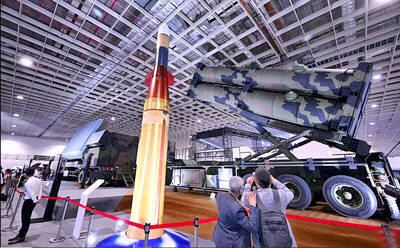
Taiwan is to commence mass production of the Tien Kung (天弓, “Sky Bow”) III, IV and V missiles by the second quarter of this year if the legislature approves the government’s NT$1.25 trillion (US$39.78 billion) special defense budget, an official said yesterday. Commenting on condition of anonymity, a defense official with knowledge of the matter said that the advanced systems are expected to provide crucial capabilities against ballistic and cruise missiles for the proposed “T-Dome,” an advanced, multi-layered air defense network. The Tien Kung III is an air defense missile with a maximum interception altitude of 35km. The Tien Kung IV and V
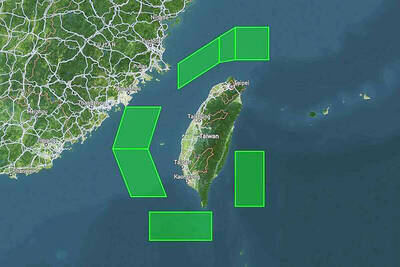
The disruption of 941 flights in and out of Taiwan due to China’s large-scale military exercises was no accident, but rather the result of a “quasi-blockade” used to simulate creating the air and sea routes needed for an amphibious landing, a military expert said. The disruptions occurred on Tuesday and lasted about 10 hours as China conducted live-fire drills in the Taiwan Strait. The Civil Aviation Administration (CAA) said the exercises affected 857 international flights and 84 domestic flights, affecting more than 100,000 travelers. Su Tzu-yun (蘇紫雲), a research fellow at the government-sponsored Institute for National Defense and Security Research, said the air
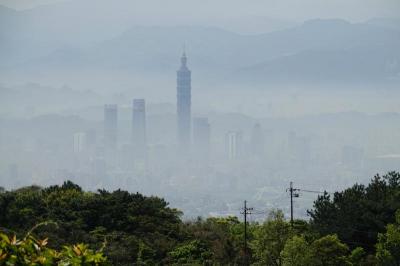
A strong continental cold air mass is to bring pollutants to Taiwan from tomorrow, the Ministry of Environment said today, as it issued an “orange” air quality alert for most of the country. All of Taiwan except for Hualien and Taitung counties is to be under an “orange” air quality alert tomorrow, indicating air quality that is unhealthy for sensitive groups. In China, areas from Shandong to Shanghai have been enveloped in haze since Saturday, the ministry said in a news release. Yesterday, hourly concentrations of PM2.5 in these areas ranged from 65 to 160 micrograms per cubic meter (mg/m³), and pollutants were
Taiwan’s armed forces have established response protocols for a wide range of sudden contingencies, including the “Wan Chun Plan” to protect the head of state, the Ministry of Defense (MND) said today. After US President Donald Trump on Saturday launched a series of airstrikes in Venezuela and kidnapped Venezuelan President Nicolas Maduro, concerns have been raised as to whether China would launch a similar “decapitation strike” on Taiwan. The armed forces regularly coordinate with relevant agencies and practice drills to ensure preparedness for a wide range of scenarios, Vice Minister of National Defense Hsu Szu-chien (徐斯儉) told reporters before a


 RSS
RSS