


The Legislative Yuan yesterday passed the third reading of a bill on delivery workers’ rights and managing delivery platforms, stipulating that, per delivery, workers must earn at least 1.25 times the minimum hourly wage, or a minimum of NT$45.
The pay rate would be adjusted annually depending on the minimum wage, the act says.
The current hourly minimum wage is NT$196.
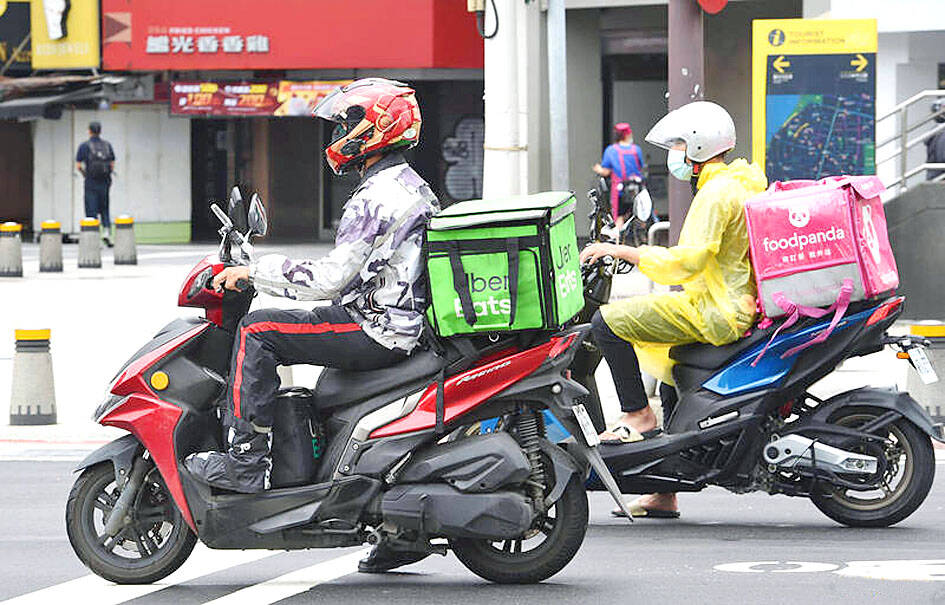
Photo: Taipei Times
The act is to take effect six months after its promulgation, and the Ministry of Labor would specify how it would be implemented after consulting with affected businesses.
The act would require delivery platforms to pay their workers at least twice per month and provide clear payment statements showing how earnings and deductions are calculated.
It also requires delivery platforms to set up a complaint system, allowing delivery workers to raise concerns about pay, account suspensions or contract terminations, and disputes with cooperating businesses or customers.
Platforms must also set up a task force of no fewer than three people to address complaints, including at least one union representative, and may not treat workers unfairly for filing complaints.
Platforms may not stipulate delivery personnel’s working hours, require them to work against their will, or treat them unfairly for refusing orders or going offline to rest.
When a local government cancels work due to dangerous weather or natural disasters, delivery platforms should suspend operations in the area and inform delivery personnel and cooperating businesses.
Platforms must provide contracted delivery workers with accident and liability insurance, and workers may not deliver until insured.
In terms of fines, the bill stipulates that delivery platforms may be fined NT$30,000 to NT$300,000 for failing to report a work-related injury within eight hours, NT$30,000 to NT$150,000 for avoiding supervision and inspection, and NT$20,000 to NT$100,000 for contravening payment regulations.
Delivery workers’ unions said that the law is a milestone for the industry, as it establishes a minimum wage, guarantees workers insurance and gives them a system through which to file complaints.
Establishing a minimum wage, insurance and grievance mechanisms under the law would clarify the rights and responsibilities of platforms and delivery workers, Taiwan Delivery Industry Rights Promotion Alliance spokesman Su Pai-hao (蘇柏豪) said.
It not only protects workers’ rights, but is key to the healthy and sustainable growth of the industry, Su said.
Whether the system can truly improve delivery workers’ situations depends on how the act is implemented and applied, National Delivery Industrial Union chairman Chen Yu-an (陳昱安) said.
Uber Eats said that it hopes the implementation of the act considers the industry’s needs, balancing the interests of all parties.
Foodpanda said it would start running operational tests to prepare for the act’s potential impacts on the market.
Additional reporting by Lin Che-yuan

REASONS FOR TRAVEL: An assistant professor said that proposed amendments to penalize drivers if they used drugs overseas would not deter people from traveling People who operate a motor vehicle under the influence of marijuana would have their driver’s license revoked, even if they used the substance while overseas, the Ministry of Transportation and Communications said yesterday, citing proposed amendments to the Road Traffic Management and Penalty Act (道路交通管理處罰條例). The amendments would also authorize the government to revoke the licenses of people determined to have used Category 1 or Category 2 narcotics, even if they were not operating a vehicle while under the influence of drugs, as well as ban them from taking the license test for three years, the ministry said. People aged 18 or

GLOBALGIVING: ‘ Caving to external pressure is not acceptable for an organization that has cultivated justice reform and human rights for 30 years,’ one NGO said A slew of non-government organizations (NGOs) have withdrawn from the GlobalGiving fundraising platform after it announced it would use “Chinese Taipei” instead of “Taiwan” from next month. The Taiwan Good Rice Association wrote on Facebook on Friday that it was informed on April 28 via a teleconference call of the change, which was made because the platform wanted to operate in China. Taiwan Good Rice is to terminate all cooperative relationships with GlobalGiving in response to the platform’s “unilateral and non-negotiable” decision to remove references to Taiwan, the NGO said. “Taiwan is in the official name of Taiwan Good Rice Association and the

HEAVY WEATHER: Typhoon Jangmi is due to crash straight into the Ryukyus as airlines look to shift flights to larger aircraft or cancel flights to Okinawa entirely Taiwan’s international air carriers announced flight adjustments over the weekend as Typhoon Jangmi is forecast to hit the Ryukyu Islands today and tomorrow. The Central Weather Administration (CWA) upgraded Jangmi from a tropical storm to a typhoon at 8am yesterday, with the eye located 580km south of Naha city. It was moving north at 19kph. Today, China Airlines’ CI-120, CI-121, CI-122 and CI-123 flights between Taoyuan and Naha, Okinawa, have been canceled as well as CI-132 and CI-133 between Kaohsiung and Naha. EVA Air’s BR-112, BR-113, BR-186 and BR-185 flights between Taoyuan and Naha are also canceled. Low-cost carrier Tigerair Taiwan canceled IT-230,
MULTIPRONGED APPROACH: China has sought to pressure Palau across a number of fronts, but the island nation has staunchly resisted overtures to ditch Taiwan Palau has been firm in backing Taiwan despite Chinese pressure that uses tourism economics, cyberattacks and criminal infiltration as tools to threaten the Pacific ally into renouncing its recognition of Taiwan as a sovereign state. The Presidential Office yesterday announced that Vice President Hsiao Bi-khim (蕭美琴) would visit Palau from Saturday to Wednesday next week at the invitation of Palauan President Surangel Whipps Jr. Whipps in April said in an interview that China had outspokenly asked Palau to “denounce Taiwan.” “And we have said: ‘We have no enemies, but nobody tells us who our friends are,’” he said. Whipps has told reporters multiple times


 RSS
RSS