


Conflict with Taiwan could leave China with “massive economic disruption, catastrophic military losses, significant social unrest, and devastating sanctions,” a US think tank said in a report released yesterday.
The German Marshall Fund of the United States (GMF) yesterday released a report titled If China Attacks Taiwan: The Consequences for China of “Minor Conflict” and “Major War” Scenarios.
The report details the “massive” economic, military, social and international costs to China in the event of a minor conflict or major war with Taiwan, estimating that the People’s Liberation Army (PLA) could sustain losses of more than half of its active-duty ground forces, including 100,000 troops killed.
Photo: Screen grab from the German Marshall Fund’s Web site
Understanding Chinese President Xi Jinping's (習近平) risk calculus is “crucial” to understanding Beijing’s possible actions, it says.
The report was edited by Bonnie Glaser, managing director of GMF's Indo-Pacific program, and its contributors include Zack Cooper, a senior fellow at the American Enterprise Institute.
It details how a minor conflict or a major war scenario would affect the People’s Republic of China (PRC) in contingencies expected to occur between this year and 2030.
The report defines a minor conflict as a blockade by Chinese ships and aircraft involving deadly air and maritime confrontations between the PLA and Taiwan, without losses of foreign personnel, concluding with the US intervening to ensure both sides mutually agree to de-escalate the situation.
A “major war” scenario would entail several months of armed conflict resulting in a PLA defeat, though it would establish control of the islands in Kinmen and Lienchiang (Matsu) counties, the report says.
That scenario would begin with an amphibious invasion of Taiwan and involve attacks on US military bases in Japan and Guam, it says.
It would result in losses of 100,000 personnel for the PLA, and 50,000 military and 50,000 civilian casualties for Taiwan, while the US would suffer 5,000 military and 1,000 civilian casualties and Japan would lose 1,000 military personnel and 500 civilians, the report says.
“The costs to the PRC of a failed military operation against Taiwan would be substantial,” it says.
However, “national humiliation” in the event of a PLA defeat would leave Beijing “strongly tempted to relaunch the war,” it says.
It could also result in military backing for a rival civilian leader or even a coup designed to restore national pride, the report says.
Starting with the economic implications, the paper references estimates by Rhodium of US$2 trillion to US$3 trillion and Bloomberg of US$10 trillion in economic losses for China in a limited escalation scenario.
As China’s annual exports account for 20 percent of GDP, compared with 10 percent for the US, any conflict “risks cutting off the country’s only sources of economic growth in the future, leaving its economy entirely dependent on weakening domestic demand,” the report says.
Meanwhile, a major war could bring “near-total embargoes on trade with China,” US economic sanctions, major fluctuations in global financial markets and disruption to manufacturing supply chains, and Hong Kong might cease to be a global economic hub, it says.
The international economy could split into three blocs: a larger group of countries aligned with the US, a smaller group of countries aligned with Beijing and a group of countries attempting to remain neutral while continuing to trade with both groups, it says.
A Taiwan contingency could also bring major social unrest and “strain the Chinese Communist Party’s (CCP) ability to maintain internal political order and social control,” particularly if defeated, the report says.
It lists the risks as a loss of legitimacy for the CCP, casualty sensitivity during a demographic decline, political dissatisfaction due to economic consequences and emboldened ethnic separatist movements that could threaten China’s territorial integrity.
The CCP is preparing by developing an intensive surveillance and internal security apparatus, but it would struggle to maintain control in a major conflict due to material shortages, political disillusionment and population dislocation, the report says.
As for the international costs, a major conflict could set China back “decades on the global stage,” it says.
Global markets could accelerate derisking, shifting supply chains away from China, while embargoes and sanctions could affect China’s access to imported energy and raw materials, it says.
Nations could respond by withdrawing foreign ambassadors and non-combatants from China, pulling out of Belt and Road Initiative projects and withdrawing from organizations such as BRICS and the Shanghai Cooperation Organization, it says.
As China holds a veto in the UN Security Council it is unlikely to be suspended from the UN General Assembly, but it could face condemnation or an International Court of Justice case, the report says.
However, Chinese leaders would likely view the international implications of a minor conflict as “manageable,” it says.
“Deterrence rests on perceptions, rather than reality,” and Chinese leaders are likely to underestimate the effects of a possible conflict and remain undeterred, it says.
China might misjudge Taiwan or the US’ capabilities or commitment, underestimate the potential costs of a conflict or could feel that it has “no better alternative” and must achieve “reunification” within a set time frame, the report says.
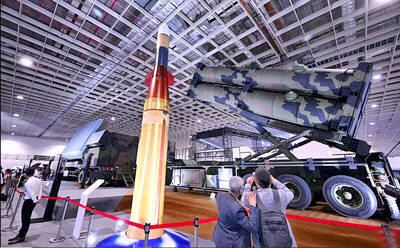
Taiwan is to commence mass production of the Tien Kung (天弓, “Sky Bow”) III, IV and V missiles by the second quarter of this year if the legislature approves the government’s NT$1.25 trillion (US$39.78 billion) special defense budget, an official said yesterday. Commenting on condition of anonymity, a defense official with knowledge of the matter said that the advanced systems are expected to provide crucial capabilities against ballistic and cruise missiles for the proposed “T-Dome,” an advanced, multi-layered air defense network. The Tien Kung III is an air defense missile with a maximum interception altitude of 35km. The Tien Kung IV and V
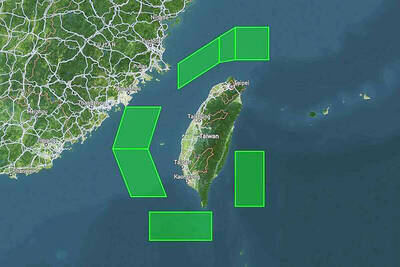
The disruption of 941 flights in and out of Taiwan due to China’s large-scale military exercises was no accident, but rather the result of a “quasi-blockade” used to simulate creating the air and sea routes needed for an amphibious landing, a military expert said. The disruptions occurred on Tuesday and lasted about 10 hours as China conducted live-fire drills in the Taiwan Strait. The Civil Aviation Administration (CAA) said the exercises affected 857 international flights and 84 domestic flights, affecting more than 100,000 travelers. Su Tzu-yun (蘇紫雲), a research fellow at the government-sponsored Institute for National Defense and Security Research, said the air
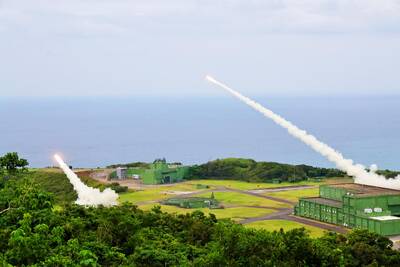
Taiwan lacks effective and cost-efficient armaments to intercept rockets, making the planned “T-Dome” interception system necessary, two experts said on Tuesday. The concerns were raised after China’s military fired two waves of rockets during live-fire drills around Taiwan on Tuesday, part of two-day exercises code-named “Justice Mission 2025.” The first wave involved 17 rockets launched at 9am from Pingtan in China’s Fujian Province, according to Lieutenant General Hsieh Jih-sheng (謝日升) of the Office of the Deputy Chief of the General Staff for Intelligence at the Ministry of National Defense. Those rockets landed 70 nautical miles (129.6km) northeast of Keelung without flying over Taiwan,
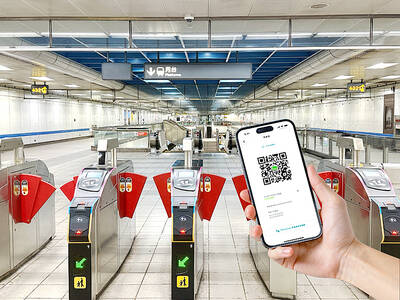
City buses in Taipei and New Taipei City, as well as the Taipei MRT, would on Saturday begin accepting QR code payments from five electronic payment providers, the Taipei Department of Transportation said yesterday. The new option would allow passengers to use the “transportation QR code” feature from EasyWallet, iPass Money, iCash Pay, Jkopay or PXPay Plus. Passengers should open their preferred electronic payment app, select the “transportation code” — not the regular payment code — unlock it, and scan the code at ticket readers or gates, General Planning Division Director-General Liu Kuo-chu (劉國著) said. People should move through the


 RSS
RSS